• Fri frakt över 249 kr
  • •
  • Snabba leveranser
  • •
  • Billiga böcker
Kundservice

Du är på sajten för privatpersoner.

Företag, bibliotek eller offentlig verksamhet?

Du handlar på classic.bokus.com, där alla dina funktioner finns intakta.
Till classic.bokus.com
Bokus logotyp. Gå till startsidan.
  • Erbjudanden
  • Student
  • Topplistor
  • Barn & ungdom
  • Bokus Play
  • E-böcker
  • Ljudböcker
  • Pocketböcker
  • Spel och pussel

5% studentrabatt – använd koden KURSBOK27 →

Sidfot

Mina sidor

    Hjälp

    • Kundservice
    • Vanliga frågor och svar
    • Frakt och leverans
    • Retur vid ångerrätt
    • Reklamera vara
    • Betalning
    • Köpvillkor
    • Allmänna villkor
    • Information om webbplatsens tillgänglighet

    Om Bokus

    • Om oss
    • Pressrum
    • För studenter
    • För företag
    • För bibliotek och offentlig verksamhet
    • För leverantörer
    • Hållbarhet

    Populärt

    • Aktuella erbjudanden
    • Presentkort
    • Studentlitteratur
    • Nya böcker
    • Topplistor
    • Signerade böcker
    • Engelska böcker

    Inspiration

    • Boktips
    • BookTok
    • Barnbokskaraktärer
    • Populära författare
    Logotyp för Bokus
    Följ oss på Facebook (extern länk)Följ oss på Instagram (extern länk)Följ oss på YouTube (extern länk)Följ oss på TikTok (extern länk)
    bokus @ CookiesAnpassa cookiesIntegritetspolicyKöpvillkor
    Till Citymail hemsida (extern länk)Till Budbee hemsida (extern länk)Till Postnord hemsida (extern länk)Till Schenker hemsida (extern länk)Till Early Bird hemsida (extern länk)Till Walleys hemsida (extern länk)
    1. Ekonomi och Ledarskap
    2. Nationalekonomi
    3. Internationell ekonomi

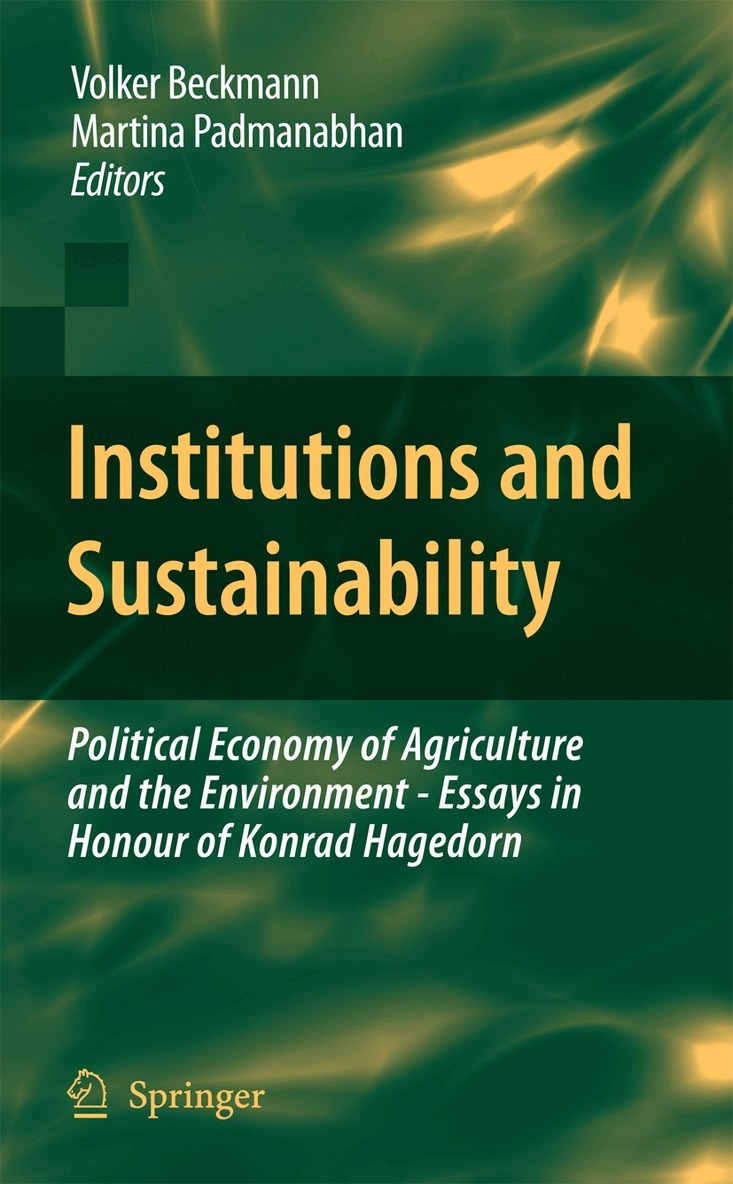
    Institutions and Sustainability

    Political Economy of Agriculture and the Environment - Essays in Honour of Konrad Hagedorn

    AvVolker Beckmann,Martina Padmanabhan

    Häftad, Engelska, 2010

    2 149 kr

    Beställningsvara. Skickas inom 10-15 vardagar. Fri frakt över 249 kr.

    Beskrivning

    From the first vague idea to use Konrad Hagedorn’s 60th birthday as an inspi- tion for taking stock of his vibrant academic contributions, this joint book project has been a great pleasure for us in many ways. Pursuing Hagedorn’s intellectual development, we have tried to reflect on the core questions of humanity according to Ernst Bloch “Who are we?”, “Where do we come from?” and “Where are we heading?” In this way, and without knowing it, Konrad Hagedorn initiated a c- lective action process he would have very much enjoyed … if he had been allowed to take part in it. But it was our aim and constant motivation to surprise him with this collection of essays in his honour. Konrad Hagedorn was reared as the youngest child of a peasant family on a small farm in the remote moorland of East Frisia, Germany. During his childhood in the poverty-ridden years after the Second World War, he faced a life where humans were heavily dependent on using nature around them for their livelihoods; meanwhile, he learned about the fragility of the environment. As a boy, he - tended a one-room schoolhouse, where his great intellectual talents were first r- ognised and used for co-teaching his schoolmates. These early teaching expe- ences might have laid the foundations for his later becoming a dedicated lecturer and mentor.

    Produktinformation

    • Utgivningsdatum:2010-10-19
    • Mått:155 x 235 x 23 mm
    • Vikt:616 g
    • Format:Häftad
    • Språk:Engelska
    • Antal sidor:388
    • Förlag:Springer
    • ISBN:9789048181841

    Utforska kategorier

    • Internationell ekonomi inom Ekonomi och Ledarskap
    • Miljövetenskap och miljöpolitik inom Naturvetenskap och teknik
    • Lantbruk, fiske och skogsbruk inom Ekonomi och Ledarskap

    Recensioner i media

    From the reviews: "This book is a fine collection of essays, located at the intersection between agricultural, environmental, and institutional economics. ... The book has several strong sides. First of all, it is truly interdisciplinary. Beyond economics, the contributed essays come from anthropology, comparative political science, economic sociology, and cognitive sciences. ... Overall, the book would fit very well the library of any research centre or department working on environmental, agricultural, and/or institutional economics." (Gam Aldashev and Elena Vallino, European Review of Agricultural Economics, Vol. 37 (3), 2010)

    Innehållsförteckning

    • Institutions and Sustainability: Introduction and Overview.- Institutions and Sustainability: Introduction and Overview.- Political Economy of Economic Development and Agricultural Policy.- The Political Economy of Agricultural Reform in Transition Countries.- Make Law, Not War? On the Political Economy of Violence and Appropriation.- A Marathon Rather than a Sprint: The Reform of the Farmers’ Pension System in Germany and its Impacts.- Complex Policy Choices Regarding Agricultural Externalities: Efficiency, Equity and Acceptability.- Institutions, Governance and Sustainability.- Multi-level Governance and Natural Resource Management: The Challenges of Complexity, Diversity, and Uncertainty.- Constraints on Rural Governance in the European Union: A Role for Co-operative Associations?.- Making Environmental Administration More Effective: A Contribution from New Institutional Economics.- Public Good Markets: The Possible Role of Hybrid Governance Structures in Institutions for Sustainability.- Property Rights, Collective Action and Natural Resources.- A Century of Institutions and Ecology in East Africa’s Rangelands: Linking Institutional Robustness with the Ecological Resilience of Kenya’s Maasailand.- The Downgrading Effect of Abuse of Power on Trust and Collective Action in Bulgaria’s Irrigation Sector.- Payment for Environmental Services: Interactions with Property Rights and Collective Action.- An Institutional Economics Analysis of Land Use Contracting: The Case of the Netherlands.- Challenges of Institutional Analysis for Sustainability.- Sustainability, Institutions and Behavior.- Institutional Change and Ecological Economics: The Role of Mental Models and Sufficient Reason.- Analysing Institutions: What Method to Apply?.