• Fri frakt över 249 kr
  • •
  • Snabba leveranser
  • •
  • Billiga böcker
Kundservice

Du är på sajten för privatpersoner.

Företag, bibliotek eller offentlig verksamhet?

Du handlar på classic.bokus.com, där alla dina funktioner finns intakta.
Till classic.bokus.com
Bokus logotyp. Gå till startsidan.
  • Erbjudanden
  • Nyheter
  • Student
  • Topplistor
  • Barn & ungdom
  • Bokus Play
  • E-böcker
  • Pocketböcker
  • Spel & pussel

10% rabatt på allt med kod: NYSTART10 →

Sidfot

Mina sidor

    Hjälp

    • Kundservice
    • Vanliga frågor och svar
    • Frakt och leverans
    • Retur vid ångerrätt
    • Reklamera vara
    • Betalning
    • Köpvillkor
    • Allmänna villkor
    • Information om webbplatsens tillgänglighet

    Om Bokus

    • Om oss
    • Pressrum
    • För studenter
    • För företag
    • För bibliotek och offentlig verksamhet
    • För leverantörer
    • Hållbarhet

    Populärt

    • Aktuella erbjudanden
    • Presentkort
    • Studentlitteratur
    • Nya böcker
    • Topplistor
    • Signerade böcker
    • Engelska böcker

    Inspiration

    • Boktips
    • BookTok
    • Populära bokserier
    • Barnbokskaraktärer
    • Populära författare
    Logotyp för Bokus
    Följ oss på Facebook (extern länk)Följ oss på Instagram (extern länk)Följ oss på YouTube (extern länk)Följ oss på TikTok (extern länk)
    bokus @ CookiesAnpassa cookiesIntegritetspolicyKöpvillkor
    Till Citymail hemsida (extern länk)Till Budbee hemsida (extern länk)Till Postnord hemsida (extern länk)Till Schenker hemsida (extern länk)Till Early Bird hemsida (extern länk)Till Walleys hemsida (extern länk)
    1. Samhälle och politik
    2. Samhälle och kultur

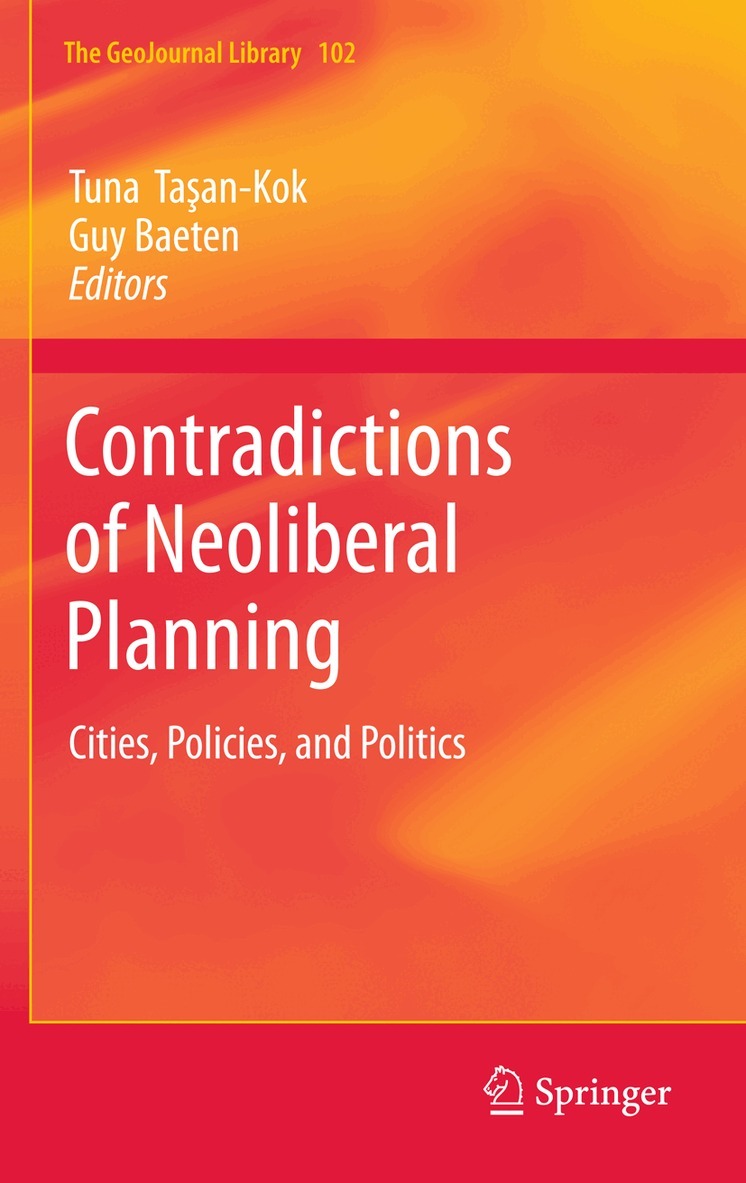
    Contradictions of Neoliberal Planning

    Cities, Policies, and Politics

    AvTuna Taşan-Kok,Guy Baeten

    Inbunden, Engelska, 2011

    Del 102 i serien GeoJournal Library

    1 086 kr

    Beställningsvara. Skickas inom 10-15 vardagar. Fri frakt över 249 kr.

    Beskrivning

    This book argues that the concepts of ‘neoliberalism’ and ‘neoliberalisation,’ while in common use across the whole range of social sciences, have thus far been generally overlooked in planning theory and the analysis of planning practice. Offering insights from papers presented during a conference session at a meeting of the Association of American Geographers in Boston in 2008 and a number of commissioned chapters, this book fills this significant hiatus in the study of planning. What the case studies from Africa, Asia, North-America and Europe included in this volume have in common is that they all reveal the uneasy cohabitation of ‘planning’ – some kind of state intervention for the betterment of our built and natural environment – and ‘neoliberalism’ – a belief in the superiority of market mechanisms to organize land use and the inferiority of its opposite, state intervention. Planning, if anything, may be seen as being in direct contrast to neoliberalism, as something that should be rolled back or even annihilated through neoliberal practice. To combine ‘neoliberal’ and ‘planning’ in one phrase then seems awkward at best, and an outright oxymoron at worst. To admit to the very existence or epistemological possibility of ‘neoliberal planning’ may appear to be a total surrender of state planning to market superiority, or in other words, the simple acceptance that the management of buildings, transport infrastructure, parks, conservation areas etc. beyond the profit principle has reached its limits in the 21st century. Planning in this case would be reduced to a mere facilitator of ‘market forces’ in the city, be it gentle or authoritarian. Yet in spite of these contradictions and outright impossibilities, planners operate within, contribute to, resist or temper an increasingly neoliberal mode of producing spaces and places, or the revival of profit-driven changes in land use. It is this contradiction between the serving of private profit-seeking interests while actually seeking the public betterment of cities that this volume has sought to describe, explore, analyze and make sense of through a set of case studies covering a wide range of planning issues in various countries. This book lays bare just how spatial planning functions in an age of market triumphalism, how planners respond to the overruling profit principle in land allocation and what is left of non-profit driven developments.

    Produktinformation

    • Utgivningsdatum:2011-09-27
    • Mått:155 x 235 x 18 mm
    • Vikt:530 g
    • Format:Inbunden
    • Språk:Engelska
    • Serie:GeoJournal Library
    • Antal sidor:220
    • Upplaga:2012
    • Förlag:Springer
    • ISBN:9789048189236

    Utforska kategorier

    • Samhälle och kultur inom Samhälle och politik
    • Sociologi inom Samhälle och politik
    • Statsvetenskap och politisk teori inom Samhälle och politik

    Recensioner i media

    This book is a must read for those interested in the archaeology and present condition of urban Zombie-neoliberalism. While the neoliberal economic project died with the financial crisis of 2008 and its aftermath, urban neoliberal recipes and strategies are still the only game in town for the elites. This seminal collection excavates the future, dystopian as it may be, of how the undead continue the haunt our cities. Is it not time to call in the Zombie busters? The reasons for such exorcism are indeed expertly laid out between the covers of this book. Erik Swyngedouw, Professor of Geography, University of Manchester, UK This book unravels skillfully the influence of international neoliberal ideologies on the predominant shift in planning practices and forces the reader to reflect on what is happening to planning's traditional concern about equity, social justice, accountability. Louis Albrechts, Emeritus Professor of Planning, Catholic University of Leuven, Belgium

    Innehållsförteckning

    • Chapter 1: Introduction: Contradictions of Neoliberal Urban Planning: Tuna Tasan-Kok.- Chapter 2: Normalising Neoliberal Planning: The Case of Malmö, Sweden: Guy Baeten.- Chapter 3: Neoliberal Urban Policy, Aspirational Citizenship and the Uses of Cultural Distinction: Mike Raco.- Chapter 4: Contradictions in the Neoliberal Policy Instruments: What is the Stance of the State?: Ayda Eraydin.- Chapter 5: Transnational Neoliberalisation and the Role of Suprenational Trade Agreements in Local Urban Policy Implementation: The Case of the European Union: Tuna Tasan-Kok and Willen Korthals Altes.- Chapter 6: Neoliberal Urban Movements?: A Geography of Conflict and Mobilisation over Urban Renaissance in Antwerp, Belgium: Maarten Loopmans and Toon Dirckx.- Chapter 7: Social Entrepreneurship in Urban Planning and Development in Montreal: Barbara van Dyck.- Chapter 8: Washing their Hands of it? Auckland Cities' Risk Management of Formely Horticultural Land as Neoliberal Responsibilities: CameronSmith and Brad Coombs.- Chapter 9: Accumulation by Dispossession and Neoliberal Urban Planning "Landing" the Mega-projects in Taipei: Sue-Ching Jou, Anders Lund Hansen and Hsin-Ling Wu.- Chapter 10: Neoliberalism, Shallow Dreaming and the Unyielding Apartheid City: Mark Oranje.- Chapter 11: Neoliberal Planning: Does it Really Exist?: Guy Baeten