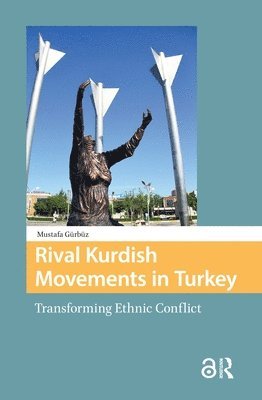
Rival Kurdish Movements in Turkey explores the conditions that encourage non-violent civic engagement in emerging civil societies. The book examines the radical transformations over the past decade in the politics of Turkey's Kurdish minority.
Mustafa Gürbüz is a policy fellow in the School of Policy, Government, and International Affairs at George Mason University and teaches Middle East politics at American University in Washington, DC.
Recensioner i media
"Dr. Gürbüz provides readers with an original and very engaging, theoretically informed and compelling account of competing Kurdish social movements in Turkey. Kurdish groups in Turkey do not just oppose or support the state; they also compete with each other. Dr. Gubruz masterfully lays out the main axes of such competition." -- David Romano, Thomas G. Strong Chair in Middle East Politics at Missouri State University and author of The Kurdish Nationalist Movement"Gürbüz shows how globalization and competition among Kurdish opposition groups has shaped the trajectory of Turkey-Kurdish relations. His multi-institutional approach is a fresh advance and essential for understanding the cycles of violence, repression, and reconciliation." -- Jack A. Goldstone, Hazel Professor of Public Policy, George Mason University"Mustafa Gürbüz makes an important new contribution to the study of Turkey's Kurdish question in comparing the secular Kurdish movement with two Islam-inspired movements that are competing with it in the region - the Kurdish Hizbullah and the Gülen movement. He also shows how the movements have mutually influenced one another in the course of their competition, Hizbullah acquiring a more explicit Kurdish character and the PKK reaching out to the pious segments of the population. This book will help the reader to understand the complexities of the situation." -- Martin van Bruinessen, Utrecht University
Innehållsförteckning
Introduction Chapter I. Kurdish Movements in the Southeast Chapter II. Exogenous Shocks at the Eve of the Millenium Chapter III. Civic Competition and Conflict Transformation Chapter IV. Resemblance and Difference: Constructing Kurdish Civil Society Chapter V. Going Native: Contesting Kurdish Islam Chapter VI. Islam Careser e: Islamic Activists Discover Kurdish Chapter VII. Enemies of the "Deep State": Narrative Conquests and Symbolic Localization Conclusion References