• Fri frakt över 249 kr
  • •
  • Snabba leveranser
  • •
  • Billiga böcker
Kundservice

Du är på sajten för privatpersoner.

Företag, bibliotek eller offentlig verksamhet?

Du handlar på classic.bokus.com, där alla dina funktioner finns intakta.
Till classic.bokus.com
Bokus logotyp. Gå till startsidan.
  • Erbjudanden
  • Nyheter
  • Student
  • Topplistor
  • Barn & ungdom
  • Bokus Play
  • E-böcker
  • Pocketböcker
  • Spel & pussel

10% rabatt på allt med kod: NYSTART10 →

Sidfot

Mina sidor

    Hjälp

    • Kundservice
    • Vanliga frågor och svar
    • Frakt och leverans
    • Retur vid ångerrätt
    • Reklamera vara
    • Betalning
    • Köpvillkor
    • Allmänna villkor
    • Information om webbplatsens tillgänglighet

    Om Bokus

    • Om oss
    • Pressrum
    • För studenter
    • För företag
    • För bibliotek och offentlig verksamhet
    • För leverantörer
    • Hållbarhet

    Populärt

    • Aktuella erbjudanden
    • Presentkort
    • Studentlitteratur
    • Nya böcker
    • Topplistor
    • Signerade böcker
    • Engelska böcker

    Inspiration

    • Boktips
    • BookTok
    • Populära bokserier
    • Barnbokskaraktärer
    • Populära författare
    Logotyp för Bokus
    Följ oss på Facebook (extern länk)Följ oss på Instagram (extern länk)Följ oss på YouTube (extern länk)Följ oss på TikTok (extern länk)
    bokus @ CookiesAnpassa cookiesIntegritetspolicyKöpvillkor
    Till Citymail hemsida (extern länk)Till Budbee hemsida (extern länk)Till Postnord hemsida (extern länk)Till Schenker hemsida (extern länk)Till Early Bird hemsida (extern länk)Till Walleys hemsida (extern länk)
    1. Psykologi och pedagogik
    2. Pedagogik
    3. Pedagogisk psykologi

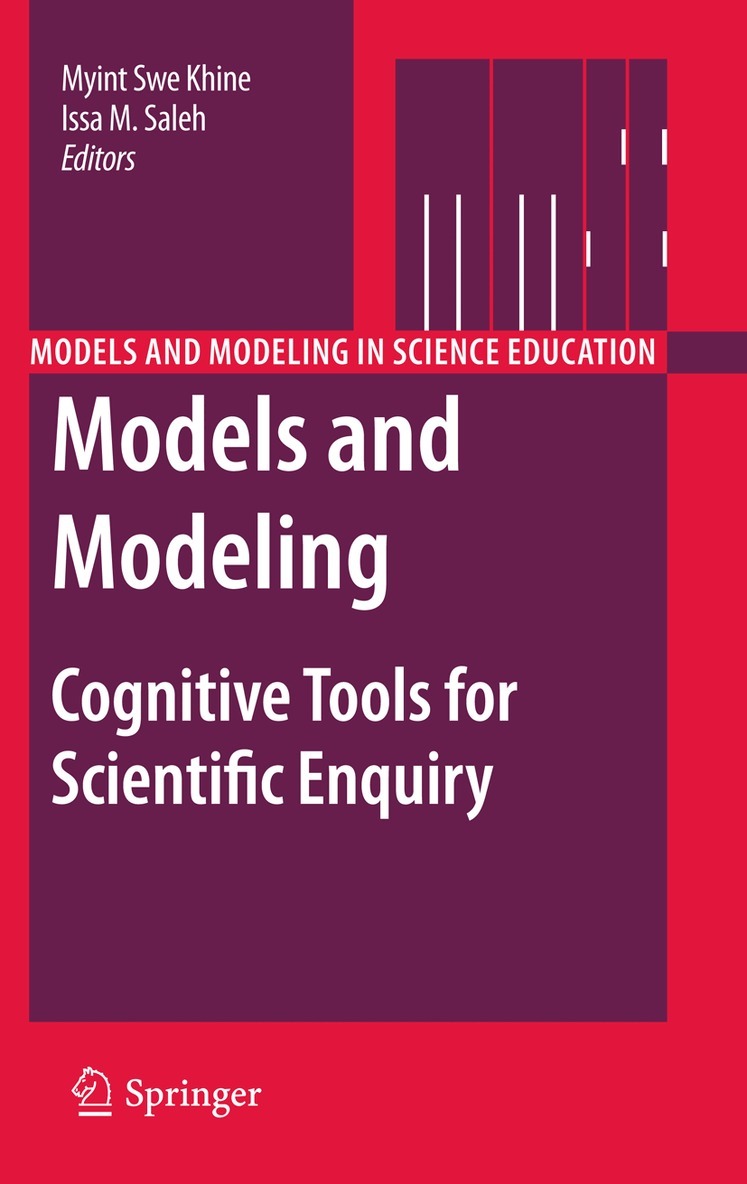
    Models and Modeling

    Cognitive Tools for Scientific Enquiry

    AvMyint Swe Khine,Issa M. Saleh

    Häftad, Engelska, 2013

    Del 6 i serien Models and Modeling in Science Education

    1 086 kr

    Beställningsvara. Skickas inom 10-15 vardagar. Fri frakt över 249 kr.

    Beskrivning

    The process of developing models, known as modeling, allows scientists to visualize difficult concepts, explain complex phenomena and clarify intricate theories. In recent years, science educators have greatly increased their use of modeling in teaching, especially real-time dynamic modeling, which is central to a scientific investigation. Modeling in science teaching is being used in an array of fields, everything from primary sciences to tertiary chemistry to college physics, and it is sure to play an increasing role in the future of education. Models and Modeling: Cognitive Tools for Scientific Enquiry is a comprehensive introduction to the use of models and modeling in science education. It identifies and describes many different modeling tools and presents recent applications of modeling as a cognitive tool for scientific enquiry.

    Produktinformation

    • Utgivningsdatum:2013-04-21
    • Mått:155 x 235 x 17 mm
    • Vikt:458 g
    • Format:Häftad
    • Språk:Engelska
    • Serie:Models and Modeling in Science Education
    • Antal sidor:292
    • Upplaga:2011
    • Förlag:Springer
    • ISBN:9789400735484

    Utforska kategorier

    • Pedagogisk psykologi inom Psykologi och pedagogik
    • Undervisning i specifika ämnen inom Psykologi och pedagogik
    • Naturvetenskap:allmänt inom Naturvetenskap och teknik

    Innehållsförteckning

    • PART I - Theory Formation and Modeling in Science Education.- Chapter 1. Modeling and the Future of Science Learning, Richard K. Coll, Denis Laijum.- Chapter 2. A Study of Expert Theory Formation: The Role of Different Model Types and Domain Frameworks, Allan Collins.-Chapter 3. The Nature of Scientific Meta-Knowledge, Barbara Y. White, Allan Collins, John R. Frederiksen.- Chapter 4. From Modeling Schemata to the Profiling Schema: Modeling across the Curricula for Profile Shaping Education, Ibrahim A. Halloun. - PART II – Modeling and Student Learning in Science Education.- Chapter 5. Helping Students Construct Robust Conceptual Models, Colleen Megowan-Romanowicz.- Chapter 6. The Molecular Workbench Software: An Innovative Dynamic Modeling Tool for Nanoscience Education, Charles Xie, Amy Pallant .- Chapter 7. Lowering the Learning Threshold: Multi-Agent-Based Models and Learning Electricity, Pratim Sengupta, Uri Wilensky.- Chapter 8. Engineering-based Modeling Experiences in the Elementary and Middle Classroom, Lyn D. English, Nicholas G. Mousoulides.- Chapter 9. Engaging Elementary Students in Scientific Modeling: The MoDeLS 5th Grade Approach and Findings, Hamin Baek, Christina Schwarz, Jing Chen, Hayat Hokayem, Li Zhan.- PART III – Modeling and Teachers’ Knowledge.- Chapter 10. Relationships between Elementary Teachers’ Conceptions of Scientific Modeling and the Nature of Science, Valarie L. Akerson, Orvil White, Huseyin Colak,Khemmawaddee Pongsanon.- Chapter 11. Science teachers’ knowledge about learning and teaching models and modeling in Public Understanding of Science, Ineke Henze, Jan H. van Driel.- Chapter 12. Teaching Pre-serviceElementary Teachers to Teach Science with Computer Models, Nicos Valanides, Charoula Angeli.- Subject Index.