• Fri frakt över 249 kr
  • •
  • Snabba leveranser
  • •
  • Billiga böcker
Kundservice

Du är på sajten för privatpersoner.

Företag, bibliotek eller offentlig verksamhet?

Du handlar på classic.bokus.com, där alla dina funktioner finns intakta.
Till classic.bokus.com
Bokus logotyp. Gå till startsidan.
  • Erbjudanden
  • Nyheter
  • Student
  • Topplistor
  • Barn & ungdom
  • Bokus Play
  • E-böcker
  • Pocketböcker
  • Spel & pussel

10% rabatt på allt med kod: NYSTART10 →

Sidfot

Mina sidor

    Hjälp

    • Kundservice
    • Vanliga frågor och svar
    • Frakt och leverans
    • Retur vid ångerrätt
    • Reklamera vara
    • Betalning
    • Köpvillkor
    • Allmänna villkor
    • Information om webbplatsens tillgänglighet

    Om Bokus

    • Om oss
    • Pressrum
    • För studenter
    • För företag
    • För bibliotek och offentlig verksamhet
    • För leverantörer
    • Hållbarhet

    Populärt

    • Aktuella erbjudanden
    • Presentkort
    • Studentlitteratur
    • Nya böcker
    • Topplistor
    • Signerade böcker
    • Engelska böcker

    Inspiration

    • Boktips
    • BookTok
    • Populära bokserier
    • Barnbokskaraktärer
    • Populära författare
    Logotyp för Bokus
    Följ oss på Facebook (extern länk)Följ oss på Instagram (extern länk)Följ oss på YouTube (extern länk)Följ oss på TikTok (extern länk)
    bokus @ CookiesAnpassa cookiesIntegritetspolicyKöpvillkor
    Till Citymail hemsida (extern länk)Till Budbee hemsida (extern länk)Till Postnord hemsida (extern länk)Till Schenker hemsida (extern länk)Till Early Bird hemsida (extern länk)Till Walleys hemsida (extern länk)
    1. Naturvetenskap och teknik
    2. Geovetenskap
    3. Miljövetenskap och miljöpolitik

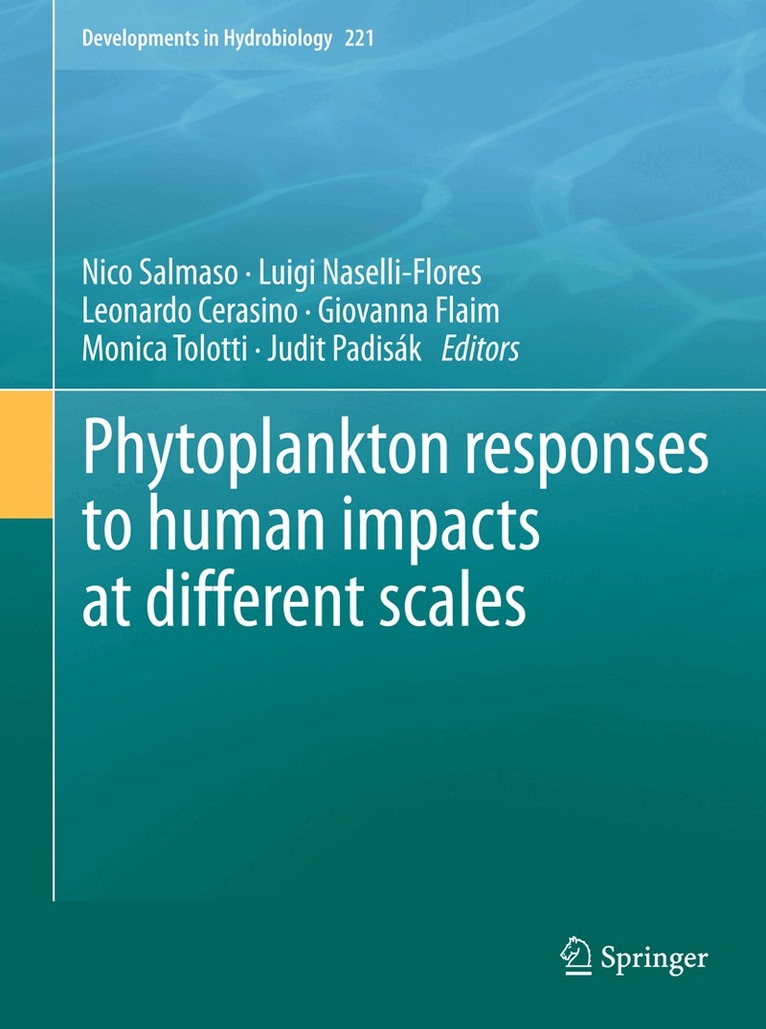
    Phytoplankton responses to human impacts at different scales

    16th Workshop of the International Association of Phytoplankton Taxonomy and Ecology (IAP)

    AvNico Salmaso,Luigi Naselli-Flores

    Häftad, Engelska, 2014

    Del 221 i serien Developments in Hydrobiology

    1 626 kr

    Beställningsvara. Skickas inom 10-15 vardagar. Fri frakt över 249 kr.

    Beskrivning

    Phytoplankton responses to human impact at different scales provides a state-of-the-art review of changes in the phytoplankton assemblages determined by human alterations of lakes and rivers. A wide spectrum of case studies describe the effects due to eutrophication and climate change, as well as other impacts connected with watershed management, hydrological alterations and introduction of non-indigenous species. The volume also includes two wide reviews on planktonic coccoid green algae and planktic heterocytous cyanobacteria. This book is addressed to ecologists and scientists involved in phytoplankton ecology and taxonomy. Many case studies provide a sound scientific basis of knowledge for a wise management of water bodies.Previously published in Hydrobiologia, vol. 698, 2012

    Produktinformation

    • Utgivningsdatum:2014-11-09
    • Mått:193 x 260 x 22 mm
    • Vikt:816 g
    • Format:Häftad
    • Språk:Engelska
    • Serie:Developments in Hydrobiology
    • Antal sidor:386
    • Upplaga:2012
    • Förlag:Springer
    • ISBN:9789400794481

    Utforska kategorier

    • Miljövetenskap och miljöpolitik inom Naturvetenskap och teknik
    • Biovetenskap inom Naturvetenskap och teknik
    • Biologi inom Naturvetenskap och teknik

    Mer om författaren

    Nico Salmaso (b. 1963). Graduated at the University of Padua (MSc, Natural Sciences, 1988) and University of Parma (PhD, Ecology, 2005), Italy. Senior Researcher at the Istituto Agrario di S. Michele all’Adige, Foundation E. Mach. His interest is focused on the ecology and long term dynamics of plankton and toxic cyanobacteria in different freshwater environments and in relation to human impact and climate change. He is member of the editorial boards of the Journal of Limnology (PAGEPress) and Advances in Oceanography and Limnology (Taylor & Francis). Luigi Naselli Flores(b.1964) graduated at the University of Palermo, Italy (MSc: 1989; PhD: 1999), biologist, Professor of Plant Ecology at the University of Palermo. He has been dealing with plankton ecology in Mediterranean inland waters since the beginning of his professional career. He presently serves as chairman of the European Federation for Freshwater Sciences (EFFS), president of the Italian Association of Oceanology and Limnology (AIOL), member of the Scientific Committee of the International Lake Environment Committee (ILEC). He is one of the associate editors of Hydrobiologia (Springer) and Lakes & Reservoirs: Research and Management (Wiley). Leonardo Cerasino (b. 1971). Graduated at the University of Bari, Italy (MSc, Medicinal Chemistry, 1996; PhD, Bioinorganic Chemistry, 2002). He has conducted research in the fields of analytical and bioinorganic chemistry (University of Bari, Italy and University of Bergen, Norway). From 2007 he is Researcher at the Istituto Agrario di S. Michele all’Adige, Foundation E. Mach. His main research interests concern the chemical characterization of cyanobacterial toxins in different matrices (water, aquatic organisms) and the trophic transfer of toxins in aquatic environments. Giovanna Flaim (b. 1956) Education - BS in Biology 1977 from Manhattan College (USA), MS in Biological Sciences (1979) from the University of Milan (I) and PhD in Botany (2005) from the University of Innsbruck (A). Researcher at the Istituto Agrario di S. Michele all’Adige, Foundation E. Mach. Main interests are algal physiology and limnology with particular regard to ecosystem functioning and the relation of abiotic and biotic factors to plankton autecology. Monica Tolotti (b. 1968) Graduated at the University of Padua (MSc, Biological Sciences, 1993) and Innsbruck, Austria, (PhD, Natural Sciences, 2000). Researcher at the Istituto Agrario di S. Michele all’Adige, Foundation E. Mach. Her interests focus on long term phytoplankton dynamics and palaeolimnological reconstruction of lake ecological evolution in relation to human impact and climate change. Judit Padisák (b. 1955) graduated at the Eötvös Loránd University of Budapest, Hungary (1979; PhD: 1990; habilitation: 1998; DSc: 1999), biologist, Professor of Limnology. She is dealing with phytoplankton community ecology since the beginning of her professional career; associate editor of Hydrobiologia, guest editor of six special volumes (Developments in Hydrobiology 81, 100, 150, 172 and Hydrobiologia 506–509, 578). She is an elected Executive Vice President of the International Society of Limnology (SIL). Judit Padisák (b. 1955) graduated at the Eötvös Loránd University of Budapest, Hungary (1979; PhD: 1990; habilitation: 1998; DSc: 1999), biologist, Professor of Limnology. She is dealing with phytoplankton community ecology since the beginning of her professional career; associate editor of Hydrobiologia, guest editor of six special volumes (Developments in Hydrobiology 81, 100, 150, 172 and Hydrobiologia 506–509, 578). She is an elected Executive Vice President of the International Society of Limnology (SIL).

    Innehållsförteckning

    • 1. Foreword.- 2. Phytoplankton response to a changing climate.- 3. Long-term trends and ?ne year-to-year tuning of phytoplankton in large lakes are ruled by eutrophication and atmospheric modes of variability.- 4. Deep living Planktothrix rubescens modulated by environmental constraints and climate forcing.- 5. Resource ratio and human impact.- 6. Temperature modulated effects of nutrients on phytoplankton changes in a mountain lake.- 7. Coupling high-resolution measurements to a three-dimensional lake model to assess the spatial and temporal dynamics of the cyanobacterium Planktothrix rubescens in a medium-sized lake.- 8. Mixotrophic phytoplankton is enhanced by UV radiation in a low altitude, P-limited Mediterranean lake.- 9. Sedimentation of phytoplankton.- 10. Watershed land use types as drivers of freshwater phytoplankton structure.- 11. Catchement land use and trophic state impacts on phytoplankton composition.- 12. Phytoplankton dynamics in permanent and temporary Mediterraneanwaters.- 13. Present-absent.- 14. Bloom forming cyanobacterial complexes co-occurring in a subtropical large reservoir: validation of dominant eco-strategies.- 15. The habitat template of morphology-based functional groups.- 16. Comparison of morpho-functional phytoplankton classifications in human-impacted shallow lakes with different stable states.- 17. Phytoplanktopn functional and morpho-functional approach in large floodplain rivers.- 18. Phytoplankton functional groups as indicators of human impacts along the River Loire (France).- 19. Functional groups of phytoplankton shaping diversity of shallow lake ecosystems.- 20. Photosynthetic characteristics and physiological plasticity of an Aphanizomenon flos-aquae (Cyanobacteria, Nostocaceae) winter bloom in a deep oligo-mesotrophic lake (Lake Stechlin, Germany).- 21. The queer Tetraëdron minimum from Lake Kivu (Eastern Africa).- 22. Changes in galactolipid composition of the cold freshwater dinoflagellate Borghiella dodgei in response to temperature.- 23. Present state of the systematic of planktonic coccoid green algae in inland waters.- 24. An update to moden taxonomy (2011) of freshwater planktic heterocytous cyanobacteria.- 25. Biogeographically interesting planktonic Nostocales (Cyanobacteria) in the Czech Repiblic and their polyphasic evaluation resulting in taxonomic revisions of Anabaena bergii Ostenfeld 1908 (Chrysosporum gen, nov.) and A. tenericaulis Nygaard 1949 (Dolichospermum tenericaule comb. nova).- 26. Taxonomic and phylogenetic evaluation of Limnothrix strains (Oscillatoriales, Cyanobacteria) by adding Limnothrix planctonica strains isolated from central China.- 27. Impairing the largest and most productive forest on our planet.