• Fri frakt över 249 kr
  • •
  • Snabba leveranser
  • •
  • Billiga böcker
Kundservice

Du är på sajten för privatpersoner.

Företag, bibliotek eller offentlig verksamhet?

Du handlar på classic.bokus.com, där alla dina funktioner finns intakta.
Till classic.bokus.com
Bokus logotyp. Gå till startsidan.
  • Erbjudanden
  • Nyheter
  • Student
  • Topplistor
  • Barn & ungdom
  • Bokus Play
  • E-böcker
  • Pocketböcker
  • Spel & pussel

10% rabatt på allt med kod NYSTART10 →

Sidfot

Mina sidor

    Hjälp

    • Kundservice
    • Vanliga frågor och svar
    • Frakt och leverans
    • Retur vid ångerrätt
    • Reklamera vara
    • Betalning
    • Köpvillkor
    • Allmänna villkor
    • Information om webbplatsens tillgänglighet

    Om Bokus

    • Om oss
    • Pressrum
    • För studenter
    • För företag
    • För bibliotek och offentlig verksamhet
    • För leverantörer
    • Hållbarhet

    Populärt

    • Aktuella erbjudanden
    • Presentkort
    • Studentlitteratur
    • Nya böcker
    • Topplistor
    • Signerade böcker
    • Engelska böcker

    Inspiration

    • Boktips
    • BookTok
    • Populära bokserier
    • Barnbokskaraktärer
    • Populära författare
    Logotyp för Bokus
    Följ oss på Facebook (extern länk)Följ oss på Instagram (extern länk)Följ oss på YouTube (extern länk)Följ oss på TikTok (extern länk)
    bokus @ CookiesAnpassa cookiesIntegritetspolicyKöpvillkor
    Till Citymail hemsida (extern länk)Till Budbee hemsida (extern länk)Till Postnord hemsida (extern länk)Till Schenker hemsida (extern länk)Till Early Bird hemsida (extern länk)Till Walleys hemsida (extern länk)
    1. Filosofi och religion
    2. Filosofi
    3. Filosofiska discipliner

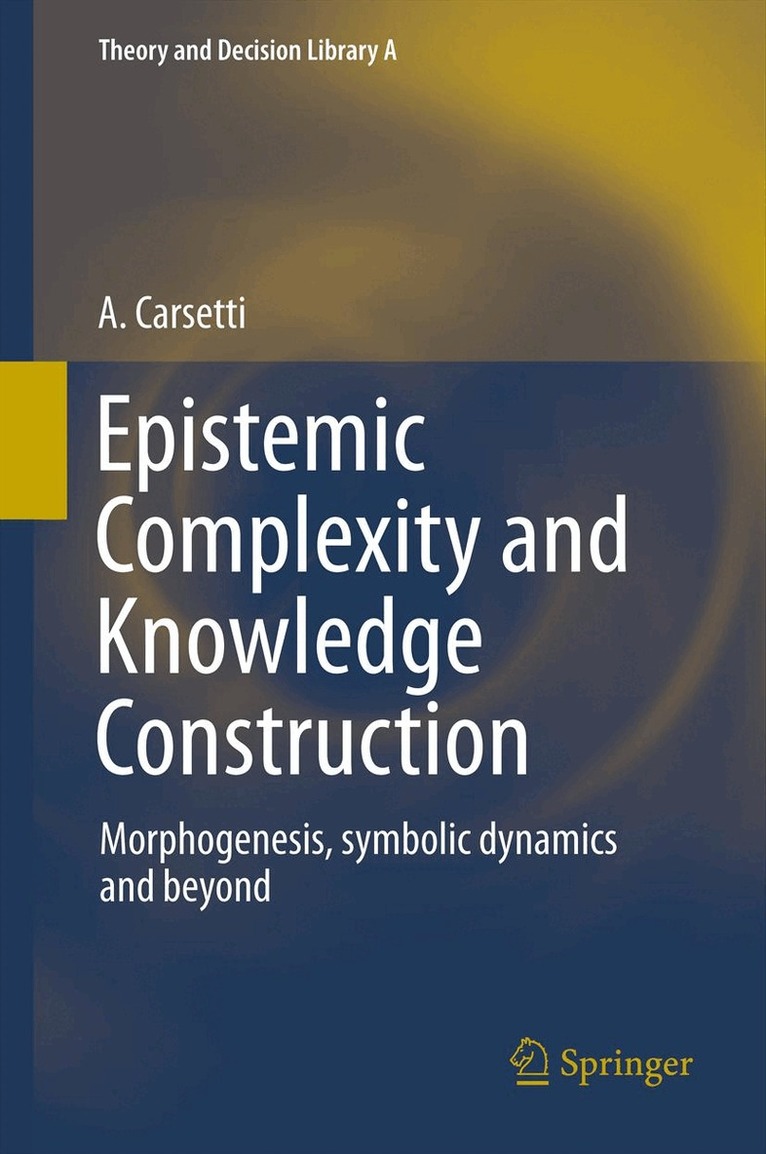
    Epistemic Complexity and Knowledge Construction

    Morphogenesis, symbolic dynamics and beyond

    AvA. Carsetti

    Häftad, Engelska, 2015

    Del 45 i serien Theory and Decision Library A:

    1 085 kr

    Beställningsvara. Skickas inom 10-15 vardagar. Fri frakt över 249 kr.

    Fler format och utgåvor

    Inbunden

    1 085 kr

    E-bok

    1 413 kr

    Beskrivning

    The volume as its first target aims at clarifying that peculiar entanglement of complexity, causality, meaning, emergence and intentionality that characterises the unfolding of the "natural forms" of human cognitionAs is well known, cognition is not only a self-organising process. It is also a co-operative and coupled process. If we consider the external environment as a complex, multiple and stratified Source which interacts with the nervous system, we can easily realise that the cognitive activities devoted to the "intelligent" search for the depth information living in the Source, may determine the very change of the complexity conditions according to which the Source progressively expresses its "wild" action. In this sense, simulation models are not neutral or purely speculative: the true cognition actually appears to be necessarily connected with successful forms of reading, those forms, in particular, that permit a specific coherent unfolding of the deep information content of the Source. Therefore, the simulation models, if valid, materialise as "creative" channels, i.e., as autonomous functional systems, as the very roots of a new possible development of the entire system represented by mind and its Reality. From a general point of view, the objectivity of Reality is also proportionate to the autonomy reached by cognitive processes. In this sense, at the level of cultural evolution, reference procedures act as guide, mirror and canalisation with respect to primary information flows and involved selective forces: they offer themselves as the actual instruments for the constant renewal of the code, for the invention and the actual articulation of an ever-new incompressibility. From an effective point of view, they appear as indissolubly linked to the successive definition of specific (and innovative) measures of the epistemic complexity. These measures cannot concern only statistical rarity (Shannon) or computational incompressibility (Kolmogorov-Chaitin), on the contrary they should also be able to take into account the coupled connection between the Source and the cognitive agent, the evolution of this connection as well as the successive constitution of meaning as symbolic form. Hence the possible (and necessary) definition of new axiomatic systems, new measure spaces, the real displaying of processes of continuous reorganisation at the semantic level. Indeed, it is only through a complete, first-order "reduction" and a correlated non-standard second-order analysis that new incompressibility will actually manifest itself. Therefore, the reference procedures appear to be related to a process of multiplication of minds, as well as to a process of "clarification" of meanings which finally emerges as vision via principles.

    Produktinformation

    • Utgivningsdatum:2015-04-12
    • Mått:155 x 235 x 10 mm
    • Vikt:260 g
    • Format:Häftad
    • Språk:Engelska
    • Serie:Theory and Decision Library A:
    • Antal sidor:151
    • Upplaga:2013
    • Förlag:Springer
    • ISBN:9789400797246

    Utforska kategorier

    • Filosofiska discipliner inom Filosofi och religion

    Recensioner i media

    From the reviews: "Book constitutes a major contribution to our understanding of the mechanisms of knowledge construction ... . a fine work, a fascinating set of discussions concerning an extremely interesting area. It contributes to the current and lively debate about the nature of cognition and about the role played by symbolic dynamics and epistemic complexity in the development of biological and cognitive activities. Anyone who is interested in functional and neural models concerning knowledge construction will be informed by the wealth of material presented in this volume." (Magali Fernandez-Salazar, Minds & Machines, January, 2014)

    Innehållsförteckning

    • Dedication.- Acknowledgements.- 1. Complexity, Self-Organization and Natural Evolution. - 1. Entropy and the “intermediate state”.- 2. Algorithmic complexity and self-referentiality .- 3. Cellular automata and self-organization. - 2. Embodiment Processes and Biological Computing.- 1. The game of life and the alternative splicing. - 2. The interface between ruler and coder.- 3. The recipe at work: the role of the simulation tools at the evolutionary level.- 4. Reflexive domains vs. self-organizing domains. - 3. Randomness, Semantic Information and Limitations Procedures. - 1. Logic and probability: the role of constituents. - 2. Semantic information and algorithmic complexity.- 3. Surface information vs. depth information: the biological computer.- 4. Non-standard models and limitation procedures.- 4. Natural Language and Boolean Semantics: the Genesis of the Cognitive Code. - 1.Intensional  language and natural logic.- 2. Logic and ontology.- 3. Meaning as use and the unfolding of cognitive activity.- 5. Morphogenesis and the Emergence of Meaning. - 1. Eigenforms, categorial  intuitions and  rational perception.- 2. Meaning clarification and the "thinking I".- 3. Knowledge and Reality: the role of conceptual constructions. - Name Index.- Subject Index.