• Fri frakt över 249 kr
  • •
  • Snabba leveranser
  • •
  • Billiga böcker
Kundservice

Du är på sajten för privatpersoner.

Företag, bibliotek eller offentlig verksamhet?

Du handlar på classic.bokus.com, där alla dina funktioner finns intakta.
Till classic.bokus.com
Bokus logotyp. Gå till startsidan.
  • Erbjudanden
  • Nyheter
  • Student
  • Topplistor
  • Barn & ungdom
  • Bokus Play
  • E-böcker
  • Pocketböcker
  • Spel & pussel

10% studentrabatt med kod TERM26

Sidfot

Mina sidor

    Hjälp

    • Kundservice
    • Vanliga frågor och svar
    • Frakt och leverans
    • Retur vid ångerrätt
    • Reklamera vara
    • Betalning
    • Köpvillkor
    • Allmänna villkor
    • Information om webbplatsens tillgänglighet

    Om Bokus

    • Om oss
    • Pressrum
    • För studenter
    • För företag
    • För bibliotek och offentlig verksamhet
    • För leverantörer
    • Hållbarhet

    Populärt

    • Aktuella erbjudanden
    • Presentkort
    • Studentlitteratur
    • Nya böcker
    • Topplistor
    • Signerade böcker
    • Engelska böcker

    Inspiration

    • Boktips
    • BookTok
    • Populära bokserier
    • Barnbokskaraktärer
    • Populära författare
    Logotyp för Bokus
    Följ oss på Facebook (extern länk)Följ oss på Instagram (extern länk)Följ oss på YouTube (extern länk)Följ oss på TikTok (extern länk)
    bokus @ CookiesAnpassa cookiesIntegritetspolicyKöpvillkor
    Till Citymail hemsida (extern länk)Till Budbee hemsida (extern länk)Till Postnord hemsida (extern länk)Till Schenker hemsida (extern länk)Till Early Bird hemsida (extern länk)Till Walleys hemsida (extern länk)
    1. Naturvetenskap och teknik
    2. Matematik och naturvetenskap
    3. Matematik
    4. Optimering

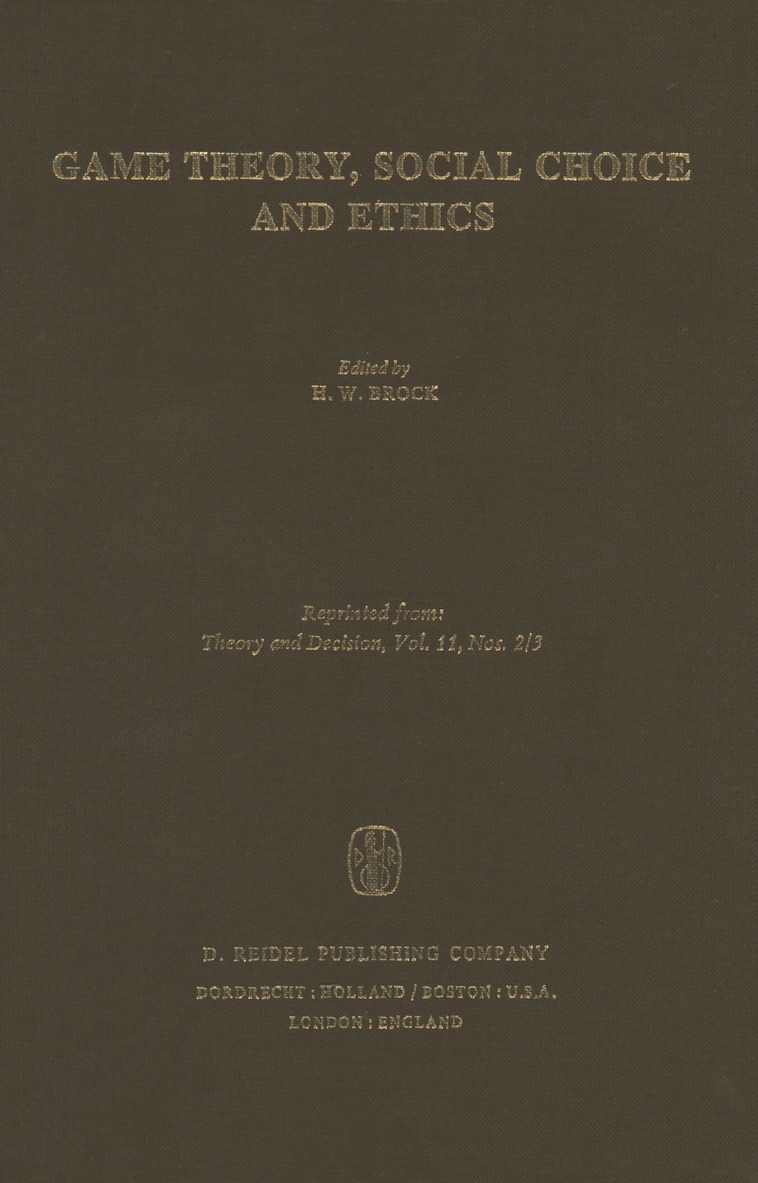
    Game Theory, Social Choice and Ethics

    AvH. Brock

    Häftad, Engelska, 2011

    549 kr

    Beställningsvara. Skickas inom 10-15 vardagar. Fri frakt över 249 kr.

    Beskrivning

    There are problems to whose solution I would attach an infinitely greater import­ ancf! than to those of mathematics, for example touching ethics, or our relation to God, or conceming our destiny and our future; but their solution lies wholly beyond us and completely outside the province 0 f science. J. F. C. Gauss For a1l his prescience in matters physical and mathematieal, the great Gauss apparently did not foresee one development peculiar to OUT own time. The development I have in mind is the use of mathematical reasoning - in partieu­ lar the axiomatic method - to explicate alternative concepts of rationality and morality. The present bipartite collection of essays (Vol. 11, Nos. 2 and 3 of this journal) is entitled 'Game Theory, Social Choiee, and Ethics'. The eight papers represent state-of-the-art research in formal moral theory. Their intended aim is to demonstrate how the methods of game theory, decision theory, and axiomatic social choice theory can help to illuminate ethical questions central not only to moral theory, but also to normative public policy analysis. Before discussion of the contents of the papers, it should prove helpful to recall a number of pioneering papers that appeared during the decade of the 1950s. These papers contained aseries of mathematical and conceptual break­ through which laid the basis for much of today's research in formal moral theory. The papers deal with two somewhat distinct topics: the concept of individual and collective rationality, and the concept of social justiee.

    Produktinformation

    • Utgivningsdatum:2011-11-11
    • Mått:152 x 229 x 12 mm
    • Vikt:298 g
    • Format:Häftad
    • Språk:Engelska
    • Antal sidor:204
    • Förlag:Springer
    • ISBN:9789400995345

    Utforska kategorier

    • Optimering inom Naturvetenskap och teknik
    • Ledarskap och motivation inom Ekonomi och Ledarskap
    • Företagsekonomi inom Ekonomi och Ledarskap

    Innehållsförteckning

    • Foreword.- Don’t Shoot the Trumpeter - He’s Doing his Best!: Reflections on a Problem of Fair Division.- Welfare Judgments and Future Generations.- Moral Structures and Axiomatic Theory.- A Diagrammatic Exposition of Justice.- A Game Theoretic Account of Social Justice.- Disparate Goods and Rawls’ Difference Principle: A Social Choice Theoretic Treatment.- Bayesian Decision Theory, Rule Utilitarianism, and Arrow’s Impossibility Theorem.- Decision-making Under Ignorance with Implications for Social Choice.