• Fri frakt över 249 kr
  • •
  • Snabba leveranser
  • •
  • Billiga böcker
Kundservice

Du är på sajten för privatpersoner.

Företag, bibliotek eller offentlig verksamhet?

Du handlar på classic.bokus.com, där alla dina funktioner finns intakta.
Till classic.bokus.com
Bokus logotyp. Gå till startsidan.
  • Erbjudanden
  • Nyheter
  • Student
  • Topplistor
  • Barn & ungdom
  • Bokus Play
  • E-böcker
  • Pocketböcker
  • Spel & pussel

10% rabatt på allt med kod: NYSTART10 →

Sidfot

Mina sidor

    Hjälp

    • Kundservice
    • Vanliga frågor och svar
    • Frakt och leverans
    • Retur vid ångerrätt
    • Reklamera vara
    • Betalning
    • Köpvillkor
    • Allmänna villkor
    • Information om webbplatsens tillgänglighet

    Om Bokus

    • Om oss
    • Pressrum
    • För studenter
    • För företag
    • För bibliotek och offentlig verksamhet
    • För leverantörer
    • Hållbarhet

    Populärt

    • Aktuella erbjudanden
    • Presentkort
    • Studentlitteratur
    • Nya böcker
    • Topplistor
    • Signerade böcker
    • Engelska böcker

    Inspiration

    • Boktips
    • BookTok
    • Populära bokserier
    • Barnbokskaraktärer
    • Populära författare
    Logotyp för Bokus
    Följ oss på Facebook (extern länk)Följ oss på Instagram (extern länk)Följ oss på YouTube (extern länk)Följ oss på TikTok (extern länk)
    bokus @ CookiesAnpassa cookiesIntegritetspolicyKöpvillkor
    Till Citymail hemsida (extern länk)Till Budbee hemsida (extern länk)Till Postnord hemsida (extern länk)Till Schenker hemsida (extern länk)Till Early Bird hemsida (extern länk)Till Walleys hemsida (extern länk)
    1. Naturvetenskap och teknik
    2. Matematik och naturvetenskap
    3. Naturvetenskap:allmänt
    4. Naturvetenskapens filosofi

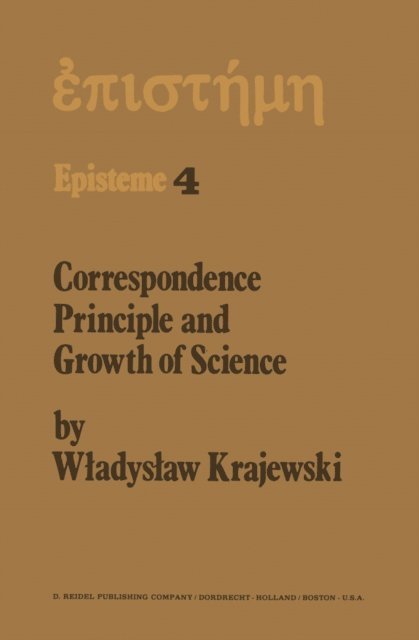
    Correspondence Principle and Growth of Science

    AvW. Krajewski

    Häftad, Engelska, 2011

    Del 4 i serien Episteme

    547 kr

    Beställningsvara. Skickas inom 10-15 vardagar. Fri frakt över 249 kr.

    Fler format och utgåvor

    E-bok

    710 kr

    Beskrivning

    This book is devoted to the problems of the growth of science. These prob­ lems, neglected for a long time by the philosophers of science, have become in the 60's and 70's a subject of vivid discussion. There are philosophers who stress only the dependence of science upon various sociological, psycho­ logical and other factors and deny any internal laws of the development of knowledge, like approaching the truth. The majority rejects such nihilism and searches for the laws of the growth of science. However, they often overlook the role of the Correspondence Principle which connects the suc­ cessive scientific theories. On the other hand, some authors, while stressing the role of this principle, overlook logical difficulties connected with it, e. g. the problem of the incompatibility of successive theories, of the falsity of some of their assumptions, etc. I believe the Correspondence Principle to be a basic principle of the pro­ gress of contemporary physics and, probably, of every advanced science. How­ ever, this principle must be properly interpreted and the above-mentioned logical difficulties must be solved. Their solution requires, as it seems, revealing the idealizational nature of the basic laws of science, in any case of the quantitative laws of advanced sciences. This point has been recently emphasized by some Polish philosophers, especially in Poznan.
    Produktinformation

    • Utgivningsdatum:2011-10-14
    • Mått:155 x 235 x 9 mm
    • Vikt:248 g
    • Format:Häftad
    • Språk:Engelska
    • Serie:Episteme
    • Antal sidor:138
    • Förlag:Springer
    • ISBN:9789401011808

    Utforska kategorier

    • Naturvetenskapens filosofi inom Naturvetenskap och teknik

    Innehållsförteckning

    • 1. Correspondence Principle.- 1.1. Bohr’s Principle.- 1.2. The Attitude of Philosophers.- 1.3. A General Methodological Principle in Physics.- 1.4. Descriptive and Normative Versions.- 1.5. Some Logical Difficulties.- Notes to Chapter 1.- 2. Idealization and Factualization.- 2.1. Scientific Law an an Implication.- 2.2. Factual and Idealizational Laws.- 2.3. Idealization in Science.- 2.4. The Attitude of Philosophers.- 2.5. Idealization and Factualization.- 2.6. Idealization and Essence.- 2.7. Some Controversial Issues.- Notes to Chapter 2.- 3. Reduction.- 3.1. The Concept of Reduction.- 3.2. Heterogeneous Reduction.- 3.3. Non-Mechanistic Reductionism.- 3.4. Trivial Homogeneous Reduction.- 3.5. Non-Trivial Homogeneous Reduction.- 3.6. Reduction of an Idealizational Law to a Factual One.- Notes to Chapter 3.- 4. Correspondence Relation.- 4.1. Definition.- 4.2. Simple Implicative Version.- 4.3. Approximative Version.- 4.4. Explanative Version.- 4.5. ‘Dialectical’ Version.- 4.6. Renewed Implicative Version.- 4.7. Some Formal Features.- 4.8. Correspondence Sequence and Correspondence Network.- Notes to Chapter 4.- 5. The Problem of the Incommensurability and Relations Among Theories.- 5.1. The Claim of Incommensurability.- 5.2. The Problem of Meaning Variance.- 5.3. The Problem of ‘Untranslatable’ Languages.- 5.4. The Problem of the ‘Theory-Ladenness’ of Facts.- 5.5. Various Relations Among Theories.- Notes to Chapter 5.- 6. The Types of Methodological Empiricism.- 6.1. Inductivism.- 6.2. Hypothetism.- 6.3. Pluralistic Hypothetism.- 6.4. Idealizational Hypothetism.- 6.5. Pluralistic Idealizational Hypothetism.- 6.6. A Confrontation: the Diversity of Methods.- Notes to Chapter 6.- 7. Revolutions and Continuity.- 7.1. Simple Cumulativism (No Revolutions or OneRevolution).- 7.2. Simple Anticumulativism (Permanent Revolution or Occasional Revolutions Without Continuity).- 7.3. A Dialectical View (Revolutions and Continuity).- 7.4. The Threshold of Maturity (Two Kinds of Revolutions).- 7.5. Periods of Evolution and of Revolution.- 7.6. The Concept of Revolution and Anti-Cumulative Changes.- Notes to Chapter 7.- 8. Relative and Absolute Truth.- 8.1. Relative Truth.- 8.2. Absolute Truths in Science.- 8.3. Truth-Content and Approximate Truth.- 8.4. The Truth of Idealizational Laws and of Their Factualizations.- 8.5. Relative Truth and Essence.- 8.6. Towards the Absolute Truth.- Notes to Chapter 8.- 9. Internal and External History of Science.- 9.1. Internal and External Factors.- 9.2. The Problem of the Methodological Historicism.- 9.3. Internal History as an Idealization.- Notes to Chapter 9.- Index of Names.