• Fri frakt över 249 kr
  • •
  • Snabba leveranser
  • •
  • Billiga böcker
Kundservice

Du är på sajten för privatpersoner.

Företag, bibliotek eller offentlig verksamhet?

Du handlar på classic.bokus.com, där alla dina funktioner finns intakta.
Till classic.bokus.com
Bokus logotyp. Gå till startsidan.
  • Erbjudanden
  • Nyheter
  • Student
  • Topplistor
  • Barn & ungdom
  • Bokus Play
  • E-böcker
  • Pocketböcker
  • Spel & pussel

10% rabatt på allt med kod: NYSTART10 →

Sidfot

Mina sidor

    Hjälp

    • Kundservice
    • Vanliga frågor och svar
    • Frakt och leverans
    • Retur vid ångerrätt
    • Reklamera vara
    • Betalning
    • Köpvillkor
    • Allmänna villkor
    • Information om webbplatsens tillgänglighet

    Om Bokus

    • Om oss
    • Pressrum
    • För studenter
    • För företag
    • För bibliotek och offentlig verksamhet
    • För leverantörer
    • Hållbarhet

    Populärt

    • Aktuella erbjudanden
    • Presentkort
    • Studentlitteratur
    • Nya böcker
    • Topplistor
    • Signerade böcker
    • Engelska böcker

    Inspiration

    • Boktips
    • BookTok
    • Populära bokserier
    • Barnbokskaraktärer
    • Populära författare
    Logotyp för Bokus
    Följ oss på Facebook (extern länk)Följ oss på Instagram (extern länk)Följ oss på YouTube (extern länk)Följ oss på TikTok (extern länk)
    bokus @ CookiesAnpassa cookiesIntegritetspolicyKöpvillkor
    Till Citymail hemsida (extern länk)Till Budbee hemsida (extern länk)Till Postnord hemsida (extern länk)Till Schenker hemsida (extern länk)Till Early Bird hemsida (extern länk)Till Walleys hemsida (extern länk)
    1. Naturvetenskap och teknik
    2. Matematik och naturvetenskap
    3. Biologi
    4. Biokemi

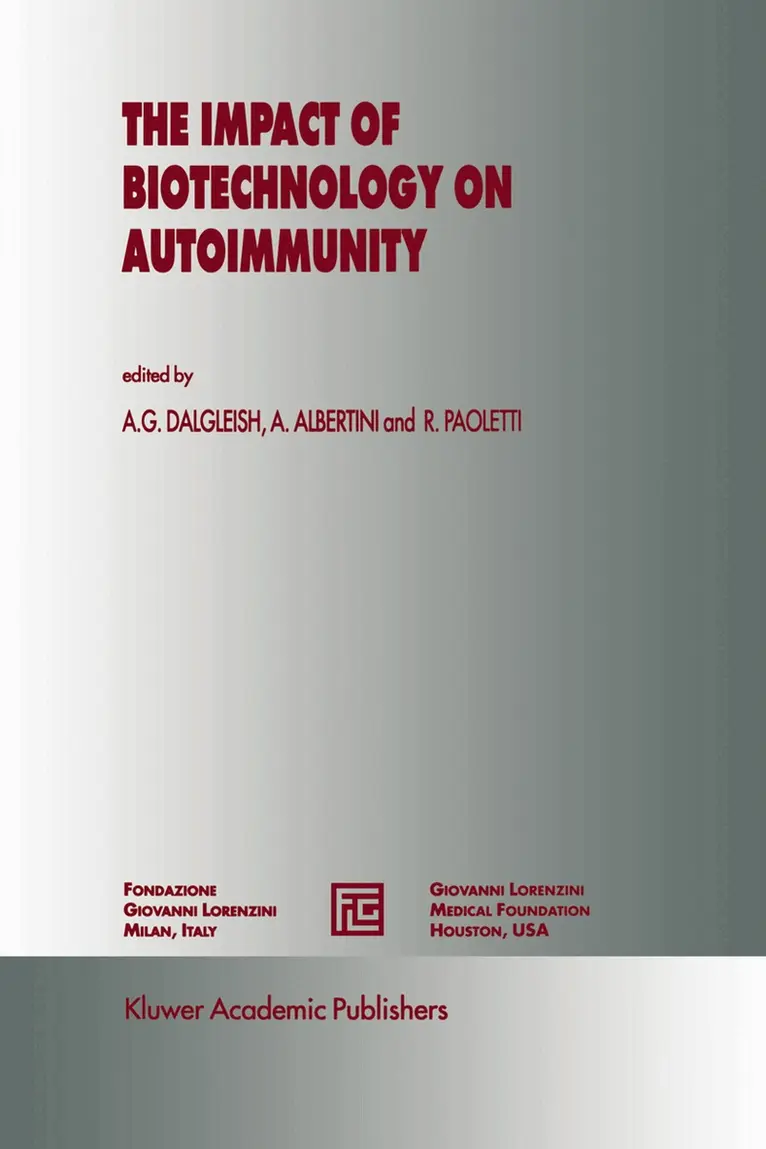
    Impact of Biotechnology on Autoimmunity

    AvA.G. Dalgleish,A. Albertini

    Häftad, Engelska, 2012

    Del i serien Medical Science Symposia Series

    2 230 kr

    Beställningsvara. Skickas inom 10-15 vardagar. Fri frakt över 249 kr.

    Beskrivning

    The term "autoimmunity" has been used to categorize a number of different diseases of unknown etiology. The term as applied to many of these diseases would probably be interpreted best as "autoreactivity," as the clinical phenotypes are often characterized by an inflammatory-like accumulation of activated cells of the immune system at sites of obvious damage of normal cells and/or tissue. The reasons as to why an immune system should attack itself are far from clear, although the association with specific infectious diseases in genetically susceptible people remains perhaps our best lead. The input of the biotechnological revolution has enabled us to attempt to readdress many of the fundamental questions raised by clinical and serological associations with autoimmune disease. The ability to dissect the immune response to these infectious agents which are associated with autoimmune features (as well as the facility to identify new agents, e. g. HIV), in addition to the ability to clone and sequence immune response genes, has enabled a much better understanding, at least of the complexity of "autoimmunity" to be gleaned. This volume contains the chapters that summarize the plenary presentations given at The Impact of Biotechnology on AUTOIMMUNI1Y meeting in Florence, Italy in June 1993. They cover all aspects from pathogenesis to treatment. The association with infectious diseases and autoimmunity is comprehensively covered by David Isenberg who reviews major issues, such as the association of autoantibodies appearing after infectious disease and antibacterial antibodies associated with autoimmune disease.

    Produktinformation

    • Utgivningsdatum:2012-10-12
    • Mått:160 x 240 x 9 mm
    • Vikt:255 g
    • Format:Häftad
    • Språk:Engelska
    • Serie:Medical Science Symposia Series
    • Antal sidor:137
    • Förlag:Springer
    • ISBN:9789401044844

    Utforska kategorier

    • Biokemi inom Naturvetenskap och teknik
    • Onkologi inom Medicin
    • Sjukdomar och rubbningar inom Medicin

    Innehållsförteckning

    • I. Molecular Mechanisms of Autoimmunity.- 1. Role of HLA-DQ2 and -DQ8 as Susceptibility Molecules in CoeliacDisease - A Model-disease of Autoimmunity.- 2. Immunoglobulin V Gene Repertoire of Human B Cells.- 3. Recent Progress in Human Natural Killer Cell Ontogeny.- II. Diagnostic Markers in Autoimmune Disease.- 4. Role of the HLA-DQ Genotype in IDDM Susceptibility.- 5. New Clinical and Molecular Features of “Essential” MixedCryoglobulinemia.- III. Infection and Autoimmunity.- 6. Post-Streptococcal Autoimmune Sequelae: A Link Between Infectionand Autoimmunity.- 7. Infection and Autoimmunity: Possible Contribution of Heat Shock Proteins.- 8. Chronic Infection and Autoimmunity.- 9. The Role of HLA Mimicry by HIV in the Pathogenesis of AIDS.- 10. Idiotypic Induction of Autoimmune Diseases: A New Aspect ofInfection and Autoimmunity.- IV. Clinical Aspects of Autoimmune Diseases.- 11. Immunopathology of Insulin-Dependent Diabetes Mellitus (IDDM).- 12. Autoimmune Mechanisms in Rheumatoid Synovial Inflammation.- 13. Antinuclear Antibodies: Clinical and Diagnostic Relevance.- 14. TAPI Allele Association with IDDM.- V. Therapeutic Advances in Autoimmune Diseases.- 15. Induction of Peripheral Tolerance in Primed Mice.- 16. Epitope Screening Libraries: A New Strategy to Identify MHC-Specific Antagonists.- 17. The Therapeutic Use of Anti-CD3 Monoclonal Antibodies inAutoimmune Diseases-Application to Type I Insulin-Dependent Diabetes.- 18. Engineering of IL-1 Antagonists.