• Fri frakt över 249 kr
  • •
  • Snabba leveranser
  • •
  • Billiga böcker
Kundservice

Du är på sajten för privatpersoner.

Företag, bibliotek eller offentlig verksamhet?

Du handlar på classic.bokus.com, där alla dina funktioner finns intakta.
Till classic.bokus.com
Bokus logotyp. Gå till startsidan.
  • Erbjudanden
  • Nyheter
  • Student
  • Topplistor
  • Barn & ungdom
  • Bokus Play
  • E-böcker
  • Pocketböcker
  • Spel & pussel

10% rabatt på allt med kod: NYSTART10 →

Sidfot

Mina sidor

    Hjälp

    • Kundservice
    • Vanliga frågor och svar
    • Frakt och leverans
    • Retur vid ångerrätt
    • Reklamera vara
    • Betalning
    • Köpvillkor
    • Allmänna villkor
    • Information om webbplatsens tillgänglighet

    Om Bokus

    • Om oss
    • Pressrum
    • För studenter
    • För företag
    • För bibliotek och offentlig verksamhet
    • För leverantörer
    • Hållbarhet

    Populärt

    • Aktuella erbjudanden
    • Presentkort
    • Studentlitteratur
    • Nya böcker
    • Topplistor
    • Signerade böcker
    • Engelska böcker

    Inspiration

    • Boktips
    • BookTok
    • Populära bokserier
    • Barnbokskaraktärer
    • Populära författare
    Logotyp för Bokus
    Följ oss på Facebook (extern länk)Följ oss på Instagram (extern länk)Följ oss på YouTube (extern länk)Följ oss på TikTok (extern länk)
    bokus @ CookiesAnpassa cookiesIntegritetspolicyKöpvillkor
    Till Citymail hemsida (extern länk)Till Budbee hemsida (extern länk)Till Postnord hemsida (extern länk)Till Schenker hemsida (extern länk)Till Early Bird hemsida (extern länk)Till Walleys hemsida (extern länk)
    1. Naturvetenskap och teknik
    2. Matematik och naturvetenskap
    3. Biologi
    4. Zoologi

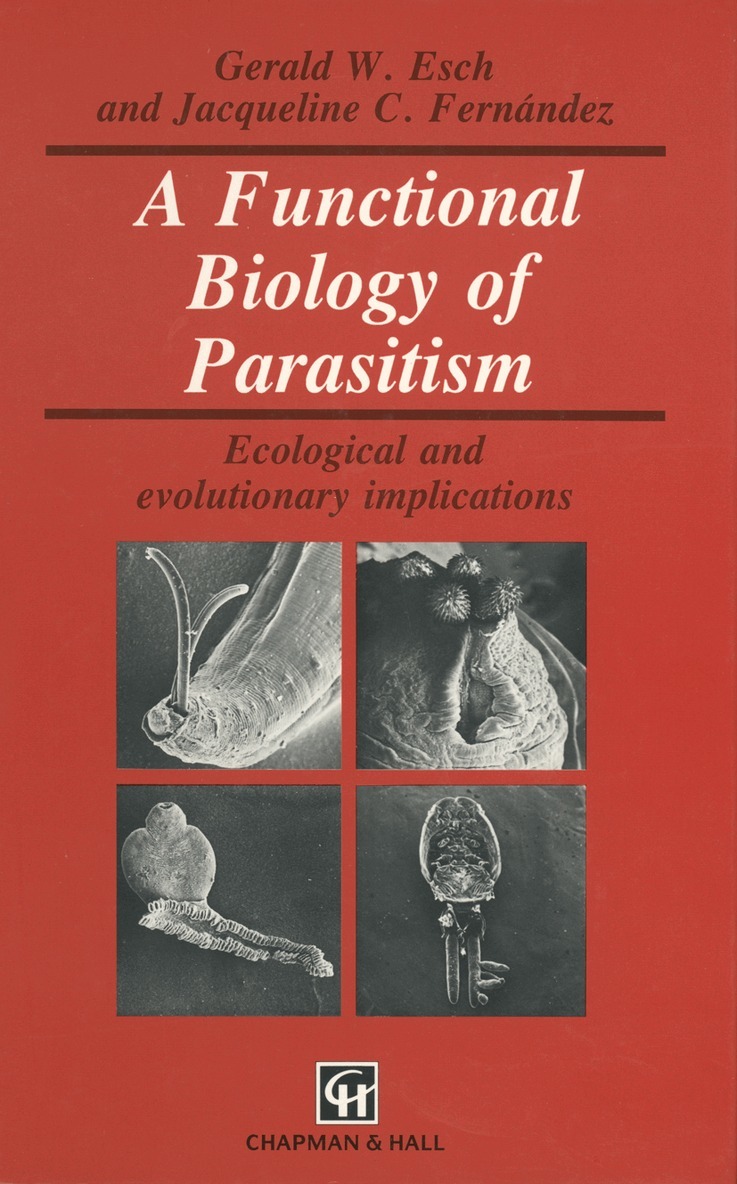
    Functional Biology of Parasitism

    Ecological and evolutionary implications

    AvG.W. Esch,J.C. Fernandez

    Häftad, Engelska, 2014

    Del i serien Topics in Gastroenterology

    547 kr

    Beställningsvara. Skickas inom 10-15 vardagar. Fri frakt över 249 kr.

    Beskrivning

    Series Editor: Peter Calow, Department of Zoology, University of Sheffield, England The main aim of this series will be to illustrate and to explain the way organisms 'make a living' in nature. At the heart of this - their functional biology - is the way organisms acquire and then make use of resources in metabolism, movement, growth, reproduction, and so on. These processes will form the fundamental framework of all the books in the series. Each book will concentrate on a particular taxon (species, family, class or even phylum) and will bring together information on the form, physiology, ecology and evolutionary biology of the group. The aim will be not only to describe how organisms work, but also to consider why they have come to work in that way. By concentration on taxa which are well known, it is hoped that the series will not only illustrate the success of selection, but also show the constraints imposed upon it by the physiological, morphological and developmental limitations of the groups. Another important feature of the series will be its organismic orientation. Each book will emphasize the importance of functional integration in the day­ to-day lives and the evolution of organisms. This is crucial since, though it may be true that organisms can be considered as collections of gene­ determined traits, they nevertheless interact with their environment as integrated wholes and it is in this context that individual traits have been subjected to natural selection and have evolved.

    Produktinformation

    • Utgivningsdatum:2014-08-23
    • Mått:155 x 235 x 20 mm
    • Vikt:540 g
    • Format:Häftad
    • Språk:Engelska
    • Serie:Topics in Gastroenterology
    • Antal sidor:337
    • Upplaga:1993
    • Förlag:Springer
    • ISBN:9789401050395

    Utforska kategorier

    • Zoologi inom Naturvetenskap och teknik
    • Djurböcker inom Djur och Natur

    Innehållsförteckning

    • 1 Introduction.- 1.1 The extent of parasitism.- 1.2 Definitions.- 1.3 The concept of harm.- 1.4 Some adaptations to parasitism.- 1.5 Life cycle and ecology.- >2 Population concepts.- 2.1 Background.- 2.2 General definitions.- 2.3 Factors affecting parasite populations.- 2.4 The dispersion concept.- 2.5 Dynamics of population growth.- 3 Factors influencing parasite populations.- 3.1 Density-independent factors: introduction.- 3.2 Density-independent factors: case histories.- 3.3 Density-dependent factors: introduction.- 3.4 Density-dependent factors: case histories.- 3.5 Suprapopulation dynamics: introduction.- 3.6 Suprapopulation dynamics: case histories.- 4 Influence of parasites on host populations.- 4.1 Introduction to the concept of regulation.- 4.2 Crofton’s approach.- 4.3 Overdispersion and regulation: introduction.- 4.4 Overdispersion and regulation: case histories.- 4.5 Epidemiological implications.- 4.6 Models.- 5 Life history strategies.- 5.1 Introduction.- 5.2 Reproductive strategies.- 5.3 Colonization strategies.- 5.4 Host behaviour and transmission.- 5.5 Theoretical considerations.- 6 Infracommunity dynamics.- 6.1 Introduction.- 6.2 The evolution of parasite communities.- 6.3 Infracommunity structure.- 6.4 The screen/filter concept.- 7 Component and compound communities.- 7.1 Introduction.- 7.2 Core-satellite and generalist-specialist species concepts.- 7.3 Determinants of component communities.- 7.4 Habitat variability (succession) and parasitism.- 7.5 The biocoenosis and parasite flow.- 7.6 The allogenic-autogenic species concept.- 8 Biogeographical aspects.- 8.1 Introduction.- 8.2 Factors affecting the geographical distribution of parasites.- 8.3 Patterns of distribution.- 8.4 Ecological aspects.- 8.5 Applied aspects of biogeography.- 9 Evolutionaryaspects.- 9.1 Introduction.- 9.2 Microevolution.- 9.3 Evolution of host-parasite interactions.- 9.4 Parasite influence in the evolutionary biology of the host.- 10 Summary.- 10.1 Introduction.- 10.2 Population concepts.- 10.3 Factors influencing parasite populations.- 10.4 Influence of parasites on host populations.- 10.5 Life-history strategies.- 10.6 Infracommunity dynamics.- 10.7 Component and compound communities.- 10.8 Biogeographical aspects.- 10.9 Evolutionary aspects.- 10.10 What next for the evolution and ecology of parasitism?.- References.- Taxonomic host index.- Taxonomic parasite index.