• Fri frakt över 249 kr
  • •
  • Snabba leveranser
  • •
  • Billiga böcker
Kundservice

Du är på sajten för privatpersoner.

Företag, bibliotek eller offentlig verksamhet?

Du handlar på classic.bokus.com, där alla dina funktioner finns intakta.
Till classic.bokus.com
Bokus logotyp. Gå till startsidan.
  • Erbjudanden
  • Nyheter
  • Student
  • Topplistor
  • Barn & ungdom
  • Bokus Play
  • E-böcker
  • Pocketböcker
  • Spel & pussel

10% studentrabatt med kod TERM26

Sidfot

Mina sidor

    Hjälp

    • Kundservice
    • Vanliga frågor och svar
    • Frakt och leverans
    • Retur vid ångerrätt
    • Reklamera vara
    • Betalning
    • Köpvillkor
    • Allmänna villkor
    • Information om webbplatsens tillgänglighet

    Om Bokus

    • Om oss
    • Pressrum
    • För studenter
    • För företag
    • För bibliotek och offentlig verksamhet
    • För leverantörer
    • Hållbarhet

    Populärt

    • Aktuella erbjudanden
    • Presentkort
    • Studentlitteratur
    • Nya böcker
    • Topplistor
    • Signerade böcker
    • Engelska böcker

    Inspiration

    • Boktips
    • BookTok
    • Populära bokserier
    • Barnbokskaraktärer
    • Populära författare
    Logotyp för Bokus
    Följ oss på Facebook (extern länk)Följ oss på Instagram (extern länk)Följ oss på YouTube (extern länk)Följ oss på TikTok (extern länk)
    bokus @ CookiesAnpassa cookiesIntegritetspolicyKöpvillkor
    Till Citymail hemsida (extern länk)Till Budbee hemsida (extern länk)Till Postnord hemsida (extern länk)Till Schenker hemsida (extern länk)Till Early Bird hemsida (extern länk)Till Walleys hemsida (extern länk)
    1. Filosofi och religion
    2. Filosofi
    3. Filosofiska discipliner

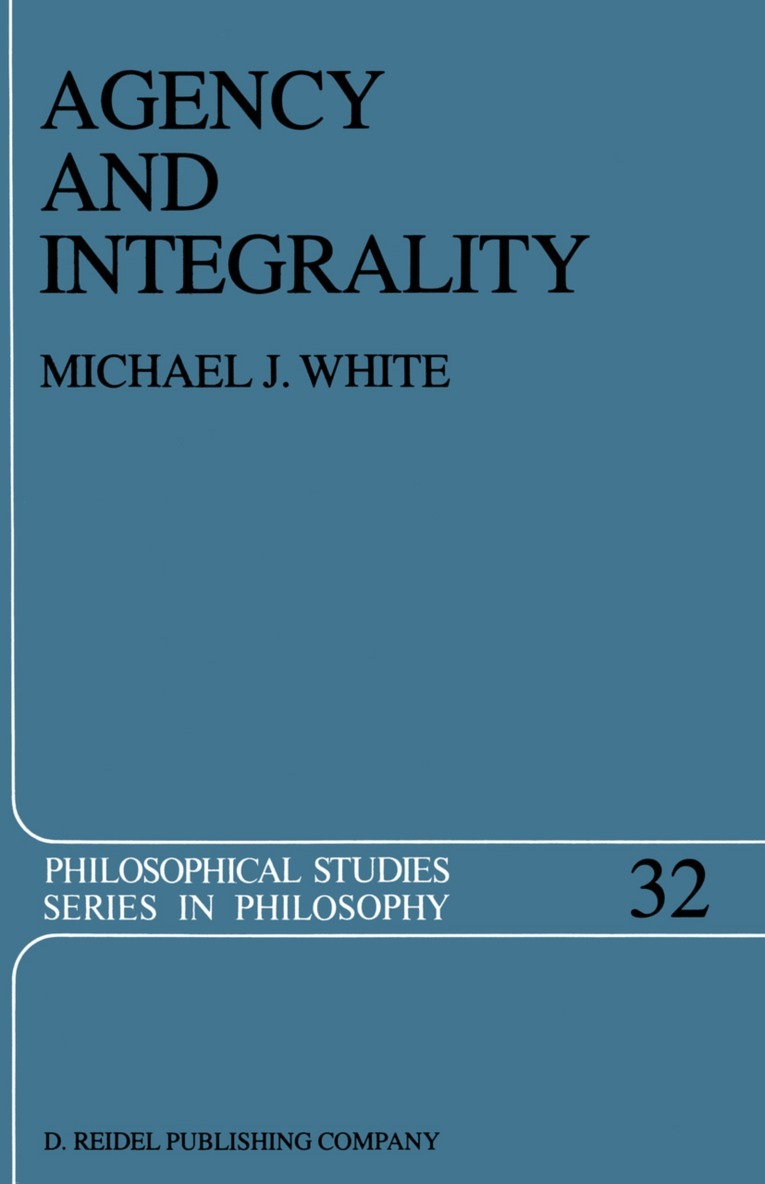
    Agency and Integrality

    Philosophical Themes in the Ancient Discussions of Determinism and Responsibility

    AvMichael J. White

    Häftad, Engelska, 2011

    Del 32 i serien Philosophical Studies Series

    549 kr

    Beställningsvara. Skickas inom 10-15 vardagar. Fri frakt över 249 kr.

    Fler format och utgåvor

    E-bok

    712 kr

    Beskrivning

    It is not very surprising that it was no less true in antiquity than it is today that adult human beings are held to be responsible for most of their actions. Indeed, virtually all cultures in all historical periods seem to have had some conception of human agency which, in the absence of certain responsibility-defeating conditions, entails such responsibility. Few philosophers have had the temerity to maintain that this entailment is trivial because such responsibility-defeating conditions are always present. Another not very surprising fact is that ancient thinkers tended to ascribe integrality to "what is" (to on). That is, they typically regarded "what is" as a cosmos or whole with distinguishable parts that fit together in some coherent or cohesive manner, rather than either as a "unity" with no parts or as a collection containing members (ta onta or "things that are") standing in no "natural" relations to one another. 1 The philoso­ phical problem of determinism and responsibility may, I think, best be characterized as follows: it is the problem of preserving the phenomenon of human agency (which would seem to require a certain separateness of individual human beings from the rest of the cosmos) when one sets about the philosophical or scientific task of explaining the integrality of "what is" by means of the development of a theory of causation or explanation ( concepts that came to be lumped together by the Greeks under the term "aitia") .

    Produktinformation

    • Utgivningsdatum:2011-12-21
    • Mått:152 x 229 x 17 mm
    • Vikt:443 g
    • Format:Häftad
    • Språk:Engelska
    • Serie:Philosophical Studies Series
    • Antal sidor:296
    • Förlag:Springer
    • ISBN:9789401088572

    Utforska kategorier

    • Filosofiska discipliner inom Filosofi och religion

    Innehållsförteckning

    • One: Introduction: The Immortal Chimpanzee at its Typewriter.- A. Plenitude and the Temporal-Frequency Model of the Modalities.- B. Plenitude and Atomist Cosmology?.- C. Summary and Conclusion.- Notes.- Two: The Legacy of Aristotle.- A. Pitfalls.- B. Three Types of Necessity.- C. Aristotle’s Fundamental Modal Principle.- D. Absolute Necessity and the Ultimate Mover.- E. Aristotle and Determinism.- F. The Energeia-Kin?sis Distinction and Aristotelian Determinism.- G. Summary and Conclusion.- Notes.- Three: Diodorean Fatalism.- A. Diodorus the Megarian?.- B. Diodorus’Denial of Motion.- C. Diodorus’ Account of the Alethic Modalities and His Fatalism.- D. The Master Argument and Diodorean Fatalism.- E. Summary and Conclusion.- Notes.- Four: Chrysippus’ Compatibilism.- A. The Avoidance of Necessity and Retention of Fate.- B. “Obscure Causes” and Chrysippus’ Compatibilism.- C. “What Is Up to Us” and Fate.- D. Chrysippean and Spinozistic Reconciliationism.- E. Summary and Conclusion.- Notes.- Five: Peripatetic Polemics.- A. Stoic and Peripatetic Conceptions of Heimarmen?.- B. Causal/Temporal Sequences: Stoic and Peripatetic Conceptions.- C. A Fronte Conditional Necessity.- D. A Tergo Conditional Necessity.- E. Summary and Conclusion.- Notes.- Six: Cosmic Cycles, Time, and Determinism.- A. Two Versions of Cosmic Cycles.- B. Cosmic Cycles and the Temporal-Frequency Model of the Modalities.- C. Cosmic Cycles and the Actuality of the Future.- D. Summary and Conclusion.- Notes.- Seven: Plotinus and Human Autonomy.- A. Book III of the Nicomachean Ethics and its Aftermath.- B. A Stoic Metaphysical Move.- C. Moral Responsibility and Aristotle’s Predicament.- D. Plotinus and Ennead 3.- E. Plotinus and Ennead 6.- F. The Constative and Performative Views ofResponsibility-Attribution.- G. Summary and Conclusion.- Notes.- Eight: Philosophical Postscript.- A. The Temporal-Frequency Model of the Alethic Modalities.- B. Responsibility and Determinism.- Notes.- Notes.- Index Locorum.- Index of Names.