• Fri frakt över 249 kr
  • •
  • Snabba leveranser
  • •
  • Billiga böcker
Kundservice

Du är på sajten för privatpersoner.

Företag, bibliotek eller offentlig verksamhet?

Du handlar på classic.bokus.com, där alla dina funktioner finns intakta.
Till classic.bokus.com
Bokus logotyp. Gå till startsidan.
  • Erbjudanden
  • Nyheter
  • Student
  • Topplistor
  • Barn & ungdom
  • Bokus Play
  • E-böcker
  • Pocketböcker
  • Spel & pussel

10% rabatt på allt med kod NYSTART10 →

Sidfot

Mina sidor

    Hjälp

    • Kundservice
    • Vanliga frågor och svar
    • Frakt och leverans
    • Retur vid ångerrätt
    • Reklamera vara
    • Betalning
    • Köpvillkor
    • Allmänna villkor
    • Information om webbplatsens tillgänglighet

    Om Bokus

    • Om oss
    • Pressrum
    • För studenter
    • För företag
    • För bibliotek och offentlig verksamhet
    • För leverantörer
    • Hållbarhet

    Populärt

    • Aktuella erbjudanden
    • Presentkort
    • Studentlitteratur
    • Nya böcker
    • Topplistor
    • Signerade böcker
    • Engelska böcker

    Inspiration

    • Boktips
    • BookTok
    • Populära bokserier
    • Barnbokskaraktärer
    • Populära författare
    Logotyp för Bokus
    Följ oss på Facebook (extern länk)Följ oss på Instagram (extern länk)Följ oss på YouTube (extern länk)Följ oss på TikTok (extern länk)
    bokus @ CookiesAnpassa cookiesIntegritetspolicyKöpvillkor
    Till Citymail hemsida (extern länk)Till Budbee hemsida (extern länk)Till Postnord hemsida (extern länk)Till Schenker hemsida (extern länk)Till Early Bird hemsida (extern länk)Till Walleys hemsida (extern länk)
    1. Naturvetenskap och teknik
    2. Matematik och naturvetenskap
    3. Matematik
    4. Tillämpad matematik

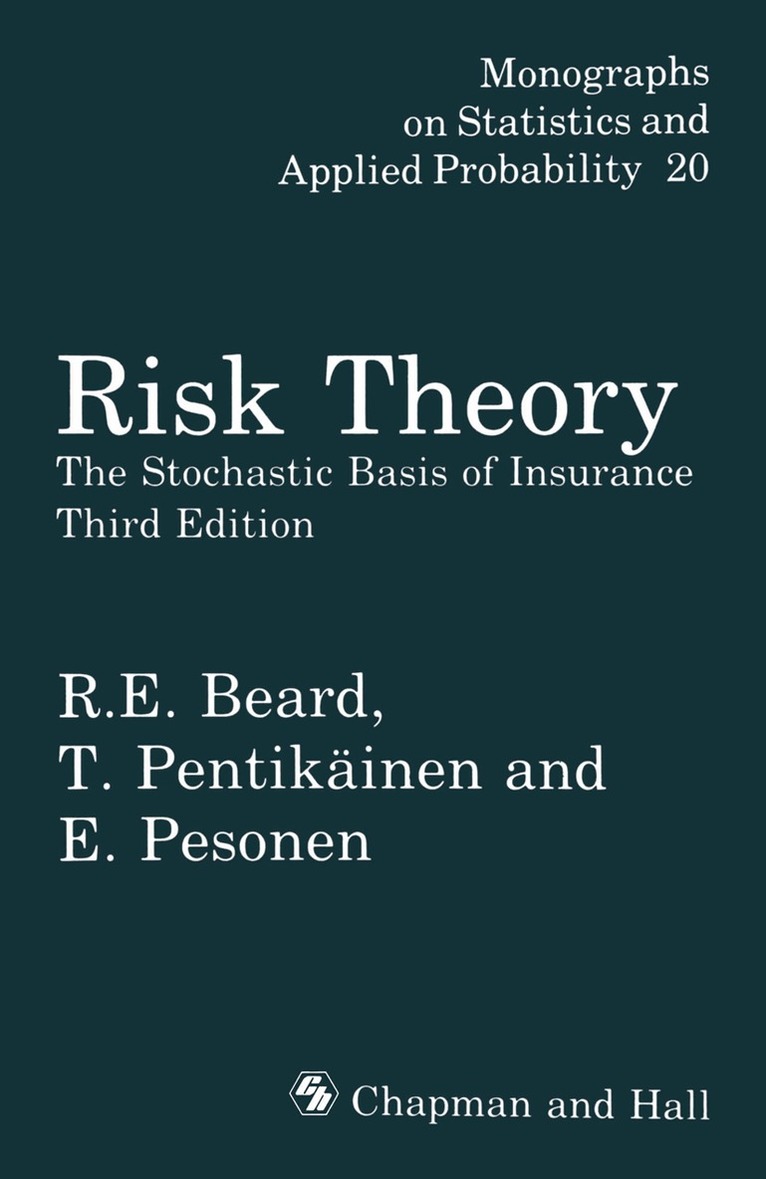
    Risk Theory

    The Stochastic Basis of Insurance

    AvR. Beard

    Häftad, Engelska, 2013

    Del i serien Monographs on Statistics and Applied Probability

    546 kr

    Beställningsvara. Skickas inom 10-15 vardagar. Fri frakt över 249 kr.

    Fler format och utgåvor

    E-bok

    700 kr

    Beskrivning

    The theory of risk already has its traditions. A review of its classical results is contained in Bohlmann (1909). This classical theory was associated with life insurance mathematics, and dealt mainly with deviations which were expected to be produced by random fluctua­ tions in individual policies. According to this theory, these deviations are discounted to some initial instant; the square root of the sum of the squares of the capital values calculated in this way then gives a measure for the stability of the portfolio. A theory constituted in this manner is not, however, very appropriate for practical purposes. The fact is that it does not give an answer to such questions as, for example, within what limits a company's probable gain or loss will lie during different periods. Further, non-life insurance, to which risk theory has, in fact, its most rewarding applications, was mainly outside the field of interest of the risk theorists. Thus it is quite understandable that this theory did not receive very much attention and that its applications to practical problems of insurance activity remained rather unimportant. A new phase of development began following the studies of Filip Lundberg (1909, 1919), which, thanks to H. Cramer (1926), e.O.

    Produktinformation

    • Utgivningsdatum:2013-01-03
    • Mått:140 x 216 x 24 mm
    • Vikt:536 g
    • Format:Häftad
    • Språk:Engelska
    • Serie:Monographs on Statistics and Applied Probability
    • Antal sidor:408
    • Upplaga:1984
    • Förlag:Springer
    • ISBN:9789401176828

    Utforska kategorier

    • Tillämpad matematik inom Naturvetenskap och teknik

    Innehållsförteckning

    • 1 Definitions and notation.- 1.1 The purpose of the theory of risk.- 1.2 Stochastic processes in general.- 1.3 Positive and negative risk sums.- 1.4 Main problems.- 1.5 On the notation.- 1.6 The moment generating function, the characteristic function, and the Laplace transform.- 2 Claim number process.- 2.1 Introduction.- 2.2 The Poisson process.- 2.3 Discussion of conditions.- 2.4 Some basic formulae.- 2.5 Numerical values of Poisson probabilities.- 2.6 The additivity of Poisson variables.- 2.7 Time-dependent variation of risk exposure.- 2.8 Formulae concerning the mixed Poisson distribution.- 2.9 The Polya process.- 2.10 Risk exposure variation inside the portfolio.- 3 Compound Poisson process.- 3.1 The distribution of claim size.- 3.2 Compound distribution of the aggregate claim.- 3.3 Basic characteristics of F.- 3.4 The moment generating function.- 3.5 Estimation of S.- 3.6 The dependence of the S function on reinsurance.- 3.7 Decomposition of the portfolio into sections.- 3.8 Recursion formula for F.- 3.9 The normal approximation.- 3.10 Edgeworth series.- 3.11 Normal power approximation.- 3.12 Gamma approximation.- 3.13 Approximations by means of functions belonging to the Pearson family.- 3.14 Inversion of the characteristic function.- 3.15 Mixed methods.- 4 Applications related to one-year time-span.- 4.1 The basic equation.- 4.2 Evaluation of the fluctuation range of the annual underwriting profits and losses.- 4.3 Some approximate formulae.- 4.4 Reserve funds.- 4.5 Rules for the greatest retention.- 4.6 The case of several Ms.- 4.7 Excess of loss reinsurance premium.- 4.8 Application to stop loss reinsurance.- 4.9 An application to insurance statistics.- 4.10 Experience rating, credibility theory.- 5 Variance as a measure of stability.- 5.1 Optimum form of reinsurance.- 5.2 Reciprocity of two companies.- 5.3 Equitability of safety loadings: a link to theory of multiplayer games.- 6 Risk processes with a time-span of several years.- 6.1 Claims.- 6.2 Premium income P(1, t).- 6.3 Yield of investments.- 6.4 Portfolio divided in sections.- 6.5 Trading result.- 6.6 Distribution of the solvency ratio u.- 6.7 Ruin probability ?T(u), truncated convolution.- 6.8 Monte Carlo method.- 6.9 Limits for the finite time ruin probability ?T.- 7 Applications related to finite time-span T.- 7.1 General features of finite time risk processes.- 7.2 The size of the portfolio.- 7.3 Evaluation of net retention M.- 7.4 Effect of cycles.- 7.5 Effect of the time-span T.- 7.6 Effect of inflation.- 7.7 Dynamic control rules.- 7.8 Solvency profile.- 7.9 Evaluation of the variation range of u(t).- 7.10 Safety loading.- 8 Risk theory analysis of life insurance.- 8.1 Cohort analysis.- 8.2 Link to classic individual risk theory.- 8.3 Extensions of the cohort approach.- 8.4 General system.- 9 Ruin probability during an infinite time period.- 9.1 Introduction.- 9.2 The infinite time ruin probability.- 9.3 Discussion of the different methods.- 10 Application of risk theory to business planning.- 10.1 General features of the models.- 10.2 An example of risk theory models.- 10.3 Stochastic dynamic programming.- 10.4 Business objectives.- 10.5 Competition models.- Appendixes.- A Derivation of the Poisson and mixed Poisson processes.- B Edgeworth expansion.- C Infinite time ruin probability.- D Computation of the limits for the finite time ruin probability according to method of Section 6.9.- E Random numbers.- F Solutions to the exercises.- Author index.