• Fri frakt över 249 kr
  • •
  • Snabba leveranser
  • •
  • Billiga böcker
Kundservice

Du är på sajten för privatpersoner.

Företag, bibliotek eller offentlig verksamhet?

Du handlar på classic.bokus.com, där alla dina funktioner finns intakta.
Till classic.bokus.com
Bokus logotyp. Gå till startsidan.
  • Erbjudanden
  • Nyheter
  • Student
  • Topplistor
  • Barn & ungdom
  • Bokus Play
  • E-böcker
  • Pocketböcker
  • Spel & pussel

10% rabatt på allt med kod NYSTART10 →

Sidfot

Mina sidor

    Hjälp

    • Kundservice
    • Vanliga frågor och svar
    • Frakt och leverans
    • Retur vid ångerrätt
    • Reklamera vara
    • Betalning
    • Köpvillkor
    • Allmänna villkor
    • Information om webbplatsens tillgänglighet

    Om Bokus

    • Om oss
    • Pressrum
    • För studenter
    • För företag
    • För bibliotek och offentlig verksamhet
    • För leverantörer
    • Hållbarhet

    Populärt

    • Aktuella erbjudanden
    • Presentkort
    • Studentlitteratur
    • Nya böcker
    • Topplistor
    • Signerade böcker
    • Engelska böcker

    Inspiration

    • Boktips
    • BookTok
    • Populära bokserier
    • Barnbokskaraktärer
    • Populära författare
    Logotyp för Bokus
    Följ oss på Facebook (extern länk)Följ oss på Instagram (extern länk)Följ oss på YouTube (extern länk)Följ oss på TikTok (extern länk)
    bokus @ CookiesAnpassa cookiesIntegritetspolicyKöpvillkor
    Till Citymail hemsida (extern länk)Till Budbee hemsida (extern länk)Till Postnord hemsida (extern länk)Till Schenker hemsida (extern länk)Till Early Bird hemsida (extern länk)Till Walleys hemsida (extern länk)
    1. Naturvetenskap och teknik
    2. Teknik och industri
    3. Elektronik och kommunikationer

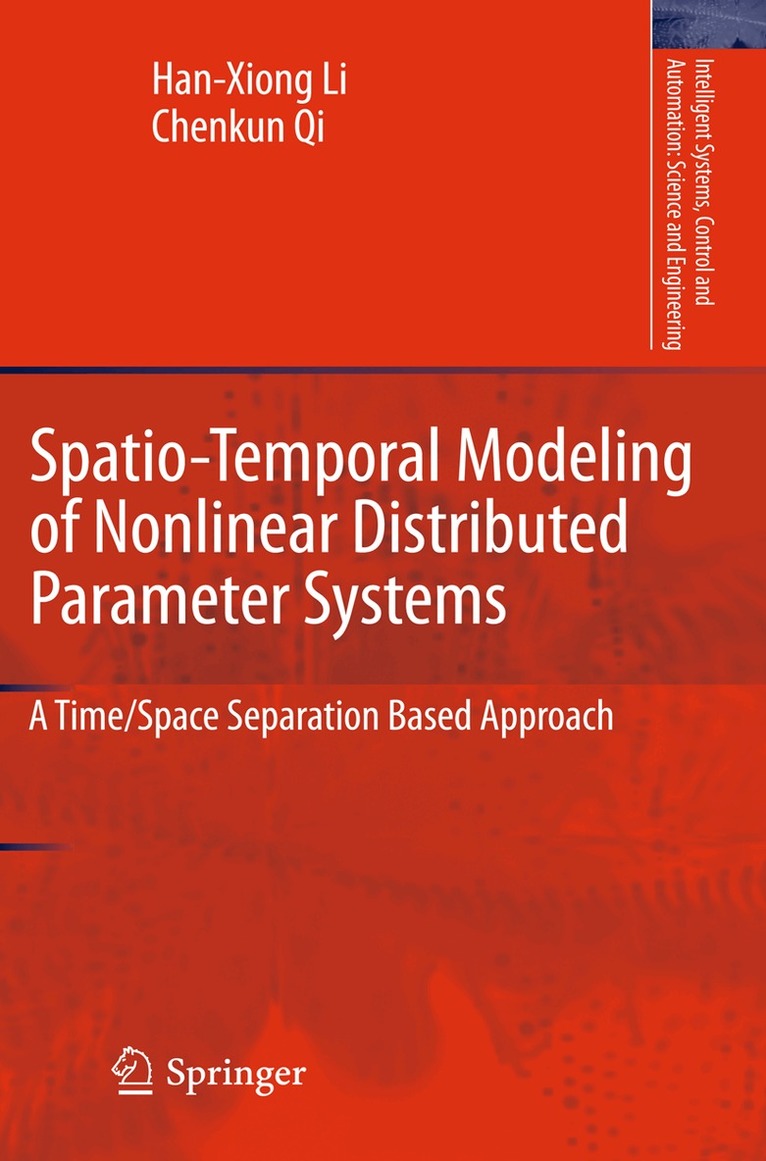
    Spatio-Temporal Modeling of Nonlinear Distributed Parameter Systems

    A Time/Space Separation Based Approach

    AvHan-Xiong Li,Chenkun Qi

    Häftad, Engelska, 2014

    Del 50 i serien Intelligent Systems, Control and Automation: Science and Engineering

    546 kr

    Beställningsvara. Skickas inom 10-15 vardagar. Fri frakt över 249 kr.

    Fler format och utgåvor

    Inbunden

    546 kr

    Beskrivning

    The purpose of this volume is to provide a brief review of the previous work on model reduction and identifi cation of distributed parameter systems (DPS), and develop new spatio-temporal models and their relevant identifi cation approaches.In this book, a systematic overview and classifi cation on the modeling of DPS is presented fi rst, which includes model reduction, parameter estimation and system identifi cation. Next, a class of block-oriented nonlinear systems in traditional lumped parameter systems (LPS) is extended to DPS, which results in the spatio-temporal Wiener and Hammerstein systems and their identifi cation methods. Then, the traditional Volterra model is extended to DPS, which results in the spatio-temporal Volterra model and its identification algorithm. All these methods are based on linear time/space separation. Sometimes, the nonlinear time/space separation can play a better role in modeling of very complex processes.Thus, a nonlinear time/space separation based neural modeling is also presented for a class of DPS with more complicated dynamics. Finally, all these modeling approaches are successfully applied to industrial thermal processes, including a catalytic rod, a packed-bed reactor and a snap curing oven. The work is presented giving a unifi ed view from time/space separation. The book also illustrates applications to thermal processes in the electronics packaging and chemical industry. This volume assumes a basic knowledge about distributed parameter systems, system modeling and identifi cation. It is intended for researchers, graduate students and engineers interested in distributed parameter systems, nonlinear systems, and process modelingand control.

    Produktinformation

    • Utgivningsdatum:2014-10-16
    • Mått:155 x 235 x 11 mm
    • Vikt:306 g
    • Format:Häftad
    • Språk:Engelska
    • Serie:Intelligent Systems, Control and Automation: Science and Engineering
    • Antal sidor:175
    • Förlag:Springer
    • ISBN:9789401782548

    Utforska kategorier

    • Elektronik och kommunikationer inom Naturvetenskap och teknik
    • Tillämpad matematik inom Naturvetenskap och teknik
    • Teknik: allmänt inom Naturvetenskap och teknik

    Recensioner i media

    From the reviews: "A distributed parameter system (DPS) is usually an engineering equivalent of a partial differential equation (PDE) or a system of PDEs. ... this book is the extension of this idea to the nonlinear setting. ... The book addresses an engineering audience, and people not very familiar with the subject will find the list of abbreviations especially useful. The chapters are inter-connected and each chapter looks like an independent entity; it starts and ends with a summary and has its own list of references ... ." (Sergey V. Lototsky, Mathematical Reviews, Issue 2012 a)

    Innehållsförteckning

    • Preface; List of Figures; List of Tables; Abbreviations; 1 Introduction; 1.1 Background; 1.1.1 Examples of distributed parameter processes; 1.1.2 Motivation; 1.2 Contributions and organization of the book; 1.3 References; 2 Modeling of Distributed Parameter Systems: Overview and Classification; 2.1 Introduction; 2.2 White-box modeling: model reduction for known DPS; 2.2.1 Eigenfunction method; 2.2.2 Green’s function method; 2.2.3 Finite difference method; 2.2.4 Weighted residual method; 2.2.4.1 Classification based on weighting functions; 2.2.4.2 Classification based on basis functions; 2.2.5 Comparison studies of spectral and KL method; 2.3 Grey-box modeling: parameter estimation for partly known DPS; 2.3.1 FDM basedestimation; 2.3.2 FEM based estimation; 2.3.3 Spectral based estimation; 2.3.4 KL based estimation; 2.4 Black-box modeling: system identification for unknown DPS; 2.4.1 Green’s function based identification; 2.4.2 FDM based identification; 2.4.3 FEM based identification; 2.4.4 Spectral based identification; 2.4.5 KL based identification; 2.4.6 Comparison studies of neural spectral and neural KL method; 2.5 Concluding remarks; 2.6 References; 3 Spatio-Temporal Modeling for Wiener Distributed Parameter Systems; 3.1 Introduction; 3.2 Wiener distributed parameter system; 3.3 Spatio-temporal Wiener modeling methodology; 3.4 Karhunen-Loève decomposition; 3.5 Wiener model identification; 3.5.1 Modelparameterization; 3.5.2 Parameter estimation; 3.6 Simulation and experiment; 3.6.1 Catalytic rod; 3.6.2 Snap curing oven; 3.7 Summary; 3.8 References; 4 Spatio-Temporal Modeling for Hammerstein Distributed Parameter Systems; 4.1 Introduction; 4.2 Hammerstein distributed parameter system; 4.3 Spatio-temporal Hammerstein modeling methodology; 4.4 Karhunen-Loève decomposition; 4.5 Hammerstein model identification; 4.5.1 Model parameterization; 4.5.2 Structure selection; 4.5.3 Parameter estimation; 4.6 Simulation and experiment; 4.6.1 Catalytic rod; 4.6.2 Snap curing oven; 4.7 Summary; 4.8 References; 5 Multi-Channel Spatio-Temporal Modeling for Hammerstein Distributed Parameter Systems; 5.1 Introduction; 5.2 Hammerstein distributedparameter system; 5.3 Basic identification approach; 5.3.1 Basis function expansion; 5.3.2 Temporal modeling problem; 5.3.3 Least-squares estimation; 5.3.4 Singular value decomposition; 5.4 Multi-channel identification approach; 5.4.1 Motivation; 5.4.2 Multi-channel identification; 5.4.3 Convergence analysis; 5.5 Simulation and experiment; 5.5.1 Packed-bed reactor; 5.5.2 Snap curing oven; 5.6 Summary; 5.7 References; 6 Spatio-Temporal Volterra Modeling for a Class of Nonlinear DPS; 6.1 Introduction; 6.2 Spatio-temporal Volterra model; 6.3 Spatio-temporal modeling approach; 6.3.1 Time/space separation; 6.3.2 Temporal modeling problem; 6.3.3 Parameter estimation; 6.4 State space realization; 6.5 Convergence analysis; 6.6 Simulation and experiment; 6.6.1 Catalytic rod; 6.6.2 Snap curing oven; 6.7 Summary; 6.8 References; 7 Nonlinear Dimension Reduction based Neural Modeling for Nonlinear Complex DPS; 7.1 Introduction; 7.2 Nonlinear PCA based spatio-temporal modeling framework; 7.2.1 Modeling methodology; 7.2.2 Principal component analysis; 7.2.3 Nonlinear PCA for projection and reconstruction; 7.2.4 Dynamic modeling; 7.3 Nonlinear PCA based spatio-temporal modeling in neural system; 7.3.1 Neural network for nonlinear PCA; 7.3.2 Neural network for dynamic modeling; 7.4 Simulation and experiment; 7.4.1 Catalytic rod; 7.4.2 Snap curing oven; 7.5 Summary; 7.6 References; 8 Conclusions; 8.1 Conclusions; 8.2 References; Index.