• Fri frakt över 249 kr
  • •
  • Snabba leveranser
  • •
  • Billiga böcker
Kundservice

Du är på sajten för privatpersoner.

Företag, bibliotek eller offentlig verksamhet?

Du handlar på classic.bokus.com, där alla dina funktioner finns intakta.
Till classic.bokus.com
Bokus logotyp. Gå till startsidan.
  • Erbjudanden
  • Student
  • Topplistor
  • Barn & ungdom
  • Bokus Play
  • E-böcker
  • Ljudböcker
  • Pocketböcker
  • Spel och pussel

Skapa nya rutiner – hälsoböcker upp till 50% →

Sidfot

Mina sidor

    Hjälp

    • Kundservice
    • Vanliga frågor och svar
    • Frakt och leverans
    • Retur vid ångerrätt
    • Reklamera vara
    • Betalning
    • Köpvillkor
    • Allmänna villkor
    • Information om webbplatsens tillgänglighet

    Om Bokus

    • Om oss
    • Pressrum
    • För studenter
    • För företag
    • För bibliotek och offentlig verksamhet
    • För leverantörer
    • Hållbarhet

    Populärt

    • Aktuella erbjudanden
    • Presentkort
    • Studentlitteratur
    • Nya böcker
    • Topplistor
    • Signerade böcker
    • Engelska böcker

    Inspiration

    • Boktips
    • BookTok
    • Barnbokskaraktärer
    • Populära författare
    Logotyp för Bokus
    Följ oss på Facebook (extern länk)Följ oss på Instagram (extern länk)Följ oss på YouTube (extern länk)Följ oss på TikTok (extern länk)
    bokus @ CookiesAnpassa cookiesIntegritetspolicyKöpvillkor
    Till Citymail hemsida (extern länk)Till Budbee hemsida (extern länk)Till Postnord hemsida (extern länk)Till Schenker hemsida (extern länk)Till Early Bird hemsida (extern länk)Till Walleys hemsida (extern länk)
    1. Medicin
    2. Medicin: allmänt

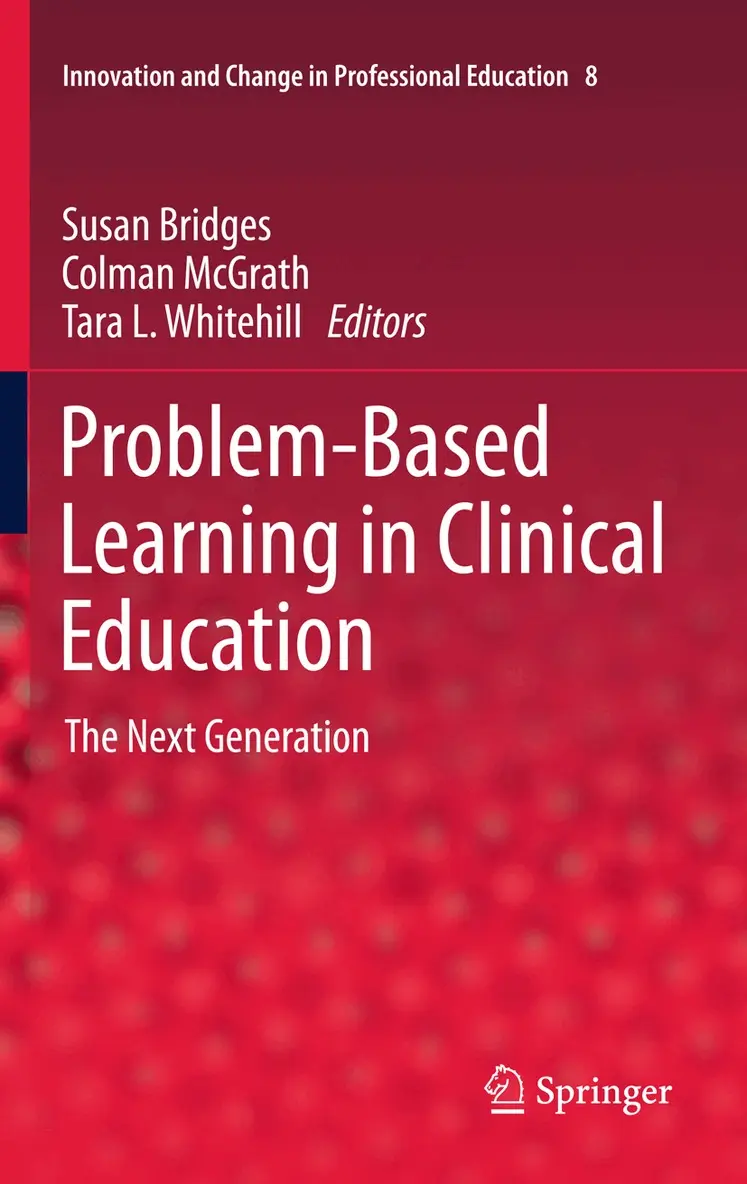
    Problem-Based Learning in Clinical Education

    The Next Generation

    AvSusan Bridges,Colman McGrath

    Häftad, Engelska, 2014

    Del 8 i serien Innovation and Change in Professional Education

    1 110 kr

    Beställningsvara. Skickas inom 10-15 vardagar. Fri frakt över 249 kr.

    Beskrivning

    Developed in the context of health sciences education in the late 1960s, problem-based learning (PBL) is now widely deployed as an education methodology. Its problem-solving, collaborative, student-centred ethos is seen as a more appropriate system of pedagogy than earlier ‘chalk-and-talk’ modes. Focusing on its use in clinical education, this collection of recent scholarship on PBL examines the ways in which PBL is both conceived and implemented in clinical education. The work has a dual emphasis, research-driven on the one hand, while on the other assessing new methodologies to explore how problem-based curricula support the achievement of students’ learning outcomes in the context of clinical education.The chapters draw on studies that explore PBL both theoretically and empirically. The volume’s eclecticism capitalises on the growing body of empirical research into PBL evaluations. It balances this with studies analysing the relatively new area of discourse-based research on PBL-in-action, whose focus has been to interrogate the ‘how’ of student learning in curricula with PBL content.This publication will be of interest to clinical teachers, curriculum designers and those interested in innovations in the scholarship of teaching and learning in PBL curricula.

    Produktinformation

    • Utgivningsdatum:2014-02-24
    • Mått:155 x 235 x 16 mm
    • Vikt:429 g
    • Format:Häftad
    • Språk:Engelska
    • Serie:Innovation and Change in Professional Education
    • Antal sidor:254
    • Upplaga:2012
    • Förlag:Springer
    • ISBN:9789401784146

    Utforska kategorier

    • Medicin: allmänt inom Medicin
    • Pedagogisk psykologi inom Psykologi och pedagogik
    • Undervisning i specifika ämnen inom Psykologi och pedagogik

    Recensioner i media

    Medical schools are the pioneers of problem-based learning (PBL). Since the advent of PBL in the late 1960s, dramatic changes have taken place in the landscape of education. The constructivist paradigm as reflected in PBL has become a significant influence on today's educational research and practice. While numerous studies have been conducted over the years to examine PBL from different angles, it is a good time to revisit medical education and take a systematic look at how PBL is being implemented and investigated in today's medical schools. This edited book, Problem-Based Learning in Clinical Education: The Next Generation, serves such a purpose. The book is unique in that it originated from the University of Hong Kong, where a curriculum overhaul has taken place to implement PBL. Further, appealing to a global audience, PBL scholars and practitioners from all over the world contributed to this edited volume. The book has a collection of 14 chapters. The first chapter by Hmelo-Silver and Eberbach provides the readers a comprehensive overview of the theoretical underpinnings of PBL and offers the necessary lenses to examine and interpret the subsequent chapters. The last chapter by Bridges, Whitehill, and McGrath summarizes the research directions in PBL based on the work presented in this book. The main part of the book examines PBL from three different perspectives: learning outcomes, new technologies, and the inside processes. Five chapters focus on different learning outcomes of PBL. Chapter 2 explores the delayed outcomes of PBL by inviting two previous students to reflect back on their PBL experience 16 years ago and discuss the impact of this experience on their later career. Chapter 3 examines board-exam performance by comparing PBL and traditional dental students' exam scores over six years. While it is impressive that the PBL students consistently outperformed the traditional students in their basic science exam scores, readers would benefit from a more in-depth discussion of the possible reasons. Chapter 4 compares students' perceived competencies in their profession as the result of a complete or a hybrid PBL curriculum. Chapter 5 examines the influence of two PBL curricula on three different outcomes: (a) students' understanding of PBL, (b) approaches to learning, and (c) exam performance. The study highlights some misalignment between students' understanding and the design intentions of PBL. Chapter 6 addresses a unique construct, learning styles, as the outcome of a three-year PBL curriculum. Three chapters are dedicated to the topic of new technologies for PBL curriculum design. In light of technology's affordances of multiple modalities, Chapter 7 describes an interactional ethnographic study to understand how different text modalities serve as learning tools to support students' knowledge construction across the PBL cycle. While related to technology, this chapter seems to fit more in the next section of the book with a focus on the processes of PBL. Chapter 8 reports an endeavor to conduct PBL by having students from two different disciplines and separated by time and location to collaborate with each other. While a set of social networking tools are described, readers could benefit from an illustration of how the tools were used to facilitate different phases of the PBL cycle. Chapter 9 compares two different modalities of problem presentation, paper or video, in their influence on the PBL process. The next four chapters explore the tutorial processes during PBL. Chapter 10 uses discourse analysis and interviews to identify important factors that influence the first-year students' adaptations to the PBL environment. Chapter 11 uses conversation analysis to demonstrate how silence may serve as a productive mechanism to facilitate the PBL process. Chapter 12 examines group dynamics from the perspective of the first-year PBL students. The findings highlight the importance of social elements in group dynamics. The last chapter of this section takes a closer look at the actual implementation of PBL and points out the importance of tutors' understanding of PBL structure and processes for effective facilitation of PBL. Overall, this book features a well-rounded collection of studies examining important topics in current clinical education, although the section on new technologies could be strengthened by including studies on more technologies, e.g., different kinds of simulation technologies that are heavily used in clinical education. The focus on research is a clear strength of this book. PBL researchers can reference the variety of research methodologies featured in this volume to examine both the processes and the various outcomes of PBL. The works in this book represent a wide range of medical disciplines, academic levels, and PBL approaches with an emphasis on the implications from research. Hence, PBL practitioners will also find this edited volume very useful in informing their curriculum planning and implementation. Kun Huang is an instructional designer for the Center for Learning and Development at the University of North Texas Health Science Center. She has implemented PBL in higher education, including health science education, and conducted extensive research on the topic. Correspondence concerning this article should be addressed to Kun Huang, University of North Texas Health Science Center, Center for Learning and Development, 3500 Camp Bowie Boulevard, Fort Worth, TX 76107; E-mail: kun.huang@unthsc.edu.unthsc.edu Interdisciplinary Journal of Problem-based Learning, Vol. 6: Iss. 2, Article 6 This document has been made available through Purdue e-Pubs, a service of the Purdue University Libraries. Please contact epubs@purdue.edu for additional information. -------------------------------------------------------------------- Problem-Based Learning in Clinical Education is the eighth in a series of publications dedicated to innovation and change in professional and post-secondary education. It was conceived to share recent scholarship in developing understanding and implementing problem-based learning (PBL). The focus is on 'how', rather than 'why' PBL, with a strong emphasis on research. The editors are to be complimented on the collection of wisdom and analysis from 34 authoritative educators. There is a helpful and succinct introduction to learning theories and PBL, which describes the features of PBL and its theoretical foundations. Part II covers achievement in student learning outcomes in PBL courses. This section includes a dialogue between three authors on evaluation in PBL, starting with the old mantra that evaluation drives learning. Charles Schuler's piece compares outcomes from the traditional course to PBL in the basic sciences. He concludes that the ability to learn about the basic sciences and understand their relevance to patient care provides a solid basis for lifelong learning and helps promote the concept of evidence-based treatments. There are informative reports from speech, hearing and language schools on their experiences, and the measured outcomes, of PBL on self-directed learning competencies in everyday work, as well as the complexities, challenges and student awareness of the learning cycle. The book includes a Euro/Australian study on the influence of two PBL 'curricular contexts' with an impressive team of well-known authors. Curricular approaches of Malmo students supported deep learning approaches, whilst Adelaide students' experiences were associated with decreased deep approaches. This was despite a clear focus by Adelaide students on the professional relevance of their learning in PBL. The study highlights the importance of reviewing students' perceptions, understanding, approaches and outcome of their curricula, particularly after their first semester experience. Part III deals with new technologies in support of PBL. The first section on Interactional Ethnography addresses the limited research on independent and on-line learning. This considers the changing emphasis towards visual, aural and spatial influences on learning. Howe and Schnabel write on the impact of social networking and how web-based interprofessional collaboration is changing the face of PBL. PBL is now a global phenomenon. One section illustrates the challenges of implementation of this learning model in an Asian pedagogical context. Discourse and divergent cultures are critical influences when investigating PBL as well as learning styles and social relations with peers. There is an interesting analysis of silence in the PBL dynamic. It is potentially a productive and collaborative practice. It can be a platform for handling conflicting information as well as an indication of shifting relations in a group dynamic. A Hamburg study considers the challenges of PBL sessions in a hybrid curriculum and the importance of anticipating problems explained. This review presents a few vignettes in a volume that constitutes an essential repository of information on education and PBL in the clinical sciences. It is highly recommended by this reviewer. Diarmuid Shanley - diarmuid.shanley@dental.tcd.ie Published in European Journal of Dental Education - John Wiley & Sons A/S

    Innehållsförteckning

    • Part I Introduction.- 1. Learning Theories and Problem-based Learning.- Part II Investigating the Achievement in Student Learning Outcomes in PBL Programmes.- 2. A Backward Glance, the Forward Gaze: Evaluation in Problem-based Courses.- 3. Comparisons in Basic Science Learning Outcomes between Students in PBL and Traditional Dental Curricula at the Same Dental School.- 4. Experiences from Two Swedish Speech and Language Pathology Education Programmes Using Different Approaches to Problem-based Learning.- 5. The Influence of Two PBL Curricula Contexts on First-year Students’ Understandings of PBL, Approaches to Learning and Outcomes.- 6. Learning Styles and Academic Outcomes: A Longitudinal Study on the Impact of a Problem-based Learning Curriculum.- Part III Researching New Technologies for PBL Curriculum Design.- 7. Multimodality in Problem-based Learning (PBL): An International Ethnography.- 8. The Changing Face of Problem-based Learning: Social networking and Interprofessional Collaboration.- 9. Effects of Video Triggers on the PBL Process.- Part IV Exploring ‘Inside’ the PBL Tutorial Process.- 10. Japanese First-year PBL Students’ Learning Processes: A Classroom Discourse Analysis.- 11. Sounds of Silence: Examining Silence in Problem-based Learning (PBL) in Asia.- 12. Getting on with Each Other: PBL Group Dynamics and Function.- 13. PBL Tutorials in a Hybrid Curriculum: Opportunities and Challenges.- Part V Conclusion.- 14. The Next Generation: Research Directions in PBL.- Appendices.- Index.
    Hoppa över listan

    Du kanske också är intresserad av

    Tara L. Whitehill, Colman McGrath, Susan Bridges - Problem-Based Learning in Clinical Education, E-bok

    Problem-Based Learning in Clinical Education

    Tara L. Whitehill, Colman McGrath, Susan Bridges

    E-bok
    2012

    1 373 kr

    Mien Segers, F. Dochy, E. Cascallar - Optimising New Modes of Assessment: In Search of Qualities and Standards, Inbunden

    Optimising New Modes of Assessment: In Search of Qualities and Standards

    Mien Segers, F. Dochy, E. Cascallar

    Inbunden, 2003

    1 568 kr

    Henny P.A. Boshuizen, Rainer Bromme, Hans Gruber - Professional Learning: Gaps and Transitions on the Way from Novice to Expert, Inbunden
    Del 2

    Professional Learning: Gaps and Transitions on the Way from Novice to Expert

    Henny P.A. Boshuizen, Rainer Bromme, Hans Gruber

    Inbunden, 2004

    1 047 kr

    Susan Bridges, Colman McGrath, Tara L. Whitehill - Problem-Based Learning in Clinical Education, Inbunden
    Del 8

    Problem-Based Learning in Clinical Education

    Susan Bridges, Colman McGrath, Tara L. Whitehill

    Inbunden, 2012

    1 110 kr

    Janet P. Hafler - Extraordinary Learning in the Workplace, Inbunden

    Extraordinary Learning in the Workplace

    Janet P. Hafler

    Inbunden, 2011

    1 360 kr

    Gloria Dall 'Alba - Learning to be Professionals, Inbunden

    Learning to be Professionals

    Gloria Dall 'Alba

    Inbunden, 2009

    1 047 kr

    Anne Mc Kee, Michael Eraut - Learning Trajectories, Innovation and Identity for Professional Development, Häftad
    Del 7

    Learning Trajectories, Innovation and Identity for Professional Development

    Anne Mc Kee, Michael Eraut

    Häftad, 2013

    1 110 kr

    Henny P.A. Boshuizen, Rainer Bromme - Professional Learning, Övrigt

    Professional Learning

    Henny P.A. Boshuizen, Rainer Bromme

    1 619 kr

    Anders Siig Andersen, Simon B. Heilesen - Roskilde Model: Problem-Oriented Learning and Project Work, Inbunden
    Del 12

    Roskilde Model: Problem-Oriented Learning and Project Work

    Anders Siig Andersen, Simon B. Heilesen

    Inbunden, 2014

    1 464 kr

    Anne Mc Kee, Michael Eraut - Learning Trajectories, Innovation and Identity for Professional Development, Inbunden
    Del 7

    Learning Trajectories, Innovation and Identity for Professional Development

    Anne Mc Kee, Michael Eraut

    Inbunden, 2011

    1 047 kr