• Fri frakt över 249 kr
  • •
  • Snabba leveranser
  • •
  • Billiga böcker
Kundservice

Du är på sajten för privatpersoner.

Företag, bibliotek eller offentlig verksamhet?

Du handlar på classic.bokus.com, där alla dina funktioner finns intakta.
Till classic.bokus.com
Bokus logotyp. Gå till startsidan.
  • Erbjudanden
  • Nyheter
  • Student
  • Topplistor
  • Barn & ungdom
  • Bokus Play
  • E-böcker
  • Pocketböcker
  • Spel & pussel

10% rabatt på allt med kod NYSTART10 →

Sidfot

Mina sidor

    Hjälp

    • Kundservice
    • Vanliga frågor och svar
    • Frakt och leverans
    • Retur vid ångerrätt
    • Reklamera vara
    • Betalning
    • Köpvillkor
    • Allmänna villkor
    • Information om webbplatsens tillgänglighet

    Om Bokus

    • Om oss
    • Pressrum
    • För studenter
    • För företag
    • För bibliotek och offentlig verksamhet
    • För leverantörer
    • Hållbarhet

    Populärt

    • Aktuella erbjudanden
    • Presentkort
    • Studentlitteratur
    • Nya böcker
    • Topplistor
    • Signerade böcker
    • Engelska böcker

    Inspiration

    • Boktips
    • BookTok
    • Populära bokserier
    • Barnbokskaraktärer
    • Populära författare
    Logotyp för Bokus
    Följ oss på Facebook (extern länk)Följ oss på Instagram (extern länk)Följ oss på YouTube (extern länk)Följ oss på TikTok (extern länk)
    bokus @ CookiesAnpassa cookiesIntegritetspolicyKöpvillkor
    Till Citymail hemsida (extern länk)Till Budbee hemsida (extern länk)Till Postnord hemsida (extern länk)Till Schenker hemsida (extern länk)Till Early Bird hemsida (extern länk)Till Walleys hemsida (extern länk)
    1. Naturvetenskap och teknik
    2. Matematik och naturvetenskap
    3. Fysik
    4. Materietillstånd

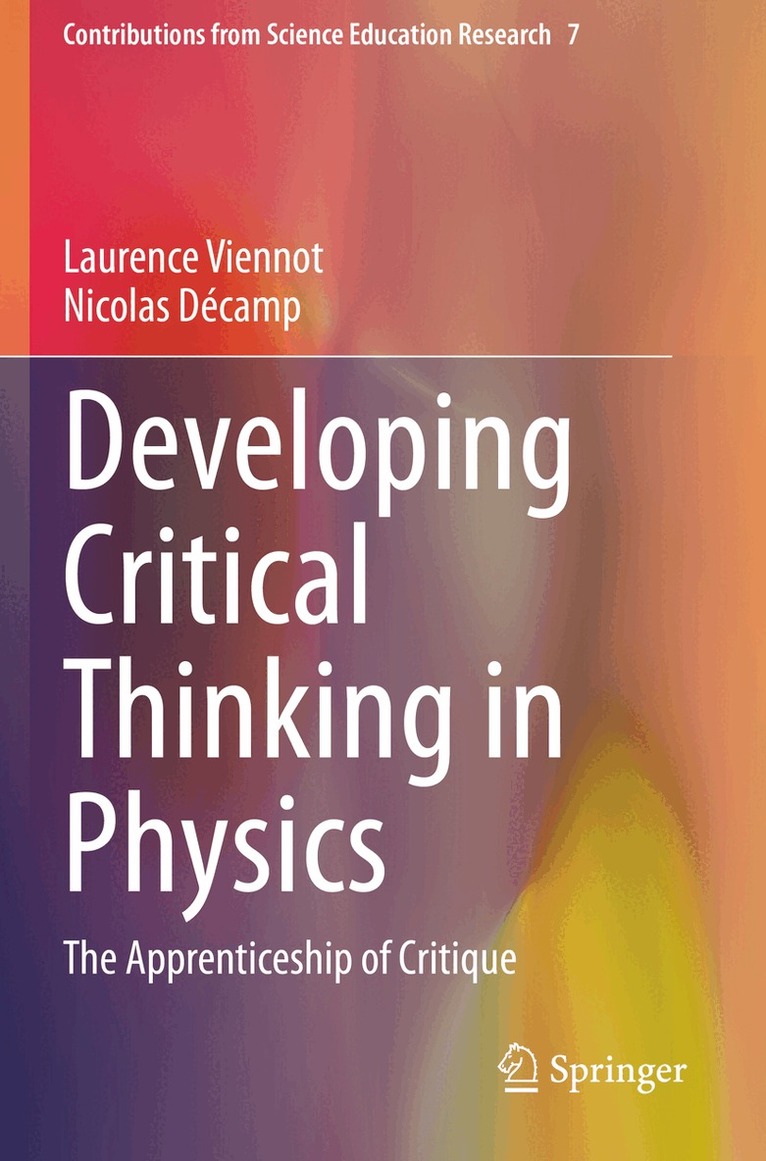
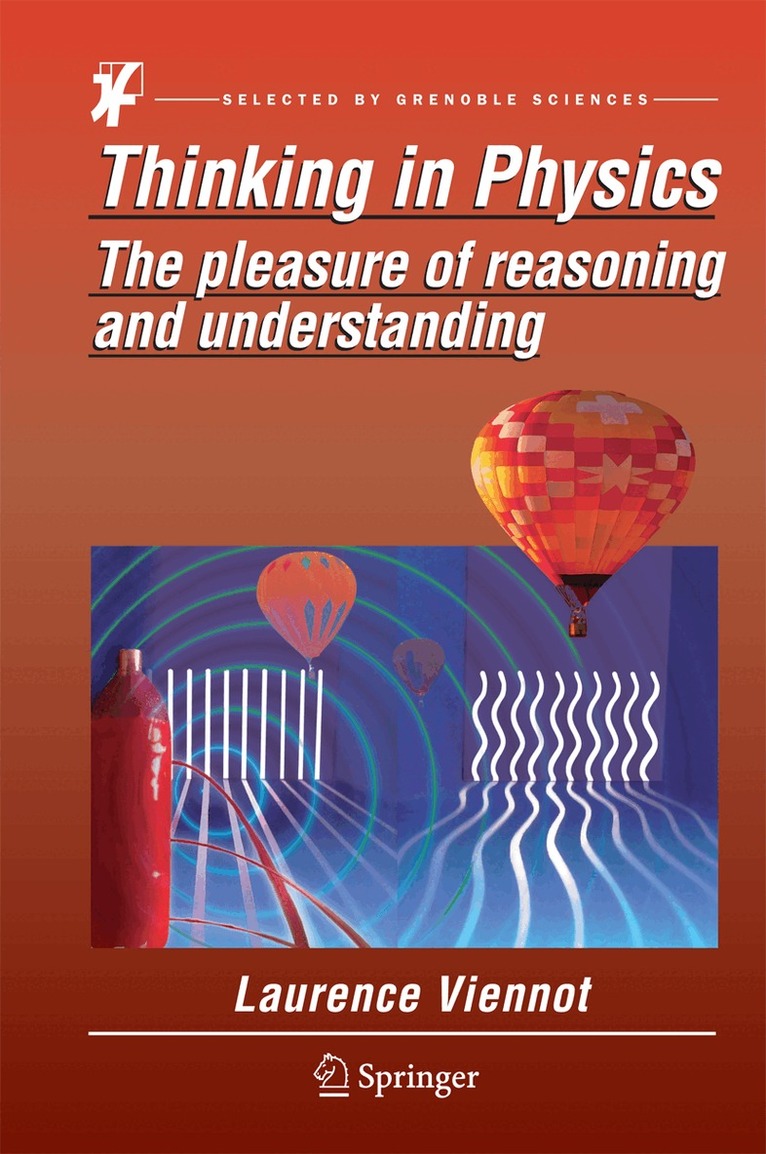
    Thinking in Physics

    The pleasure of reasoning and understanding

    AvLaurence Viennot

    Häftad, Engelska, 2016

    1 085 kr

    Beställningsvara. Skickas inom 10-15 vardagar. Fri frakt över 249 kr.

    Fler format och utgåvor

    Inbunden

    1 085 kr

    E-bok

    1 413 kr

    Beskrivning

    Read this book if you care about students really understanding physics and getting genuine intellectual satisfaction from doing so. Read it too if you fear that this goal is out of reach – you may be surprised! Laurence Viennot here shows ways to deal with the awkward fact that common sense thinking is often not the same as scientific thinking. She analyses examples of frequent and widespread errors and confusions, which provide a real eye-opener for the teacher. More than that, she shows ways to avoid and overcome them. The book argues against over-emphasis on “fun” applications, demonstrating that students also enjoy and value clear thinking.The book has three parts: • making sense of special scientific ways of reasoning (words, images, functions)• making connections between very different topics, each illuminating the other• simplifying, looking for consistency and avoiding incoherent over-simplificationThe book is enhanced with supplementary online materials that will allow readers to further expand their teaching or research interests and think about them more deeply.
    Produktinformation

    • Utgivningsdatum:2016-08-23
    • Mått:155 x 235 x 11 mm
    • Vikt:289 g
    • Format:Häftad
    • Språk:Engelska
    • Antal sidor:161
    • Förlag:Springer
    • ISBN:9789402402018

    Utforska kategorier

    • Materietillstånd inom Naturvetenskap och teknik
    • Lärarutbildning inom Psykologi och pedagogik
    • Undervisning i specifika ämnen inom Psykologi och pedagogik

    Mer om författaren

    Laurence Viennot is emeritus professor at the Université Denis Diderot (Paris 7) and contributed to the creation of the LDPES (Laboratoire de Didactique de la Physique dans l'Enseignement Supérieur) laboratory, now part of the Laboratoire André Revuz. She has for a long time been responsible for the Master's course in science teaching, but devotes herself equally to training physics instructors. Her books and publications are recognised worldwide as sources of reference (Teaching Physics, Enquête sur le concept de causalité, etc.). Previous books:VIENNOT L. 1979. Le raisonnement spontané en dynamique élémentaire. Paris : Hermann.VIENNOT L. 1996. Raisonner en physique: la part du sens commun. Avec la contribution de A. Benséghir, H. Caldas, F.Chauvet, J.L. Closset, W. Kaminski, L. Maurines, J. Menigaux, S. Rainson, S. Rozier, E. Saltiel, Bruxelles: De Boeck. VIENNOT L. 2002. Razonar en fisica. La contribucion del sentido comun. Trad: M.J. Pozo Municio. Madrid: Ant Machado libros (Visor Distribuciones).VIENNOT L. 2001. Reasoning in Physics   The part of common sense, Trad. A. Moisy. Dordrecht: Kluwer Ac. Pub.VIENNOT L. 2002. Enseigner la Physique. Avec la collaboration de U.Besson, F. Chauvet, P. Colin, C. Hirn-Chaine, W. Kaminski, S. Rainson. Bruxelles: De Boeck.VIENNOT L. 2003. Teaching physics. With the collaboration of U. Besson, F. Chauvet, P. Colin, C. Hirn-Chaine, W. Kaminski, S. Rainson. Trad. M. Greenwood & A. Moisy. Dordrecht: Kluwer Ac. Pub. VIENNOT L. & DEBRU C. (Eds.) 2003. Enquête sur le concept de causalité. Paris: PUF. VIENNOT L (Dir.) 2009. Didactique, épistémologie et histoire des sciences – Penser l’enseignement. Collection Sciences, histoire et société, Paris : PUF.VIENNOT, L. 2011. En physique, pour comprendre . Collection Grenoble Sciences. Paris : EDP Sciences.

    Innehållsförteckning

    • Foreword.- Foreword to the French Edition.- Preface.- Part I Learning to think: words, images and functions.- 1 Essential tools for comprehension.- 2 Some surprising invariances.- 3 Analysis of functional dependence: a powerful tool.- 4 Putting things into practice.- Part II Physics: linking factors.- 5 Links between phenomena in terms of type of functional dependence.- 6 The relationship between different approaches to the same phenomenon.- Part III Simplicity: ruin or triumph of coherence?.- 7 Optimising simple experiments.- 8 Popularising physics: what place for reasoning?.- 9 Conclusion.- Appendix A - What this book owes to physics education research.- Appendix B - The weight of air and molecular impacts: how do they relate?.- Appendix C –Causal  linear reasoning.- Appendix D - When physics should conform to beliefs: pierced bottles.- Appendix E – Reactions of trainee journalists and scientific writers confronted with inconsistency.- Appendix F – “Facilitating elements" of communication: Year 11 students ranking the risks of misunderstanding.