• Fri frakt över 249 kr
  • •
  • Snabba leveranser
  • •
  • Billiga böcker
Kundservice

Du är på sajten för privatpersoner.

Företag, bibliotek eller offentlig verksamhet?

Du handlar på classic.bokus.com, där alla dina funktioner finns intakta.
Till classic.bokus.com
Bokus logotyp. Gå till startsidan.
  • Erbjudanden
  • Nyheter
  • Student
  • Topplistor
  • Barn & ungdom
  • Bokus Play
  • E-böcker
  • Pocketböcker
  • Spel & pussel

10% rabatt på allt med kod NYSTART10 →

Sidfot

Mina sidor

    Hjälp

    • Kundservice
    • Vanliga frågor och svar
    • Frakt och leverans
    • Retur vid ångerrätt
    • Reklamera vara
    • Betalning
    • Köpvillkor
    • Allmänna villkor
    • Information om webbplatsens tillgänglighet

    Om Bokus

    • Om oss
    • Pressrum
    • För studenter
    • För företag
    • För bibliotek och offentlig verksamhet
    • För leverantörer
    • Hållbarhet

    Populärt

    • Aktuella erbjudanden
    • Presentkort
    • Studentlitteratur
    • Nya böcker
    • Topplistor
    • Signerade böcker
    • Engelska böcker

    Inspiration

    • Boktips
    • BookTok
    • Populära bokserier
    • Barnbokskaraktärer
    • Populära författare
    Logotyp för Bokus
    Följ oss på Facebook (extern länk)Följ oss på Instagram (extern länk)Följ oss på YouTube (extern länk)Följ oss på TikTok (extern länk)
    bokus @ CookiesAnpassa cookiesIntegritetspolicyKöpvillkor
    Till Citymail hemsida (extern länk)Till Budbee hemsida (extern länk)Till Postnord hemsida (extern länk)Till Schenker hemsida (extern länk)Till Early Bird hemsida (extern länk)Till Walleys hemsida (extern länk)
    1. Samhälle och politik
    2. Samhälle och kultur

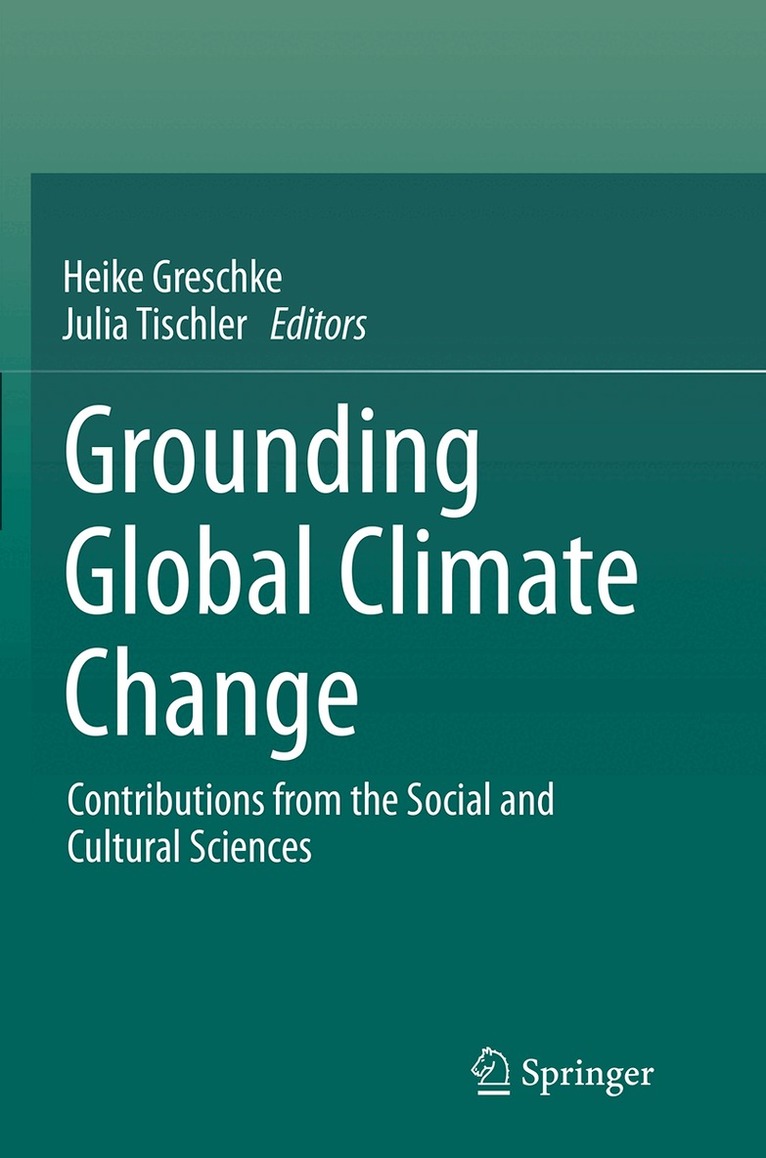
    Grounding Global Climate Change

    Contributions from the Social and Cultural Sciences

    AvHeike Greschke,Julia Tischler

    Häftad, Engelska, 2016

    1 085 kr

    Beställningsvara. Skickas inom 10-15 vardagar. Fri frakt över 249 kr.

    Beskrivning

    This book traces the evolution of climate change research, which, long dominated by the natural sciences, now sees greater involvement with disciplines studying the socio-cultural implications of change. In their introduction, the editors chart the changing role of the social and cultural sciences, delineating three strands of research: socio-critical approaches which connect climate change to a call for cultural or systemic change; a mitigation and adaption strand which takes the physical reality of climate change as a starting point, and focuses on the concerns of climate change-affected communities and their participation in political action; and finally, culture-sensitive research which places emphasis on indigenous peoples, who contribute the least to the causes of climate change, who are affected most by its consequences, and who have the least leverage to influence a solution. Part I of the book explores interdisciplinarity, climate research and the role of the social sciences, including the concept of ecological novelty, an assessment of progress since the first Rio climate conference, and a 'global village' case study from Portugal. Part II surveys ethnographic perspectives in the search for social facts of global climate change, including climate and mobility in the West African Sahel, and human-non human interactions and climate change in the Canadian Subarctic. Part III shows how collaborative and comparative ethnographies can spin “global webs of local knowledge,” describing case studies of changing seasonality in Labrador and of rising water levels in the Chesapeake Bay. These perspectives are subjected to often-amusing, always incisive analysis in a concluding chapter entitled "You Ain’t Seen Nothing Yet: a death-defying look at the future of the climate debate." The contributors engage critically with the research subject of ‘climate change’ itself, reflecting on their own practices of knowledge production and epistemologicalpresuppositions. Finely detailed and sympathetic to a broad range of viewpoints, the book sets out a profile for the social sciences and humanities in the climate change field by systematically exploring methodological and theoretical challenges and approaches.

    Produktinformation

    • Utgivningsdatum:2016-09-10
    • Mått:155 x 235 x 11 mm
    • Vikt:300 g
    • Format:Häftad
    • Språk:Engelska
    • Antal sidor:181
    • Förlag:Springer
    • ISBN:9789402403718

    Utforska kategorier

    • Samhälle och kultur inom Samhälle och politik
    • Miljövetenskap och miljöpolitik inom Naturvetenskap och teknik
    • Meteorologi och klimatologi inom Naturvetenskap och teknik

    Recensioner i media

    "Grounding Global Climate Change considers the roles that the disciplines of anthropology, sociology, history, and social geography can play in studying and shaping an understanding of climate change. ... The strongly theoretical focus of the work will make it most valuable to those with strong backgrounds in the social sciences and an interest in interdisciplinary research. Summing Up: Recommended. Graduate students and above." (J. L. Rhoades, Choice, Vol. 52 (9), May, 2015)

    Innehållsförteckning

    • Introduction: grounding global climate change.- Part I: Interdisciplinarity, climate research and the role of the social sciences.- Ecological novelty: towards an interdisciplinary understanding of ecological change in the Anthropocene.- Predicting the past? Integrating climate and culture during historical famines.- Anthropology in the Anthropocene: sustainable development, climate change and interdisciplinary research.- Part II: Searching for the social facts of global climate change: ethnographic perspectives.- Climate and mobility in the West African Sahel: conceptualising the local dimensions of the environment and migration nexus.- Animal belongings: human-non human interactions and climate change in the Canadian Subarctic.- Part III: Spinning global webs of local knowledges: collaborative and comparative ethnographies.- The social facts of climate change: an ethnographic approach.- Comparing climate worlds: theorising across ethnographic fields.- Towards imagining the big picture and the finer details: exploring global applications of a local and scientific knowledge exchange methodology.- Part IV: Concluding statement.- You ain’t seen nothing yet: a death-defying look at the future of the climate debate.