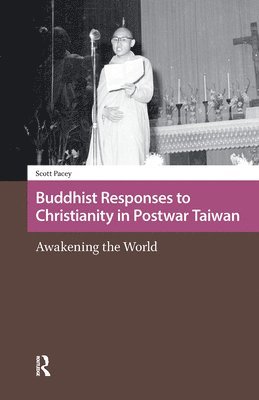
This book will be of interest to historians of Buddhism, Chinese religion and Taiwanese society, and to those with an interest in interfaith dialogue more generally.
Dr Scott Pacey is an Assistant Professor in the School of Sociology and Social Policy at the University of Nottingham.
Recensioner i media
"Pacey’s study fulfills his commitment to shed light on areas such as the scope of Buddhist-Christian engagement in postwar Taiwan, its political relevance and impact on Buddhist identity formation, and the ways in which Buddhism adapted itself to the peculiar kind of modernity endorsed by the Guómínd.ng. [...] Both well researched and nicely edited, this book is warmly recommended to scholars and students of East Asian religions and modern Buddhism." - Ugo Dessì, Religious Studies Review, Vol. 48, No. 2, June 202
Innehållsförteckning
Acknowledgements A note on romanization and translations Preface Introduction Chinese Buddhism and identity The three teachings Buddhism and Christianity in China New intellectual and political responses Enter the KMT Modernity, and "KMT modernity" Taixu Overview of the study Chapter 1. Buddhism and Patriotism Taiwan's political context Buddhism and KMT values Awakening the world Conclusion Chapter 2. Buddhism and Chinese Culture Cultural renaissance From Moses to Marx "Slave society" East of Eden The genesis of a new approach The study of Buddhism Conclusion Chapter 3. Buddhism and Modernity Pointing at the moon Open letters to Du The science of Sakyamuni God and Gotama Yinshun's sources Conclusion Chapter 4. Decline and Revitalization Perceiving the decline History as polemic From the temple to the ivory tower Conclusion Chapter 5. Sermons among mountains Dharma Drum Mountain Tzu Chi Buddha-Light Mountain Lingjiu Shan and Zhongtai Chansi Conclusion Conclusion Religious inter-connectivity Interfaith competition in Taiwan after 1949 KMT modernity Interfaith competition and identity Summary List of Chinese characters Bibliography Index