• Fri frakt över 249 kr
  • •
  • Snabba leveranser
  • •
  • Billiga böcker
Kundservice

Du är på sajten för privatpersoner.

Företag, bibliotek eller offentlig verksamhet?

Du handlar på classic.bokus.com, där alla dina funktioner finns intakta.
Till classic.bokus.com
Bokus logotyp. Gå till startsidan.
  • Erbjudanden
  • Nyheter
  • Student
  • Topplistor
  • Barn & ungdom
  • Bokus Play
  • E-böcker
  • Pocketböcker
  • Spel & pussel

10% studentrabatt med kod TERM26

Sidfot

Mina sidor

    Hjälp

    • Kundservice
    • Vanliga frågor och svar
    • Frakt och leverans
    • Retur vid ångerrätt
    • Reklamera vara
    • Betalning
    • Köpvillkor
    • Allmänna villkor
    • Information om webbplatsens tillgänglighet

    Om Bokus

    • Om oss
    • Pressrum
    • För studenter
    • För företag
    • För bibliotek och offentlig verksamhet
    • För leverantörer
    • Hållbarhet

    Populärt

    • Aktuella erbjudanden
    • Presentkort
    • Studentlitteratur
    • Nya böcker
    • Topplistor
    • Signerade böcker
    • Engelska böcker

    Inspiration

    • Boktips
    • BookTok
    • Populära bokserier
    • Barnbokskaraktärer
    • Populära författare
    Logotyp för Bokus
    Följ oss på Facebook (extern länk)Följ oss på Instagram (extern länk)Följ oss på YouTube (extern länk)Följ oss på TikTok (extern länk)
    bokus @ CookiesAnpassa cookiesIntegritetspolicyKöpvillkor
    Till Citymail hemsida (extern länk)Till Budbee hemsida (extern länk)Till Postnord hemsida (extern länk)Till Schenker hemsida (extern länk)Till Early Bird hemsida (extern länk)Till Walleys hemsida (extern länk)
    1. Naturvetenskap och teknik
    2. Matematik och naturvetenskap
    3. Matematik
    4. Tillämpad matematik

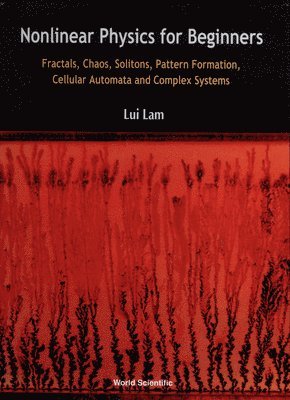
    NONLINEAR PHYSICS FOR BEGINNERS: FRACTALS, CHAOS, SOLITONS, PATTERN FORMATION, CELLULAR AUTOMATA AND COMPLEX SYSTEMS

    AvLAM LUI,Lui Lam

    Häftad, Engelska, 1998

    469 kr

    Tillfälligt slut

    Fler format och utgåvor

    Inbunden

    Tillf. slut

    Beskrivning

    Almost all real systems are nonlinear. For a nonlinear system the superposition principle breaks down: The system's response is not proportional to the stimulus it receives; the whole is more than the sum of its parts. The three parts of this book contains the basics of nonlinear science, with applications in physics. Part I contains an overview of fractals, chaos, solitons, pattern formation, cellular automata and complex systems. In Part II, 14 reviews and essays by pioneers, as well as 10 research articles are reprinted. Part III collects 17 students projects, with computer algorithms for simulation models included.The book can be used for self-study, as a textbook for a one-semester course, or as supplement to other courses in linear or nonlinear systems. The reader should have some knowledge in introductory college physics. No mathematics beyond calculus and no computer literacy are assumed.

    Produktinformation

    • Utgivningsdatum:1998-04-11
    • Mått:207 x 279 x 21 mm
    • Vikt:988 g
    • Format:Häftad
    • Språk:Engelska
    • Antal sidor:348
    • Förlag:World Scientific Publishing Co Pte Ltd
    • ISBN:9789810201418

    Utforska kategorier

    • Tillämpad matematik inom Naturvetenskap och teknik
    • Fysik inom Naturvetenskap och teknik

    Mer om författaren

    Lui Lam, San Jose State Univ.

    Innehållsförteckning

    • Introduction: Overview of Nonlinear Physics; Fractals; Chaos; Solitons; Pattern Formation; Cellular Automata and Complex Systems; Sample Projects: A brief description of 17 projects in Nonlinear Physics carried out by senior and graduate students at San Jose State Univ., with references and computer programs; Reprints: Fractal Growth Processes (L M Sander); Multifractal Phenomena in Physuics and Chemistry (H E Stanley & P Meakin); The Devil's Staircase (P Bak); Fractal Geometry in Crumpled Paper Balls (M A F Gromes); Fractal of Large Scale Structure in the Universe (L Z Fang); Chaos (J P Crutchfield et al.); Chaos, Strange Attractors, and Fractal Basin Boundaries in Nonlinear Dynamics (C Grebogi et al.); How Random is a Coin Toss? (J Ford); Chaos in a Dripping Faucet (H N Nunez Yepez et al.); Dendrites, Viscous Fingers, and the Theory of Pattern Formation (J A Langer); Tip Splitting Without Interfacial Tension and Denadritic Growth Patters Arising from Molecular Anisotropy (J Nittmann & H E Stanley); Oblique Roll Instability in an Electroconvective Anisotropic Fluid (R Ribotta et al.); Chemical Waves (J Ross et al.); Soliton Propagation in Liquid Crystals (Lin Leo et al.); Possible Relevance of Soliton Solutions to Superconductivity (T D Lee); Cellular Automata as Models of Complexity (S Wolfram); Quantum Chaos (M C Gutzwiller); Catastrophes and Self-Organized Criticality (P Bak); More is Different (P W Anderson).