
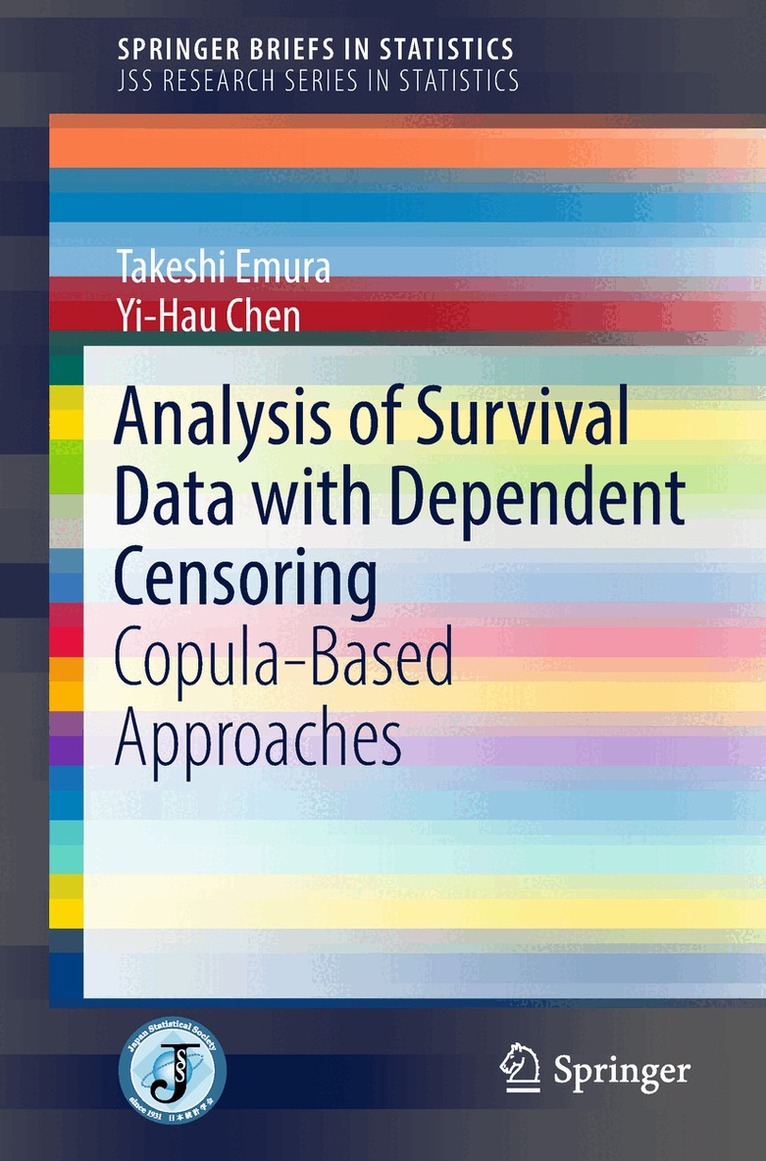
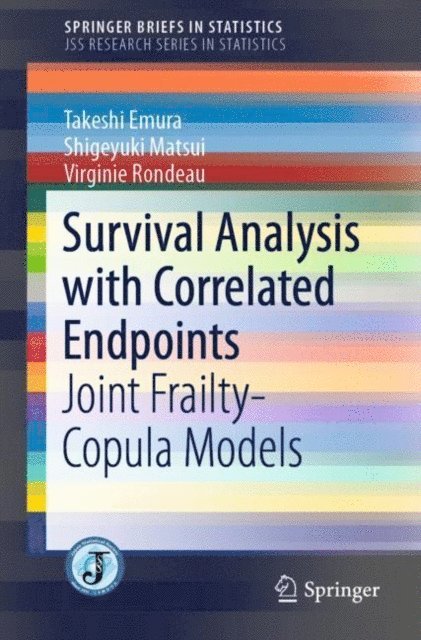
Survival Analysis with Correlated Endpoints
Joint Frailty-Copula Models
666 kr
Beställningsvara. Skickas inom 10-15 vardagar. Fri frakt över 249 kr.
Beskrivning
This book introduces readers to advanced statistical methods for analyzing survival data involving correlated endpoints. In particular, it describes statistical methods for applying Cox regression to two correlated endpoints by accounting for dependence between the endpoints with the aid of copulas. The practical advantages of employing copula-based models in medical research are explained on the basis of case studies. In addition, the book focuses on clustered survival data, especially data arising from meta-analysis and multicenter analysis. Consequently, the statistical approaches presented here employ a frailty term for heterogeneity modeling. This brings the joint frailty-copula model, which incorporates a frailty term and a copula, into a statistical model. The book also discusses advanced techniques for dealing with high-dimensional gene expressions and developing personalized dynamic prediction tools under the joint frailty-copula model. To help readers apply the statistical methods to real-world data, the book provides case studies using the authors’ original R software package (freely available in CRAN). The emphasis is on clinical survival data, involving time-to-tumor progression and overall survival, collected on cancer patients. Hence, the book offers an essential reference guide for medical statisticians and provides researchers with advanced, innovative statistical tools. The book also provides a concise introduction to basic multivariate survival models.
Produktinformation
Utforska kategorier
Mer om författaren
Recensioner i media
Innehållsförteckning
Hoppa över listan
Mer från samma författare
Survival Analysis with Correlated Endpoints
Virginie Rondeau, Shigeyuki Matsui, Takeshi Emura
E-bok
2019868 kr
Copula-Based Markov Models for Time Series
Li-Hsien Sun, Xin-Wei Huang, Mohammed S. Alqawba, Jong-Min Kim, Takeshi Emura
Häftad, 2020
666 kr
Copula-Based Markov Models for Time Series
Takeshi Emura, Jong-Min Kim, Mohammed S. Alqawba, Xin-Wei Huang, Li-Hsien Sun
E-bok
2020877 kr
Hoppa över listan
Mer från samma serie
Del 12
Del 14
Del 9
Del 15
Statistical Approaches to Orofacial Pain and Temporomandibular Disorders Research
Daniele Manfredini, Rosa Arboretti, Luca Guarda Nardini, Eleonora Carrozzo, Luigi Salmaso
Häftad, 2014
573 kr
Statistical Analysis of Operational Risk Data
Giovanni De Luca, Danilo Carità, Francesco Martinelli
Häftad, 2020
557 kr
Regression Models for the Comparison of Measurement Methods
Heleno Bolfarine, Mário de Castro, Manuel Galea
Häftad, 2020
557 kr
Hoppa över listan
Du kanske också är intresserad av
Survival Analysis with Correlated Endpoints
Virginie Rondeau, Shigeyuki Matsui, Takeshi Emura
E-bok
2019868 kr
Frontiers of Biostatistical Methods and Applications in Clinical Oncology
Shigeyuki Matsui, John Crowley
Inbunden, 2017
1 252 kr
Copula-Based Markov Models for Time Series
Takeshi Emura, Jong-Min Kim, Mohammed S. Alqawba, Xin-Wei Huang, Li-Hsien Sun
E-bok
2020877 kr
Design and Analysis of Clinical Trials for Predictive Medicine
Shigeyuki Matsui, Marc Buyse, Richard Simon
Häftad, 2020
834 kr
Copula-Based Markov Models for Time Series
Li-Hsien Sun, Xin-Wei Huang, Mohammed S. Alqawba, Jong-Min Kim, Takeshi Emura
Häftad, 2020
666 kr
Frontiers of Biostatistical Methods and Applications in Clinical Oncology
John Crowley, Shigeyuki Matsui
E-bok
20171 575 kr