• Fri frakt över 249 kr
  • •
  • Snabba leveranser
  • •
  • Billiga böcker
Kundservice

Du är på sajten för privatpersoner.

Företag, bibliotek eller offentlig verksamhet?

Du handlar på classic.bokus.com, där alla dina funktioner finns intakta.
Till classic.bokus.com
Bokus logotyp. Gå till startsidan.
  • Erbjudanden
  • Nyheter
  • Student
  • Topplistor
  • Barn & ungdom
  • Bokus Play
  • E-böcker
  • Pocketböcker
  • Spel & pussel

Må bättre, för mindre! Upp till 50% rabatt på hälsoböcker

Sidfot

Mina sidor

    Hjälp

    • Kundservice
    • Vanliga frågor och svar
    • Frakt och leverans
    • Retur vid ångerrätt
    • Reklamera vara
    • Betalning
    • Köpvillkor
    • Allmänna villkor
    • Information om webbplatsens tillgänglighet

    Om Bokus

    • Om oss
    • Pressrum
    • För studenter
    • För företag
    • För bibliotek och offentlig verksamhet
    • För leverantörer
    • Hållbarhet

    Populärt

    • Aktuella erbjudanden
    • Presentkort
    • Studentlitteratur
    • Nya böcker
    • Topplistor
    • Signerade böcker
    • Engelska böcker

    Inspiration

    • Boktips
    • BookTok
    • Populära bokserier
    • Barnbokskaraktärer
    • Populära författare
    Logotyp för Bokus
    Följ oss på Facebook (extern länk)Följ oss på Instagram (extern länk)Följ oss på YouTube (extern länk)Följ oss på TikTok (extern länk)
    bokus @ CookiesAnpassa cookiesIntegritetspolicyKöpvillkor
    Till Citymail hemsida (extern länk)Till Budbee hemsida (extern länk)Till Postnord hemsida (extern länk)Till Schenker hemsida (extern länk)Till Early Bird hemsida (extern länk)Till Walleys hemsida (extern länk)
    1. Djur och Natur
    2. Naturböcker
    3. Växtböcker

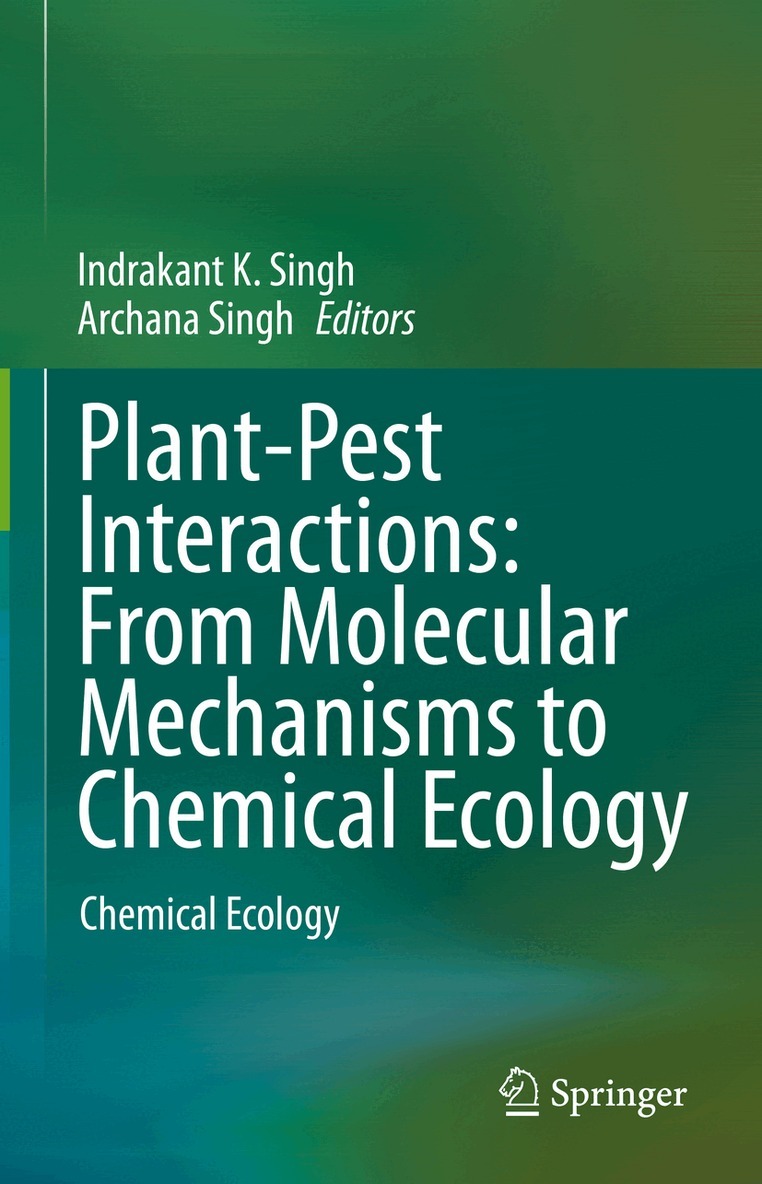
    Plant-Pest Interactions: From Molecular Mechanisms to Chemical Ecology

    Chemical Ecology

    AvIndrakant K. Singh,Archana Singh

    Inbunden, Engelska, 2021

    2 165 kr

    Beställningsvara. Skickas inom 10-15 vardagar. Fri frakt över 249 kr.

    Beskrivning

    As food producers, plants are constantly under attack by insects. Over the course of evolution, plants have not only developed a sophisticated defense apparatus but have also refined biochemical defense mechanisms to protect themselves, thereby maintaining the ecological balance. Plant-pest interactions induce an elaborate array of reactions involving the release of volatile compounds, effector and signaling molecules, trans-membrane proteins, and a variety of enzymes and hormones. This book offers a comprehensive guide to the strategies that plants employ against insects and other pests to ensure their continued survival. Addressing an important gap in the literature, it shares the latest findings in the field of plant–pest interactions for a broad audience. Providing an overview of the current state of knowledge on plant-pest interactions and their role in the genetic improvement of crops, it offers an essential guide for researchers and professionals in the fields of agriculture, plant pathology, entomology, cell biology, molecular biology and genetics.

    Produktinformation

    • Utgivningsdatum:2021-01-19
    • Mått:155 x 235 x undefined mm
    • Vikt:887 g
    • Format:Inbunden
    • Språk:Engelska
    • Antal sidor:464
    • Förlag:Springer Verlag, Singapore
    • ISBN:9789811524660

    Utforska kategorier

    • Växtböcker inom Djur och Natur
    • Biokemi inom Naturvetenskap och teknik
    • Botanik inom Naturvetenskap och teknik

    Mer om författaren

    Dr. Indrakant K. Singh received his Ph.D. in Zoology from the University of Delhi (DU) and is currently working as an Assistant Professor at the Department of Zoology, Deshbandhu College, University of Delhi. He has received a Young Scientist Award from the SERB, Ministry of Science and Technology, Govt. of India; a Raman Post-Doctoral Fellowship from the MHRD, Govt. of India; a Max Planck Fellowship from the Max Planck Society, Germany, etc. Dr. Indrakant has published his research in prominent peer-reviewed journals such as JXB (Oxford), Scientific Reports, IJOBioMAc etc. His research interests include the molecular basis of plant-insect interactions and human health. Dr. Archana Singh, Assistant Professor, Department of Botany, Hans Raj College, University of Delhi, IndiaDr. Archana Singh obtained her Ph.D. in PMB from the NIPGR, Delhi, India and is currently working as an Assistant Professor at the Department of Botany, Hans Raj College, University of Delhi. She has received a Young Scientist Award and Early Career Research Award from the SERB, Ministry of Science and Technology, Govt. of India; a Raman Post-Doctoral Fellowship from the MHRD, Govt. of India; and an EMBO fellowship from EMBO, Heidelberg, Germany. She has published her research in prominent peer-reviewed journals. Over the years, she has expanded her research interests from PMB to genomics and proteomics.

    Innehållsförteckning

    • 1. Role of Herbivore-Associated Modulator Patterns (HAMPs) in Modulating Plant Defences.- 2. Transcriptomics studies revealing enigma of Insect-Plant interaction.- 3. Plant-Insect Interaction: A Proteomic approach in Defense Mechanism.- 4. Role of miRNA in plant defense against insects.- 5. Role of MAPKs during plant insect interaction.- 6. Thioredoxins as molecular players in plants, pests and pathogens.- 7. Plant volatiles and their role in insect olfaction.- 8. Direct and indirect defense against Insects.- 9. Signalling during Insect-Plant interaction.- 10. Role of Phytohormones in Plant defense against Insects: signalling and crosstalk.- 11. Plant proteinase inhibitor and protease Interactionduring Insect-Plant communication.- 12. Natural insecticidal proteins and their potential in future IPM.- 13. Deciphering the role of phytoanticipins, phytoalexins, and polyphenols in plant-insect defense.- 14. Microbial influence on plant-insect interaction.- 15. Microbe-plant insect Interactions: A Comparative dissection of Interactome.- 16. Simplified perspective of complex Insect-plant interactions.- 17. Molecular, biochemical aspect of Insect-Plant Interaction: A perspective for pest management.- 18. Molecular, biochemical aspect of Insect-Plant Interaction: A perspective for pest management