• Fri frakt över 249 kr
  • •
  • Snabba leveranser
  • •
  • Billiga böcker
Kundservice

Du är på sajten för privatpersoner.

Företag, bibliotek eller offentlig verksamhet?

Du handlar på classic.bokus.com, där alla dina funktioner finns intakta.
Till classic.bokus.com
Bokus logotyp. Gå till startsidan.
  • Erbjudanden
  • Student
  • Topplistor
  • Barn & ungdom
  • Bokus Play
  • E-böcker
  • Ljudböcker
  • Pocketböcker
  • Spel och pussel

5% studentrabatt – använd koden KURSBOK27 →

Sidfot

Mina sidor

    Hjälp

    • Kundservice
    • Vanliga frågor och svar
    • Frakt och leverans
    • Retur vid ångerrätt
    • Reklamera vara
    • Betalning
    • Köpvillkor
    • Allmänna villkor
    • Information om webbplatsens tillgänglighet

    Om Bokus

    • Om oss
    • Pressrum
    • För studenter
    • För företag
    • För bibliotek och offentlig verksamhet
    • För leverantörer
    • Hållbarhet

    Populärt

    • Aktuella erbjudanden
    • Presentkort
    • Studentlitteratur
    • Nya böcker
    • Topplistor
    • Signerade böcker
    • Engelska böcker

    Inspiration

    • Boktips
    • BookTok
    • Barnbokskaraktärer
    • Populära författare
    Logotyp för Bokus
    Följ oss på Facebook (extern länk)Följ oss på Instagram (extern länk)Följ oss på YouTube (extern länk)Följ oss på TikTok (extern länk)
    bokus @ CookiesAnpassa cookiesIntegritetspolicyKöpvillkor
    Till Citymail hemsida (extern länk)Till Budbee hemsida (extern länk)Till Postnord hemsida (extern länk)Till Schenker hemsida (extern länk)Till Early Bird hemsida (extern länk)Till Walleys hemsida (extern länk)
    1. Samhälle och politik
    2. Samhälle och kultur
    3. Kultur och medier
    4. Referensverk och tvärvetenskap

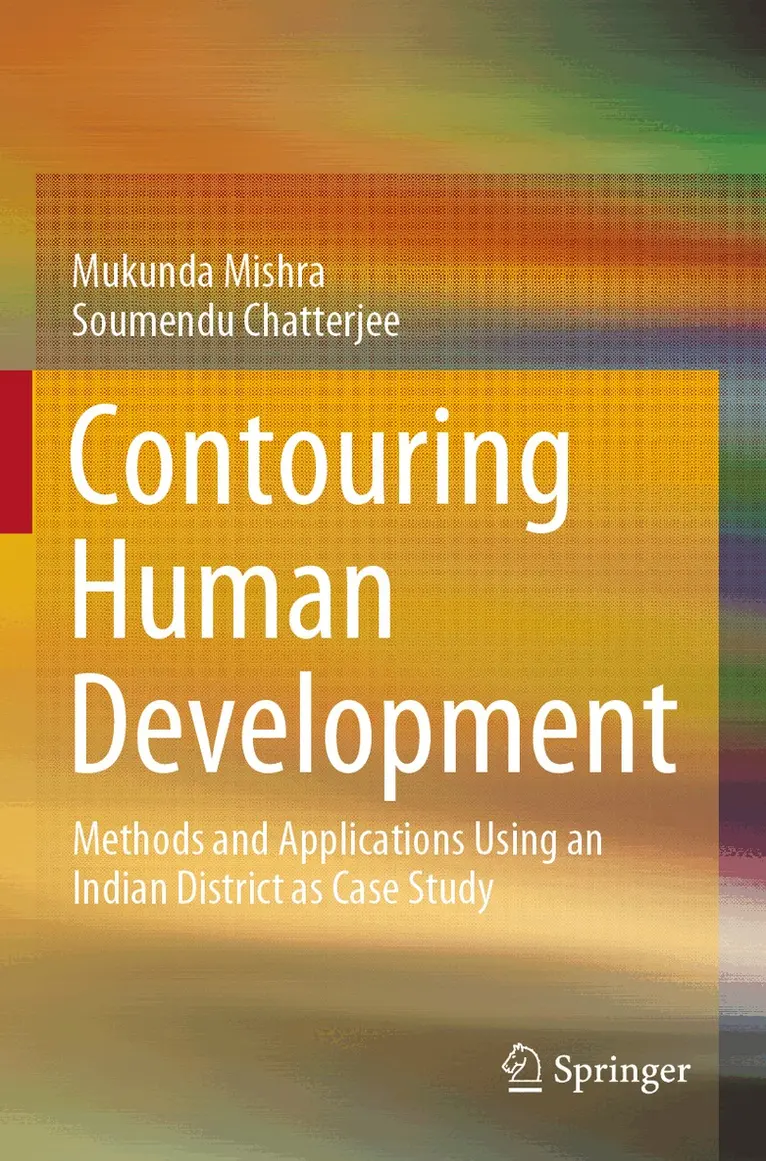
    Contouring Human Development

    Methods and Applications Using an Indian District as Case Study

    AvMukunda Mishra,Soumendu Chatterjee

    Häftad, Engelska, 2021

    1 078 kr

    Beställningsvara. Skickas inom 10-15 vardagar. Fri frakt över 249 kr.

    Fler format och utgåvor

    Inbunden

    1 078 kr

    Beskrivning

    This book acquaints readers with a range of techniques to help them effectively identify, record, map, analyze and report on patterns in various dimensions of human development (HD) with spatial scales down to the village level. It is impossible to capture HD at the local and global scale with only a single index, because differences in HD at the international scale are caused by ‘general’ factors, whereas local-scale differences are influenced by ‘specific’ factors. This book offers a variety of methods for scientifically mapping HD at any spatial scale. It covers how to rationally select variables; how to test the models; how to validate the results, and how to analyze them. For this purpose, it employs a case study on an Indian district. The socio-economic factors regulating the patterns of HD are now more complex than they were only a few decades ago, making it essential to incorporate newer models in order to successfully ‘replicate’ the real-world situation. Accordingly, the book offers essential methodological tools & techniques for mapping HD. It sheds new light on a handful of statistical multivariate analysis and machine learning algorithms that are rarely used in the social sciences when dealing with HD, yet have sound mathematical and statistical bases. These techniques can be successfully used for predictive analysis in the earth & natural sciences, decision sciences and management disciplines, and are equally effective in terms of capturing, predicting and projecting the composite HD ‘landscape.’ This book will especially benefit two groups of readers: firstly, HD practitioners who want to find out ‘why some areas are doing better than others’ by exploring the complex interactions of spatially linked variables with different HD parameters. And secondly, practitioners in other branches of the social sciences who are not concerned with HD but are looking for ‘hands-on training’ with techniques they can apply in their respectivefield of spatial investigations.

    Produktinformation

    • Utgivningsdatum:2021-05-12
    • Mått:155 x 235 x 22 mm
    • Vikt:593 g
    • Format:Häftad
    • Språk:Engelska
    • Antal sidor:358
    • Upplaga:21001
    • Förlag:Springer Verlag, Singapore
    • ISBN:9789811540851

    Utforska kategorier

    • Referensverk och tvärvetenskap inom Samhälle och politik
    • Internationell ekonomi inom Ekonomi och Ledarskap
    • Ekonomisk politik inom Ekonomi och Ledarskap

    Mer om författaren

    Mukunda Mishra is an Assistant Professor, Department of Geography, at Dr. Meghnad Saha College in West Bengal, India. The college is affiliated to the University of Gour Banga. Dr. Mishra completed his postgraduate studies in Geography and Environmental Management at Vidyasagar University (receiving top rank in both the B.Sc. and M.Sc. panels of merit) and holds a Ph.D. in Geography from the same University. He was selected for the prestigious National Merit Scholarship by the Ministry of Human Resource Development, Government of India. His research chiefly focuses on analyzing unequal human development, and on creating multi-criteria predictive models. He has more than ten years of hands-on experience in dealing with development issues at the ground level in various districts of eastern India. Soumendu Chatterjee is a Professor and Head of the Department of Geography at Presidency University in Kolkata, India. He has been teaching Geographical Science at the undergraduate and graduate levels for more than twenty years. His primary research interest is in creating scientific models for predicting complex physical and human processes on the Earth’s surface. He has more than fifty publications in national and international journals of repute to his credit, and has headed several research projects funded by the University Grants Commission (of India), Department of Science & Technology (GoI), Indian Council of Social Science Research (ICSSR) and other respected agencies in India and abroad.

    Innehållsförteckning

    • Chapter 1. Does geography matter in human development?.- Chapter 2. On contouring human development.- Chapter 3. Briefing the area for case study.- Chapter 4. Mapping the components of human development.- Chapter 5. Mapping economic inequality.- Chapter 6. Drawing the contours of educational attainment.- Chapter 7. Mapping public health scenario.- Chapter 8. Strategy mapping with predictive modelers.