• Fri frakt över 249 kr
  • •
  • Snabba leveranser
  • •
  • Billiga böcker
Kundservice

Du är på sajten för privatpersoner.

Företag, bibliotek eller offentlig verksamhet?

Du handlar på classic.bokus.com, där alla dina funktioner finns intakta.
Till classic.bokus.com
Bokus logotyp. Gå till startsidan.
  • Erbjudanden
  • Nyheter
  • Student
  • Topplistor
  • Barn & ungdom
  • Bokus Play
  • E-böcker
  • Pocketböcker
  • Spel & pussel

10% rabatt på allt med kod: NYSTART10 →

Sidfot

Mina sidor

    Hjälp

    • Kundservice
    • Vanliga frågor och svar
    • Frakt och leverans
    • Retur vid ångerrätt
    • Reklamera vara
    • Betalning
    • Köpvillkor
    • Allmänna villkor
    • Information om webbplatsens tillgänglighet

    Om Bokus

    • Om oss
    • Pressrum
    • För studenter
    • För företag
    • För bibliotek och offentlig verksamhet
    • För leverantörer
    • Hållbarhet

    Populärt

    • Aktuella erbjudanden
    • Presentkort
    • Studentlitteratur
    • Nya böcker
    • Topplistor
    • Signerade böcker
    • Engelska böcker

    Inspiration

    • Boktips
    • BookTok
    • Populära bokserier
    • Barnbokskaraktärer
    • Populära författare
    Logotyp för Bokus
    Följ oss på Facebook (extern länk)Följ oss på Instagram (extern länk)Följ oss på YouTube (extern länk)Följ oss på TikTok (extern länk)
    bokus @ CookiesAnpassa cookiesIntegritetspolicyKöpvillkor
    Till Citymail hemsida (extern länk)Till Budbee hemsida (extern länk)Till Postnord hemsida (extern länk)Till Schenker hemsida (extern länk)Till Early Bird hemsida (extern länk)Till Walleys hemsida (extern länk)
    1. Ekonomi och Ledarskap
    2. Nationalekonomi
    3. Ekonomisk politik

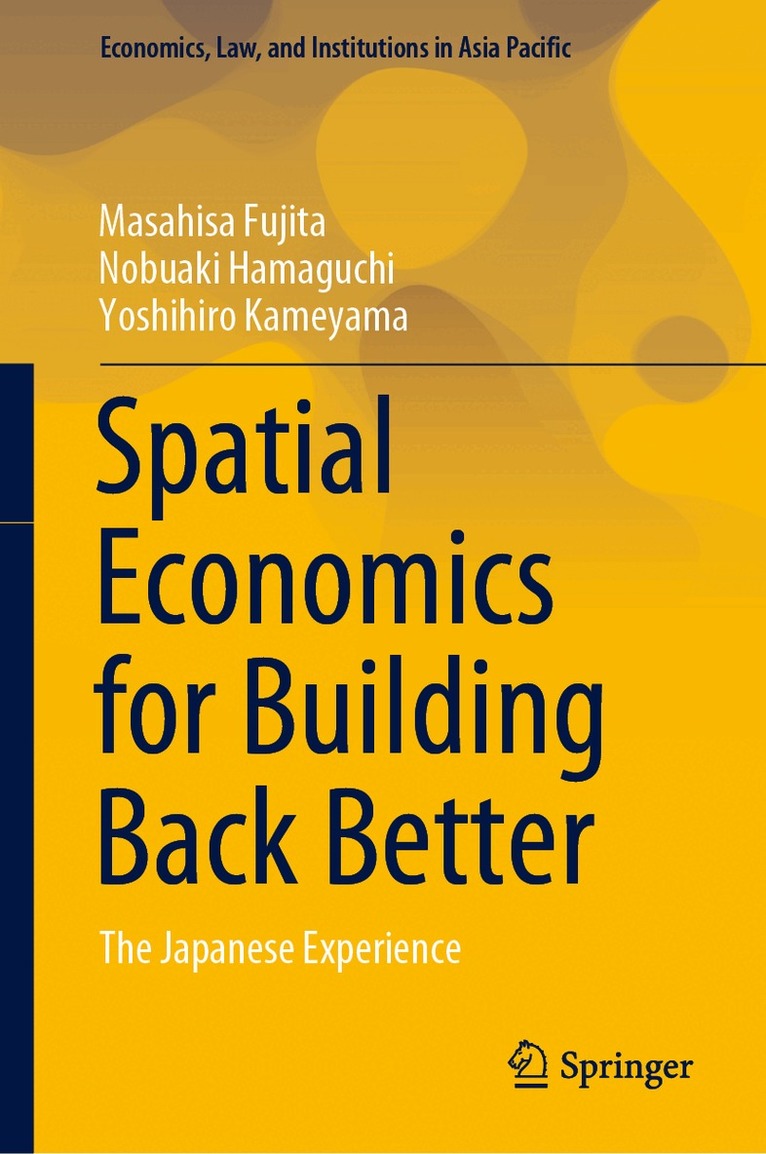
    Spatial Economics for Building Back Better

    The Japanese Experience

    AvMasahisa Fujita,Nobuaki Hamaguchi

    Inbunden, Engelska, 2021

    Del i serien Economics, Law, and Institutions in Asia Pacific

    1 194 kr

    Beställningsvara. Skickas inom 10-15 vardagar. Fri frakt över 249 kr.

    Fler format och utgåvor

    Häftad

    1 194 kr

    Beskrivning

    The central theme of this book is national land and infrastructure design in the age of the declining population and the recovery from the Great East Japan Earthquake in the affected regions in Japan. Based on the theory of spatial economics and evidence from Japanese history, the authors show that the growing economy with a population increase develops into a multi-cored and complex structure. In the population decline phase, however, such construction will be destabilized because of agglomeration economies in the central core. Then, a catastrophic shock that strikes may provoke the decline of the lower-rank-size provincial cities and their eventual disappearance if they compete  only in lower prices of staple products. Not only is the practice bad for the residents; it also leads to lower national welfare resulting from the loss of diversity and overcrowded big cities. The authors argue that small local towns can recover and will be sustained if they will endeavor in innovative production by making good use of local natural resources and social capital. Under the ongoing declining population in Japan, an undesirable concentration in Tokyo will proceed further with increasing social cost and risk. The recent novel coronavirus pandemic has highlighted that concern.

    Produktinformation

    • Utgivningsdatum:2021-10-18
    • Mått:155 x 235 x 25 mm
    • Vikt:694 g
    • Format:Inbunden
    • Språk:Engelska
    • Serie:Economics, Law, and Institutions in Asia Pacific
    • Antal sidor:329
    • Upplaga:21001
    • Förlag:Springer Verlag, Singapore
    • ISBN:9789811649509
    • Originaltitel:復興の空間経済学 人口減少時代の地域再生

    Utforska kategorier

    • Ekonomisk politik inom Ekonomi och Ledarskap
    • Sociologi inom Samhälle och politik
    • Offentlig förvaltning inom Samhälle och politik

    Mer om författaren

    Masahisa Fujita is a member of the Japan Academy and a Fellow of the Econometric Society. He has been a major contributor to spatial economic theory during his 20-year tenure at the University of Pennsylvania and more recently at Kyoto University and Konan University. Professor Fujita is the author or co-author of four books: Spatial Development Planning (1978); Urban Economic Theory (1989, Cambridge University Press), which remains to this day the most authoritative graduate textbook on urban economics; The Spatial Economy (1999, co-authored with Paul Krugman and A.J. Venables), which defines the field of new economic geography; and Economics of Agglomeration (2013, co-authored with J.-F. Thisse). Nobuaki Hamaguchi is a professor at the Research Institute for Economics and Business Administration at Kobe University. He holds a Ph.D. degree in Regional Science from the University of Pennsylvania. His researchinterests are in regional economic/industrial policies in Japan, global supply chain resilience, Latin American economy, and economic integration in the Asia-Pacific. From 2011 to date, he has been a program director and a faculty fellow of the Research Institute of Economy, Trade, and Industry (RIETI), where he organizes research projects on Japan’s regional economies. He is a member of the Regional Economic and Industrial Policy Committee of the Ministry of Economy, Trade and Industry.  Yoshihiro Kameyama is a professor at the Faculty of Economics, Saga University. He holds a Ph.D. degree in Economics from Kyoto University. His research interests are in regional economic/industrial policies in Japan, transportation infrastructure and industrial clusters, tourism, /transportation economies in East Asia, and consumer behavior and mode choices. Professor Kameyama was awarded the 27th Prize of the Japan Society of Logistics and Shipping Economics in 2018, and 2020 Best Paper Award of The Applied Regional Science Conference. From 2016 to date, he has been a visiting research professor at the Asian Growth Research Institute (AGI), where he works on a joint research project on tourism and /transportation economies in East Asia.

    Innehållsförteckning

    • Long-Term Transition of Population and National Land System.- Transformation Processes of National Land Systems and Reconstruction Policy from a Spatial Economics Perspective.- Process of Recovery from the Great East Japan Earthquake with Pictures and Data.- Population Decline and Creative Reconstruction in Disaster-Affected Areas.- Reconstruction Based on Natural Resources.- Supply Chain Resiliency.- Regeneration of Physical and Institutional Infrastructure for Local Community.- Local Community as a Device for Regional Innovation.- Building Back Better to Overcome the COVID- 19 Pandemic and the Great East Japan Earthquake.