• Fri frakt över 249 kr
  • •
  • Snabba leveranser
  • •
  • Billiga böcker
Kundservice

Du är på sajten för privatpersoner.

Företag, bibliotek eller offentlig verksamhet?

Du handlar på classic.bokus.com, där alla dina funktioner finns intakta.
Till classic.bokus.com
Bokus logotyp. Gå till startsidan.
  • Erbjudanden
  • Nyheter
  • Student
  • Topplistor
  • Barn & ungdom
  • Bokus Play
  • E-böcker
  • Pocketböcker
  • Spel & pussel

Må bättre, för mindre! Upp till 50% rabatt på hälsoböcker

Sidfot

Mina sidor

    Hjälp

    • Kundservice
    • Vanliga frågor och svar
    • Frakt och leverans
    • Retur vid ångerrätt
    • Reklamera vara
    • Betalning
    • Köpvillkor
    • Allmänna villkor
    • Information om webbplatsens tillgänglighet

    Om Bokus

    • Om oss
    • Pressrum
    • För studenter
    • För företag
    • För bibliotek och offentlig verksamhet
    • För leverantörer
    • Hållbarhet

    Populärt

    • Aktuella erbjudanden
    • Presentkort
    • Studentlitteratur
    • Nya böcker
    • Topplistor
    • Signerade böcker
    • Engelska böcker

    Inspiration

    • Boktips
    • BookTok
    • Populära bokserier
    • Barnbokskaraktärer
    • Populära författare
    Logotyp för Bokus
    Följ oss på Facebook (extern länk)Följ oss på Instagram (extern länk)Följ oss på YouTube (extern länk)Följ oss på TikTok (extern länk)
    bokus @ CookiesAnpassa cookiesIntegritetspolicyKöpvillkor
    Till Citymail hemsida (extern länk)Till Budbee hemsida (extern länk)Till Postnord hemsida (extern länk)Till Schenker hemsida (extern länk)Till Early Bird hemsida (extern länk)Till Walleys hemsida (extern länk)
    1. Ekonomi och Ledarskap
    2. Nationalekonomi
    3. Mikroekonomi

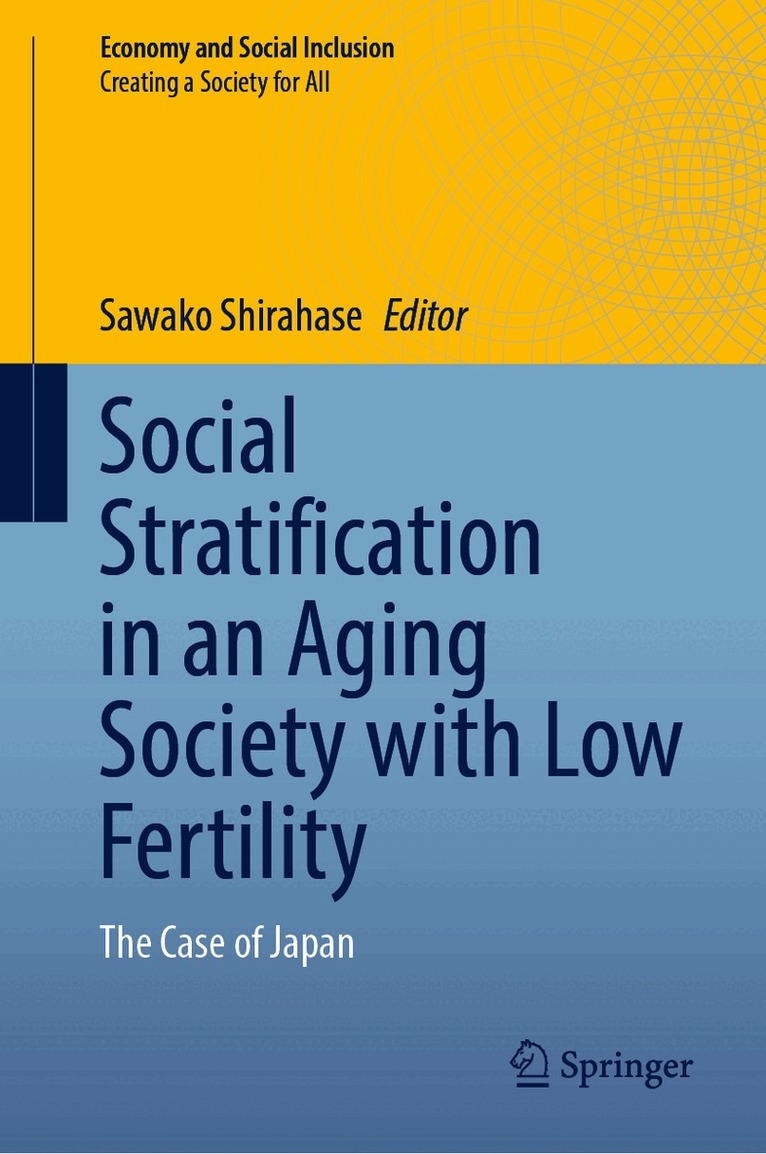
    Social Stratification in an Aging Society with Low Fertility

    The Case of Japan

    AvSawako Shirahase

    Inbunden, Engelska, 2022

    Del i serien Economy and Social Inclusion

    1 086 kr

    Beställningsvara. Skickas inom 10-15 vardagar. Fri frakt över 249 kr.

    Beskrivning

    This edited book empirically discusses stratification in contemporary Japanese society. It is unique for its examination of social inequality in relation to declining fertility and an aging population. Japan is the most aged society in the world: according to the Statistics Bureau of Japan, people who are aged 65 and above comprised 29.1% of the country’s total population in 2021. Meanwhile, the fertility rate has continuously declined since the mid-1970s. Japan experienced a dramatic change in its demographic structure in a short period of time. Such fast change could be a major factor that generated social stratification. In her industrialization, Japan was thought to share a pattern of social stratification similar to that of developed European and North American countries but with a low degree of socio-economic inequality and a high degree of homogeneity. There is no clear support for this description of Japan, although the country does share a pattern and degree of social stratification similar to that observed in Europe and North America. The social stratification theory has been developed in close relationship to the labor market; however, it is necessary to further examine the social stratification of very aged societies in which a substantial number of the population—namely, retired persons—no longer have any ties to the labor market. In this book, the contributors explore the pattern of social stratification at three life stages: young, middle-aged, and elderly. Included are discussions of various aspects of stratification such as education, work, wealth, marriage, family, gender, generation, and social attitudes.

    Produktinformation

    • Utgivningsdatum:2022-09-01
    • Mått:155 x 235 x 18 mm
    • Vikt:506 g
    • Format:Inbunden
    • Språk:Engelska
    • Serie:Economy and Social Inclusion
    • Antal sidor:214
    • Förlag:Springer Verlag, Singapore
    • ISBN:9789811936463

    Utforska kategorier

    • Mikroekonomi inom Ekonomi och Ledarskap
    • Sociologi inom Samhälle och politik
    • Sociala grupper och identitet inom Samhälle och politik

    Mer om författaren

    Sawako Shirahase is Professor of Sociology at the Graduate School of Humanities and Sociology, the University of Tokyo. She received her D.Phil. in sociology from the University of Oxford, conducted post-doctoral research at the East Asian Institute, Columbia University as a junior researcher, and held positions of Senior Research fellow at the National Institute of Population and Social Security Research, and Associate Professor of Sociology at Tsukuba University. She is currently a director of the UTokyo Center for Contemporary Japanese Studies. Dr. Shirahase’s research interests include comparative social stratification and demographic transformation, gender and generational relations, and family change and social security system. She is the author of Social Inequality in Japan (Routledge, 2014) and Demographic Change and Inequality in Japan (ed.) (Trans Pacific Press, 2011), and her recent publications are “Social Stratification Theory and PopulationAging Reconsidered,” (Social Science Japan Journal 24(2): 277–288, 2021) and The Structure of Social Stratification in the Late-stage of Life (in Japanese) (ed., with S. Arita and N. Sudo) (University of Tokyo Press, 2021).Dr. Shirahase is on the editorial board of International Sociology and Contemporary Japan, and on the advisory board of Social Politics. She currently serves as Vice President of the International Sociological Association and Vice President of the International Science Council. She was the principal investigator of the research project conducting the 2015 National Survey of Social Stratification and Social Mobility (SSM) Survey which has been conducted every 10 years since 1955.

    Innehållsförteckning

    • Chapter 1 Class Structure, Education, and Social Mobility in Post-war Japan.- Chapter 2 The changing marriage market and status homogamy.- Chapter 3 Relative Indices of Educational Attainment and Trend Analysis of Inequality of Educational Opportunity Using the 2015 SSM Survey Data.- Chapter 4 Long-Term Trends in Long-Term Employment in Japan.- Chapter 5 Intragenerational Mobility between Regular and Non-regular Employment Sectors in Japan: From the Viewpoint of the Theory of Mobility Regime.- Chapter 6 Gap in Attitudes toward Higher Education between Graduates and Non-graduates: Growing Educational Disparity in Younger Cohorts.- Chapter 7 Effects of Regional Inequality on Political Attitudes: Social Capital and Support for Redistribution and Free Competition.- Chapter 8 Explanation of Socioeconomic Inequality among the Male Elderly: An Approach Based on Estimated Income History.- Chapter 9 Another aspect of social inequality, wealth, in a super-aged society, Japan: Re-examining the conventional framework of social stratification.