• Fri frakt över 249 kr
  • •
  • Snabba leveranser
  • •
  • Billiga böcker
Kundservice

Du är på sajten för privatpersoner.

Företag, bibliotek eller offentlig verksamhet?

Du handlar på classic.bokus.com, där alla dina funktioner finns intakta.
Till classic.bokus.com
Bokus logotyp. Gå till startsidan.
  • Erbjudanden
  • Nyheter
  • Student
  • Topplistor
  • Barn & ungdom
  • Bokus Play
  • E-böcker
  • Pocketböcker
  • Spel & pussel

10% rabatt på allt med kod NYSTART10 →

Sidfot

Mina sidor

    Hjälp

    • Kundservice
    • Vanliga frågor och svar
    • Frakt och leverans
    • Retur vid ångerrätt
    • Reklamera vara
    • Betalning
    • Köpvillkor
    • Allmänna villkor
    • Information om webbplatsens tillgänglighet

    Om Bokus

    • Om oss
    • Pressrum
    • För studenter
    • För företag
    • För bibliotek och offentlig verksamhet
    • För leverantörer
    • Hållbarhet

    Populärt

    • Aktuella erbjudanden
    • Presentkort
    • Studentlitteratur
    • Nya böcker
    • Topplistor
    • Signerade böcker
    • Engelska böcker

    Inspiration

    • Boktips
    • BookTok
    • Populära bokserier
    • Barnbokskaraktärer
    • Populära författare
    Logotyp för Bokus
    Följ oss på Facebook (extern länk)Följ oss på Instagram (extern länk)Följ oss på YouTube (extern länk)Följ oss på TikTok (extern länk)
    bokus @ CookiesAnpassa cookiesIntegritetspolicyKöpvillkor
    Till Citymail hemsida (extern länk)Till Budbee hemsida (extern länk)Till Postnord hemsida (extern länk)Till Schenker hemsida (extern länk)Till Early Bird hemsida (extern länk)Till Walleys hemsida (extern länk)
    1. Naturvetenskap och teknik
    2. Geovetenskap
    3. Miljövetenskap och miljöpolitik

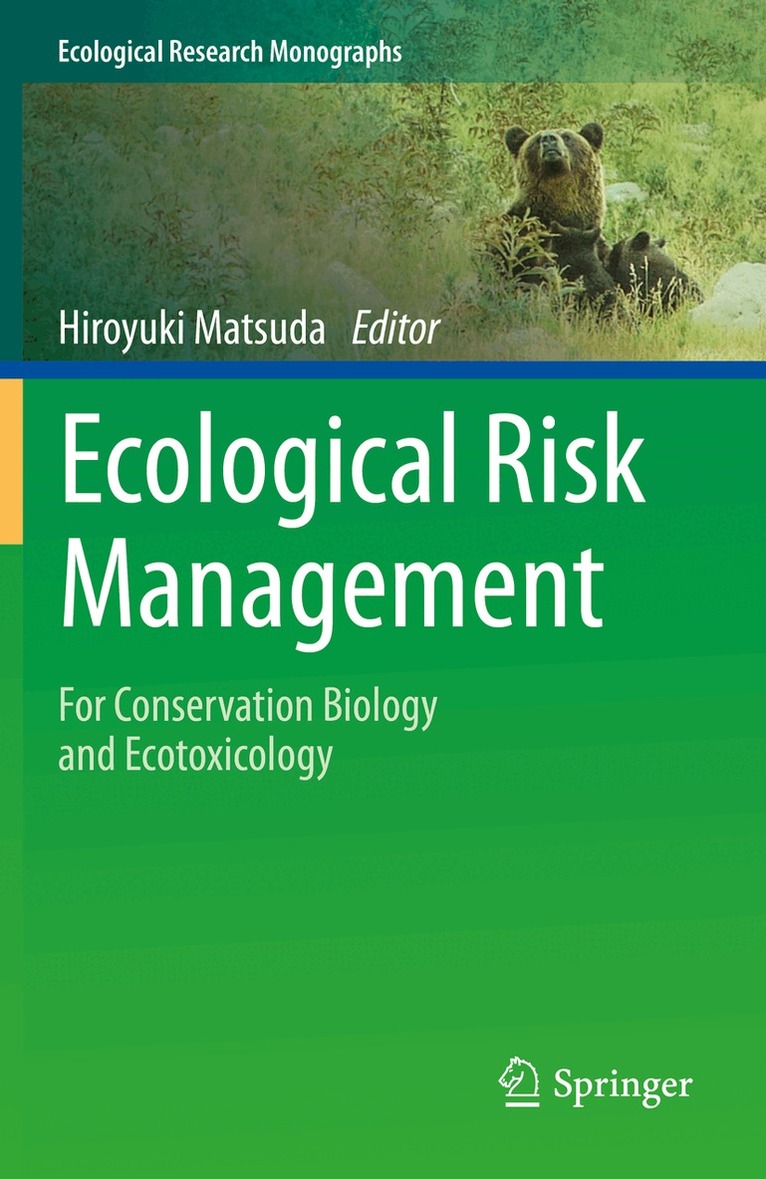
    Ecological Risk Management

    For Conservation Biology and Ecotoxicology

    AvHiroyuki Matsuda

    Häftad, Engelska, 2022

    Del i serien Ecological Research Monographs

    1 731 kr

    Beställningsvara. Skickas inom 10-15 vardagar. Fri frakt över 249 kr.

    Beskrivning

    This book introduces the theory and practice of ecological risk management. Using recent and live case studies in Japan, the book explains the use of basic mathematical techniques in extinction risk, adaptive population management, avian collision risk in wind farms, potential biological removal for marine mammals, and ecological risk assessment of heavy metals. The focus of this book is on case studies of nature conservation in Japan, including internationally renowned topics of Japanese fisheries, Shiretoko World Heritage, Fukushima Daiichi Nuclear Power Plant accident. It also covers the adaptive risk management of the new coronavirus disease.The book comprises four parts covering ecotoxicology, fisheries, wildlife management and conservation, and ecosystem-based management. It differs from other books in having its primary interest in human impacts on animals, plant, and ecosystems, while existing works in this area concentrate on the fate of toxic substances in the environments and their effects on humans. This book is unique in that it indicates various environmental issues that the theoretical ecology is potentially applicable without concentrating into any particular subject such as ecotoxicology or conservation biology. Primary readers are undergraduate/graduate students, staffs of environmental consultant companies and environmental NPOs, and journalists. Readers will find this book useful for its abundant information on case studies of ecological risk management and consensus building in Japan.

    Produktinformation

    • Utgivningsdatum:2022-05-08
    • Mått:155 x 235 x 17 mm
    • Vikt:546 g
    • Format:Häftad
    • Språk:Engelska
    • Serie:Ecological Research Monographs
    • Antal sidor:314
    • Förlag:Springer Verlag, Singapore
    • ISBN:9789813369368

    Utforska kategorier

    • Miljövetenskap och miljöpolitik inom Naturvetenskap och teknik
    • Biovetenskap inom Naturvetenskap och teknik
    • Zoologi inom Naturvetenskap och teknik

    Mer om författaren

    Hiroyuki Matsuda is expertized in mathematical ecology, fisheries management, and environmental risk management. He developed an extinction risk assessment method used in Japanese vascular plant Red List, proposed Japan's first adaptive wildlife management for Sika Deer Management Plan of Hokkaido Prefecture, and proposed an idea to expand the seasonal fishing-ban area in Shiretoko World Heritage site during a nomination process. He was a leader of Global COE Program "Global Eco-Risk Management from Asian Viewpoints", past President of the Ecological Society of Japan, past President of the East Asian Federation of Ecological Societies, former President of the Society for Population Ecology, past Chair of the Fisheries Policy Committee of the Japanese Society of Fisheries Sciences, Director of the Japan Society of Ocean Policy. He is the first Japanese Pew Fellow for Marine Conservation since 2007, co-representative of Yokohama Urban Design Center of the Sea, chairperson of Japanese Coordinating Committee for MAB (Man and the Biosphere), a Board Member of Earthwatch Japan.

    Innehållsförteckning

    • Chapter 1. Introduction: What is risk science?.- Chapter 2. How to determine the relief target for Minamata disease.- Chapter 3. Risk of radioactive contamination caused by the Accident of Fukushima Daiichi Nuclear Power Plant.- Chapter 4. How to assess ecological risks of trace metals in environment.- Chapter 5. Impact of reactive nitrogen and nitrogen footprint.- Chapter 6. Adaptive risk management of new coronavirus disease.- Chapter 7. How to convince purse seiners for sustainable fishery.- Chapter 8. Why is the tuna critically endangered and still sold in the market?- Chapter 9. Red List of Japanese vascular plants and Environmental Impact Assessment.- Chapter 10. Adaptive risk management of sika deer.- Chapter 11. Risk of avian collisions in wind turbines.- Chapter 12. Resource economics of exotic mongoose control.- Chapter 13. Beyond dichotomy in the protection and management of marine mammals.- Chapter 14. Management of human-bear conflict.- 15. Effects of dams on ecologicalrisk of inland fishes.- Chapter 16. Marine co-management plan of Shiretoko World Heritage.- Chapter 17. Marine co-management plan of Shiretoko World Heritage.- Chapter 18. Multi-species fisheries management.