• Fri frakt över 249 kr
  • •
  • Snabba leveranser
  • •
  • Billiga böcker
Kundservice

Du är på sajten för privatpersoner.

Företag, bibliotek eller offentlig verksamhet?

Du handlar på classic.bokus.com, där alla dina funktioner finns intakta.
Till classic.bokus.com
Bokus logotyp. Gå till startsidan.
  • Erbjudanden
  • Nyheter
  • Student
  • Topplistor
  • Barn & ungdom
  • Bokus Play
  • E-böcker
  • Pocketböcker
  • Spel & pussel

10% rabatt på allt med kod NYSTART10 →

Sidfot

Mina sidor

    Hjälp

    • Kundservice
    • Vanliga frågor och svar
    • Frakt och leverans
    • Retur vid ångerrätt
    • Reklamera vara
    • Betalning
    • Köpvillkor
    • Allmänna villkor
    • Information om webbplatsens tillgänglighet

    Om Bokus

    • Om oss
    • Pressrum
    • För studenter
    • För företag
    • För bibliotek och offentlig verksamhet
    • För leverantörer
    • Hållbarhet

    Populärt

    • Aktuella erbjudanden
    • Presentkort
    • Studentlitteratur
    • Nya böcker
    • Topplistor
    • Signerade böcker
    • Engelska böcker

    Inspiration

    • Boktips
    • BookTok
    • Populära bokserier
    • Barnbokskaraktärer
    • Populära författare
    Logotyp för Bokus
    Följ oss på Facebook (extern länk)Följ oss på Instagram (extern länk)Följ oss på YouTube (extern länk)Följ oss på TikTok (extern länk)
    bokus @ CookiesAnpassa cookiesIntegritetspolicyKöpvillkor
    Till Citymail hemsida (extern länk)Till Budbee hemsida (extern länk)Till Postnord hemsida (extern länk)Till Schenker hemsida (extern länk)Till Early Bird hemsida (extern länk)Till Walleys hemsida (extern länk)
    1. Samhälle och politik
    2. Politik och statsskick
    3. Centralt styre och förvaltning

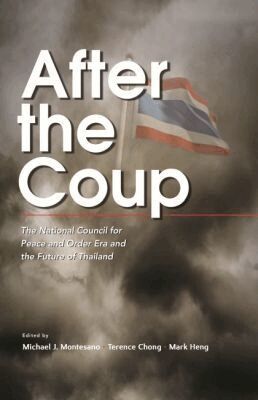
    After the Coup

    The National Council for Peace and Order Era and the Future of Thailand

    AvMichael J. Montesano,Terence Chong

    Häftad, Engelska, 2019

    578 kr

    Beställningsvara. Skickas inom 3-6 vardagar. Fri frakt över 249 kr.

    Beskrivning

    After the Coup brings together the work of a group of leading Thai intellectuals of several generations to equip readers to anticipate and understand the developments that lie ahead for Thailand. Contributors offer findings and perspectives both on the disorienting period following the Thai coup of May 2014 and on fundamental challenges to the country and its institutions. Chapters address regionalism and decentralization, the monarchy and the military, the media, demography and the economy, the long-running violence in Southern Thailand, and a number of surprising social and political trends certain to shape the future of Thailand. The volume will serve as a valuable resource for all those concerned with that future.

    Produktinformation

    • Utgivningsdatum:2019-01-31
    • Mått:152 x 228 x 24 mm
    • Vikt:333 g
    • Format:Häftad
    • Språk:Engelska
    • Antal sidor:474
    • Förlag:ISEAS
    • ISBN:9789814818988

    Utforska kategorier

    • Centralt styre och förvaltning inom Samhälle och politik
    • Statsskick och politiska processer inom Samhälle och politik
    • Statsvetenskap och politisk teori inom Samhälle och politik

    Mer om författaren

    Michael Montesano is Coordinator, Thailand Studies Programme, and Co-Coordinator, Myanmar Studies Programme, ISEAS – Yusof Ishak Institute. Terence Chong is Deputy Director of the ISEAS – Yusof Ishak Institute, and Senior Fellow in its Regional Social & Cultural Studies Programme. Mark Heng was formerly Research Officer in the ISEAS – Yusof Ishak Institute’s Nalanda-Sriwijaya Centre and Regional Social & Cultural Studies Programme.

    Recensioner i media

    This highly acclaimed collection of scholars’ answers to basic questions about the political situation after the 2014 military coup in Thailand offers a comprehensive analysis of many crucial institutions and sensitive issues that no other work has touched. The book covers the intricate relationships among conflicting classes, political movements, the military, and, above all, the monarchy. It puts on the table many important debates about the crisis of democratization in the country, including the struggle of Malay-Muslims in Southern Thailand, the transformation of electoral violence, the dilemma of political decentralization, the changing roles of the media, and the impact of slowing economic growth and an ageing society on the future of Thailand.'- Kanokrat Lertchoosakul, Chulalongkorn University, author of The Rise of the Octobrists in Contemporary Thailand'After the Coup should be read by anyone interested in understanding the current state of Thailand’s political affairs, tracing the historical origins of the current challenges and conflicts, or looking for clues about what may be to come. This outstanding set of scholars explores how Thailand’s disparate collective identities are at the root of the current political and social conflict. These collective identities carry with them different visions of what it means to be ‘Thai’, what democracy is and how it should function, and the sources of political legitimacy. The chapter authors describe how those behind Thailand’s ‘ambitious coup’ have attempted to crush, co-opt, quell, and contain these competing visions.'- Allen Hicken, University of Michigan, author of Building Party Systems in Developing Democracies'Featuring a collection of essays authored by many of the field’s leading lights, expertly curated and edited by one of the most knowledgeable scholars in Thai Studies, After the Coup is a vital contribution to the study of contemporary Thai politics. The depth and sophistication of its analysis, and the variety of viewpoints represented, make it a must-read for anyone wishing to understand the significance of the events set in motion by the military coup staged in Thailand on 22 May 2014, one in crucial respects quite unlike the series of coups d’état that punctuate the country’s modern political development.'- Federico Ferrara, City University of Hong Kong, author of The Political Development of Modern Thailand'This book covers many of the most important current aspects of the Thai political problem, to help readers better understand why Thailand continues in its struggle to democracy. For example, it provides for a very insightful sense of an emergent middle class that has been one of the main obstacles in Thai democratic progress, both before and since the military coup d’état of 2014.'- Titipol Phakdeewanich, Dean, Faculty of Political Science, Ubon Ratchathani University.