• Fri frakt över 249 kr
  • •
  • Snabba leveranser
  • •
  • Billiga böcker
Kundservice

Du är på sajten för privatpersoner.

Företag, bibliotek eller offentlig verksamhet?

Du handlar på classic.bokus.com, där alla dina funktioner finns intakta.
Till classic.bokus.com
Bokus logotyp. Gå till startsidan.
  • Erbjudanden
  • Nyheter
  • Student
  • Topplistor
  • Barn & ungdom
  • Bokus Play
  • E-böcker
  • Pocketböcker
  • Spel & pussel

10% studentrabatt med kod TERM26

Sidfot

Mina sidor

    Hjälp

    • Kundservice
    • Vanliga frågor och svar
    • Frakt och leverans
    • Retur vid ångerrätt
    • Reklamera vara
    • Betalning
    • Köpvillkor
    • Allmänna villkor
    • Information om webbplatsens tillgänglighet

    Om Bokus

    • Om oss
    • Pressrum
    • För studenter
    • För företag
    • För bibliotek och offentlig verksamhet
    • För leverantörer
    • Hållbarhet

    Populärt

    • Aktuella erbjudanden
    • Presentkort
    • Studentlitteratur
    • Nya böcker
    • Topplistor
    • Signerade böcker
    • Engelska böcker

    Inspiration

    • Boktips
    • BookTok
    • Populära bokserier
    • Barnbokskaraktärer
    • Populära författare
    Logotyp för Bokus
    Följ oss på Facebook (extern länk)Följ oss på Instagram (extern länk)Följ oss på YouTube (extern länk)Följ oss på TikTok (extern länk)
    bokus @ CookiesAnpassa cookiesIntegritetspolicyKöpvillkor
    Till Citymail hemsida (extern länk)Till Budbee hemsida (extern länk)Till Postnord hemsida (extern länk)Till Schenker hemsida (extern länk)Till Early Bird hemsida (extern länk)Till Walleys hemsida (extern länk)
    1. Samhälle och politik
    2. Samhälle och kultur
    3. Sociala grupper och identitet
    4. Genusvetenskap

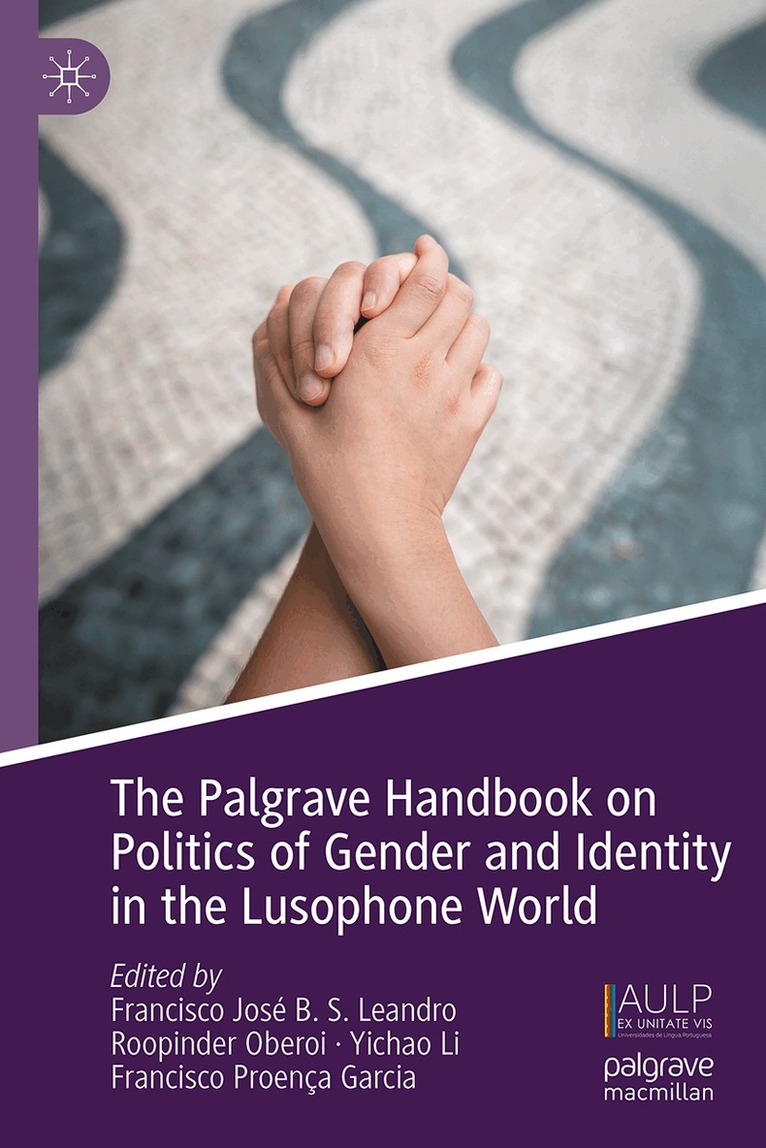
    Palgrave Handbook on Politics of Gender and Identity in the Lusophone World

    AvFrancisco José B. S. Leandro,Roopinder Oberoi

    Inbunden, Engelska, 2026

    2 650 kr

    Kommande

    Beskrivning

    This handbook offers a timely and unique authoritative contribution to global debates on gender equality and women’s empowerment, in alignment with UN Sustainable Development Goal 5. It presents interdisciplinary research on gender, international relations, and civil society across nine Portuguese-speaking countries, with a particular focus on implementing UN Security Council Resolution 1325. Combining conceptual frameworks with case studies, the volume addresses politics, economics, history, peace and security, language, sports, entrepreneurship, and education through an international relations lens. Endorsed by the Association of Portuguese Speaking Universities (AULP), this work stands as a prestigious and globally relevant resource for scholars, policymakers, and practitioners committed to advancing gender-responsive governance.

    Produktinformation

    • Utgivningsdatum:2026-12-29
    • Mått:155 x 235 x undefined mm
    • Format:Inbunden
    • Språk:Engelska
    • Antal sidor:1 130
    • Förlag:Springer Verlag, Singapore
    • ISBN:9789819577224

    Utforska kategorier

    • Genusvetenskap inom Samhälle och politik
    • Statsvetenskap och politisk teori inom Samhälle och politik
    • Internationella relationer inom Samhälle och politik

    Mer om författaren

    Francisco José B. S. Leandro is Associate Professor with Habilitation at the Faculty of Social Sciences, University of Macau. His recent works include The Development Journeys of Cabo Verde, São Tomé and Príncipe, and Timor-Leste (2023) and Is China a Global Power? The Three Great Walls of the Middle Kingdom (2025, Palgrave Macmillan).Roopinder Oberoi is Fellow at the Delhi School of Public Policy and Governance and Professor of Political Science at the University of Delhi, India. She has authored and edited several books on globalization, CSR, and HE, published extensively in peer-reviewed journals, and serves as Editor of the Social Responsibility Journal (UK).Yichao Li earned her Ph.D. from the Institute for Research on Portuguese-speaking Countries, City University of Macau. She is Assistant Research Fellow at the Institute of African Studies, Zhejiang Normal University. Her recent works include The Palgrave Handbook on China-Europe-Africa Relations (2025) and Africa–EU relations published by the Canadian Journal of African Studies (2025).Francisco Proença Garcia is a Full Professor and Associate Dean at the Institute for Political Studies, Portuguese Catholic University, Portugal. He also serves as a Visiting Professor at the University of Saint Joseph (Macau, China), the Catholic University of Mozambique (Beira, Mozambique), and as Catholic University of Portugal Chairperson of the Council for Higher Military Education (Portugal).

    Innehållsförteckning

    • Chapter 1: Introduction: Politics of Gender and Identity in the Lusophone World: Referencing the past, understanding the present, and preparing the future.- Chapter 2: Framing the Global Gender Discussion: Postcolonial and Current Discourses.- Chapter 3: Women, Gender, Colonialism, and Post-Colonialism: The International Relations Perspective.- Chapter 4: Digging in their Heels: Understanding the Eco System for Women Entrepreneurs in Ghana and India.- Chapter 5: Global Insights, Local Nuances: Examining the Evolution of Gender Discourse in Portuguese-Speaking Countries Post-UNSCR 1325.- Chapter 6: An Overview of the Women, Peace and Security Agenda: Historical Perspectives and Current Debates.- Chapter 7: Promoting Gender Equality and Women’s Empowerment in Development Cooperation: The Case of Portuguese-Speaking Countries.- Chapter 8: Women in Diplomacy in the Portuguese-speaking Countries.- Chapter 9: Scientific Research and Gender-linked Asymmetries: Overview and Trends in Cabo Verde, Guinea-Bissau, and São Tomé and Príncipe.- Chapter 10: Gender, Online Content Moderation and the Law: A Lusophone Perspective.- Chapter 11: Aesthetic Strategies for ‘Thinking Africa’ in Macau, China.- Chapter 12: Gender Equality in Sports: The Case of the Community of Portuguese-speaking Countries.- Chapter 13: Gender Equality in Sports: The Case of the Community of Portuguese-speaking Countries.- Chapter 14: Political Power and Gender Equality: Women’s Political Empowerment in Portuguese-speaking Countries.- Chapter 15: Women in the Brazilian Armed Forces: Advances and Institutional Challenges.- Chapter 16: Women's empowerment and the Social Networking Site: Brazilian Women CEOs’ Perspective on LinkedIn.- Chapter 17: Social Thought in Brazil: Women Outside the Canon.- Chapter 18: Gender and Diversity at School: Intersectionalizing Brazilian Teachers’ Perceptions of Gender and Race.- Chapter 19: Decolonizing Feminism and Constitutionalism: Transformative Feminist Constitutionalism in Brazil.- Chapter 20: The Emergence of -e as an Inclusive Neuter Gender Morpheme in Brazilian Portuguese.- Chapter 21: From Policy to Practice: The Promotion of Inclusive Language in Portugal's Gender Equality Agenda.- Chapter 22: How Are the SDGs Influencing Gender Policies in Portugal? What is Being Done at the Local Level?.- Chapter 23: Sociocultural Identity in the Digital Environment: cross-country in Brazil and Mozambique.- Chapter 24: Quota Politics: Evaluating Gender Representation in Mozambique’s Parliament.- Chapter 25: The Struggles of African Feminist Movement: A Reflection Around #MeToo.- Chapter 26: Access to Finance, Networks, and Resources: Disparities and Opportunities for Women Entrepreneurs: A Case Study of Lusophone Countries in Africa.- Chapter 27: Gender and Higher Education: The Case of Angola.- Chapter 28: Gender in Equatorial Guinea: Between Ethnic Traditions and Colonial Legacies.- Chapter 29: Women’s Writings and the Development of Gender Discourse in Equatorial Guinea.- Chapter 30: Gender Stereotype Effects on Women: Case Study of Guinea-Bissau.- Chapter 31: The Condition of Women in a State with a Fragile Democracy – The case of Guinea-Bissau.- Chapter 32: Women Entrepreneurship in Guinea-Bissau.- Chapter 33: The Gender Gap: Why is Guinea-Bissau not on track to achieve SDG5 by 2030?.- Chapter 34: Women and Terrorism in Cabo Delgado, Mozambique: Victims and Active Agents.- Chapter 35: Women and Politics in Mozambique: From the Liberation War to the Post-Independence Era.- Chapter 36: Invisible Journeys: Gendered Human Trafficking in Mozambique.- Chapter 37: “I was not the child she had wished and dreamed of” - Experiences of gender-based violence against “transgender” in Mozambique.- Chapter 38: Challenges of Gender and Financial Inclusion in Mozambique.- Chapter 39: Cabo Verde’s Gender and Public Policies: Past Perspectives and Present Challenges.- Chapter 40: Analyzing the Evolution of Females' Participation in Higher Education in Cabo Verde: A Gender Perspective.- Chapter 41: Gender Mainstreaming in Public Policy and Higher Education in Cabo Verde: A Critical Review of Theoretical Frameworks and Institutional Practices.- Chapter 42: Gender Perspectives in Small Island Development States of Portuguese Speaking Countries – The Case of São Tomé and Principe.- Chapter 43: Gender Equality and Media Representation: A Case Study of Male Journalists in São Tomé and Príncipe.- Chapter 44: Women in Higher Education: The Case of Timor-Leste.- Chapter 45: Digital Resources for Gender Studies Research in Lusophone Contexts.