• Fri frakt över 249 kr
  • •
  • Snabba leveranser
  • •
  • Billiga böcker
Kundservice

Du är på sajten för privatpersoner.

Företag, bibliotek eller offentlig verksamhet?

Du handlar på classic.bokus.com, där alla dina funktioner finns intakta.
Till classic.bokus.com
Bokus logotyp. Gå till startsidan.
  • Erbjudanden
  • Nyheter
  • Student
  • Topplistor
  • Barn & ungdom
  • Bokus Play
  • E-böcker
  • Pocketböcker
  • Spel & pussel

10% rabatt på allt med kod: NYSTART10 →

Sidfot

Mina sidor

    Hjälp

    • Kundservice
    • Vanliga frågor och svar
    • Frakt och leverans
    • Retur vid ångerrätt
    • Reklamera vara
    • Betalning
    • Köpvillkor
    • Allmänna villkor
    • Information om webbplatsens tillgänglighet

    Om Bokus

    • Om oss
    • Pressrum
    • För studenter
    • För företag
    • För bibliotek och offentlig verksamhet
    • För leverantörer
    • Hållbarhet

    Populärt

    • Aktuella erbjudanden
    • Presentkort
    • Studentlitteratur
    • Nya böcker
    • Topplistor
    • Signerade böcker
    • Engelska böcker

    Inspiration

    • Boktips
    • BookTok
    • Populära bokserier
    • Barnbokskaraktärer
    • Populära författare
    Logotyp för Bokus
    Följ oss på Facebook (extern länk)Följ oss på Instagram (extern länk)Följ oss på YouTube (extern länk)Följ oss på TikTok (extern länk)
    bokus @ CookiesAnpassa cookiesIntegritetspolicyKöpvillkor
    Till Citymail hemsida (extern länk)Till Budbee hemsida (extern länk)Till Postnord hemsida (extern länk)Till Schenker hemsida (extern länk)Till Early Bird hemsida (extern länk)Till Walleys hemsida (extern länk)
    1. Psykologi och pedagogik
    2. Pedagogik
    • Nyhet

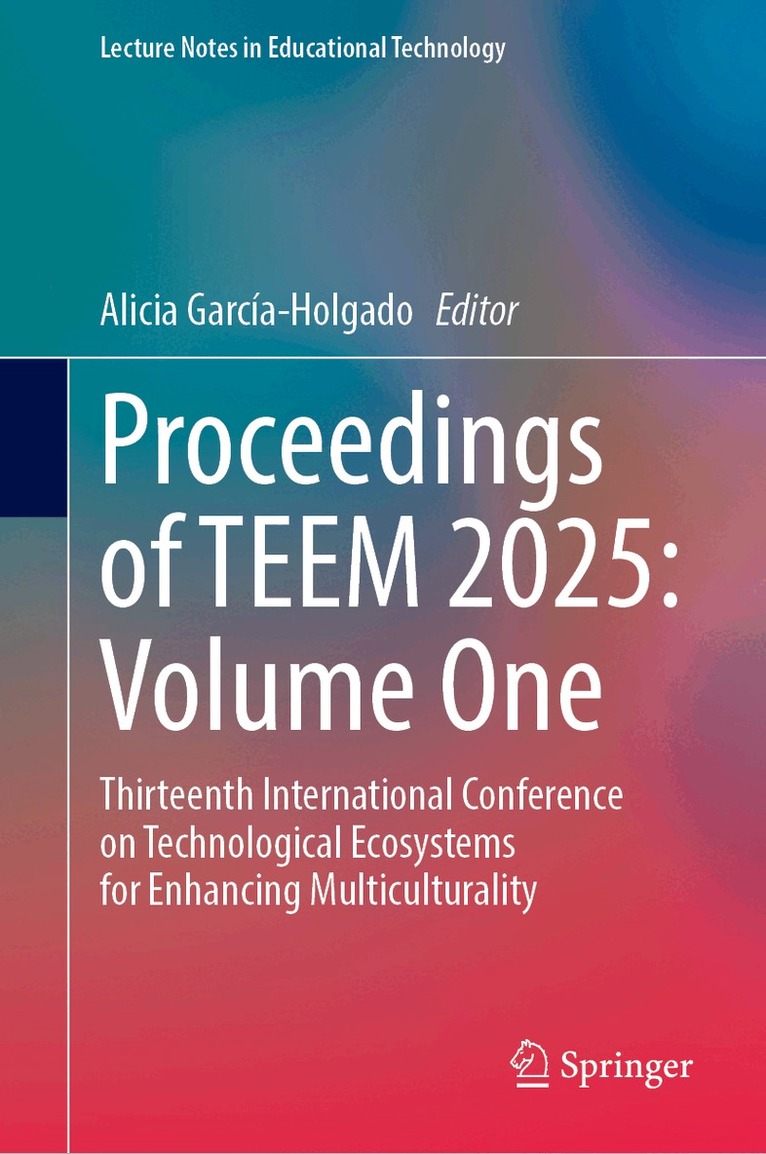
    Proceedings of TEEM 2025: Volume One

    Thirteenth International Conference on Technological Ecosystems for Enhancing Multiculturality

    AvAlicia García-Holgado

    Inbunden, Engelska, 2026

    Del i serien Lecture Notes in Educational Technology

    2 650 kr

    Beställningsvara. Skickas inom 11-20 vardagar. Fri frakt över 249 kr.

    Beskrivning

    This volume presents the first part of the proceedings of the Thirteenth International Conference on Technological Ecosystems for Enhancing Multiculturality (TEEM) 2025.It brings together research and practical experiences that show how innovation is shaping the future of education, and explores new teaching methods, the responsible use of generative AI in educational settings, and smart learning tools that adapt to the needs of each student. The book also looks at how assessment can serve as a powerful tool to improve learning, guide educational decisions, and support students through personalized and holistic guidance strategies. Last but not least, it includes contributions from early-career researchers who bring fresh and committed perspectives to educational development. With all these contributions, this book offers a well-rounded view of how education can become more innovative, inclusive, and student-centered.Readers who wish to learn more about this topic can refer to 'Proceedings of TEEM 2025: Volume Two' and 'Proceedings of TEEM 2025: Volume Three'.

    Produktinformation

    • Utgivningsdatum:2026-08-01
    • Mått:155 x 235 x undefined mm
    • Format:Inbunden
    • Språk:Engelska
    • Serie:Lecture Notes in Educational Technology
    • Antal sidor:392
    • Förlag:Springer Verlag, Singapore
    • ISBN:9789819590728

    Utforska kategorier

    • Pedagogik inom Psykologi och pedagogik
    • Högskola och universitet inom Psykologi och pedagogik
    • Material och digital teknik i undervisningen inom Psykologi och pedagogik

    Mer om författaren

    Dr. Alicia García-Holgado is an Associate Professor in the Computer Science Department, University of Salamanca, Spain. She received a degree in Computer Sciences in 2011, a Master in Science in Intelligent Systems in 2013, and obtained a PhD in 2018 from the University of Salamanca (Cum Laude) in the Doctoral Programme 'Education in the Knowledge Society', focused on the use of technological ecosystems as a tool to improve knowledge management in different contexts. She has been a member of the research GRoup of InterAction and e-Learning (GRIAL) at the University of Salamanca since 2009, where she leads the research line 'Social Responsibility and Inclusion'. Her research focuses on the development of technological ecosystems for knowledge and learning processes management in heterogeneous contexts, and the promotion of diversity and inclusion in Science, Technology, Engineering, and Mathematics (STEM), with a particular focus on engineering and technology.

    Innehållsförteckning

    • Exploring the intersection of creative teaching dynamic learning spaces and ai integration overcoming key challenges.- Innovating in education and inclusion social robots to enhance communicative competencies of children with asdtechnological challenges and issues.- Towards improved learning experiences and collaborative leadership how to use genai platforms in higher education contexts.- Designing innovative remote internships through service design methodology a case for educational transformation.- Reframing he for education 5.0 from knowledge transmitters to hybrid human machine learning ecosystems.- Use of artificial intelligence by secondary school teachers in catalonia.- Enhancing topographic education through immersive virtual reality and flipped classroom methodologies a dual approach with virtual and real practices.-Zone of proximal development in ai assessing complex thinking in personalized environments.- Models of accreditation of digital teaching competence in spain an interregional comparative study through open sources.- Collaboration among students from different courses: an experience in higher education.- Digital transformation in the era of ai in higher education advancing international cooperation through open education frameworks.- Personalized learning with the help of open source e-learning platform and generative artificial intelligence.- Exploring the use of ai-assisted tools in educational assessment: insights from pre-service teachers.- Generative ai in language teaching in higher education: systematic mapping study.- Team pulse: leveraging generative ai for enhanced project-based learning in software engineering education.- Mapping the landscape of ai and data literacy in secondary education: insights from an experts focus group using tf-idf and fasttext.- Student satisfaction with the use of conversational agents in virtual higher education.- How engineering students use and trust ai when solving mathematical tasks.- A model for assessing a national curriculum analysis in terms of stem impact using ai.- Generative ai models for complex problem solving: a case in chemical engineering.- Artificial intelligence tools in introductory programming education: classroom applications and ethical reflections.- Beyond chatbots: role-based generative ai to enhance complex thinking in master’s-level business projects.- Designing for inclusion: ethical use cases highlighting accessibility gaps in genai-powered educational virtual assistants.- enhancing domain-specific semantic search through acronym ontology integration: a case study in educational rag systems.- Integrating artificial intelligence in pre-service teacher education: findings from a pilot training experience.- Exploring a nascent field: a protocol review on generative ai and cognitive bias in projects.- Generating embeddings with large language model to characterize activities on a smart learning platform.- Ai and data practices in secondary education: a comparative study between catalonia and italy.- Enhancing financial literacy with a retrieval-augmented conversational agent.- Disciplinary and methodological differences in the use of generative ai for the elaboration of final degree projects in higher education.- Environmental engagement among youth: how do spanish students compare in the iccs 2022 international landscape.- From knowledge to action: emotions in climate change education among secondary school students.- Assessing teamwork in a mining project evaluation course: an ai-based chatbot approach integrating ahp, kpis, and project management.- Evolution of educational inequality in spain based on pisa results.- Regularisation techniques in pisa 2022.- Student’s performance in primary and secondary education: large-scale assessment through timss and pisa.- Evaluating students’ performance in the ai era: a comparative study of teacher-led and automated assessmentdigital transformation of assessment in language certification: the case of certacles.- hybrid artificial intelligence assessment of english writing texts.- Evaluation of complex and computational thinking in higher education: a systematic literature mapping from 2014 to 2024 artificial intelligence-assisted competency assessment model for complex engineering problem solving: a mixed methods approach.- Analysis of the strategies and perceptions of members of the university–business ecosystem regarding digital competencies and generative artificial intelligence to strengthen educational quality and sustainability.- Sustainability integration in marketing curricula: impact on professional performance of colombian graduates.- Public perception of ai biases in spain: the role of citizens in understanding gender racial, ideological, and cultural biases.- Emotional education in university teacher training: a doctoral proposal.- from prompt to practice: a qualitative analysis of teacher task responses generated by deepseek.- Pedagogical reflection in response to the digital trans-formations of contemporary society: an analysis of in-service teachers’ practices.- Research plan for doctoral thesis: “university education and teachers' perceptions of inclusive approaches to dyslexia: a comparative analysis between the university of salamanca and the university of costa rica.- Factors influencing teacher preparation to identify and apply mentoring with gifted and talented students in higher education.- Identifying and addressing physics misconceptions in final-year high school and first-year engineering student.- Early childhood education: key factors influencing preschool children's development.