• Fri frakt över 249 kr
  • •
  • Snabba leveranser
  • •
  • Billiga böcker
Kundservice

Du är på sajten för privatpersoner.

Företag, bibliotek eller offentlig verksamhet?

Du handlar på classic.bokus.com, där alla dina funktioner finns intakta.
Till classic.bokus.com
Bokus logotyp. Gå till startsidan.
  • Erbjudanden
  • Nyheter
  • Student
  • Topplistor
  • Barn & ungdom
  • Bokus Play
  • E-böcker
  • Pocketböcker
  • Spel & pussel

Må bättre, för mindre! Upp till 50% rabatt på hälsoböcker

Sidfot

Mina sidor

    Hjälp

    • Kundservice
    • Vanliga frågor och svar
    • Frakt och leverans
    • Retur vid ångerrätt
    • Reklamera vara
    • Betalning
    • Köpvillkor
    • Allmänna villkor
    • Information om webbplatsens tillgänglighet

    Om Bokus

    • Om oss
    • Pressrum
    • För studenter
    • För företag
    • För bibliotek och offentlig verksamhet
    • För leverantörer
    • Hållbarhet

    Populärt

    • Aktuella erbjudanden
    • Presentkort
    • Studentlitteratur
    • Nya böcker
    • Topplistor
    • Signerade böcker
    • Engelska böcker

    Inspiration

    • Boktips
    • BookTok
    • Populära bokserier
    • Barnbokskaraktärer
    • Populära författare
    Logotyp för Bokus
    Följ oss på Facebook (extern länk)Följ oss på Instagram (extern länk)Följ oss på YouTube (extern länk)Följ oss på TikTok (extern länk)
    bokus @ CookiesAnpassa cookiesIntegritetspolicyKöpvillkor
    Till Citymail hemsida (extern länk)Till Budbee hemsida (extern länk)Till Postnord hemsida (extern länk)Till Schenker hemsida (extern länk)Till Early Bird hemsida (extern länk)Till Walleys hemsida (extern länk)
    1. Djur och Natur
    2. Naturböcker
    3. Växtböcker

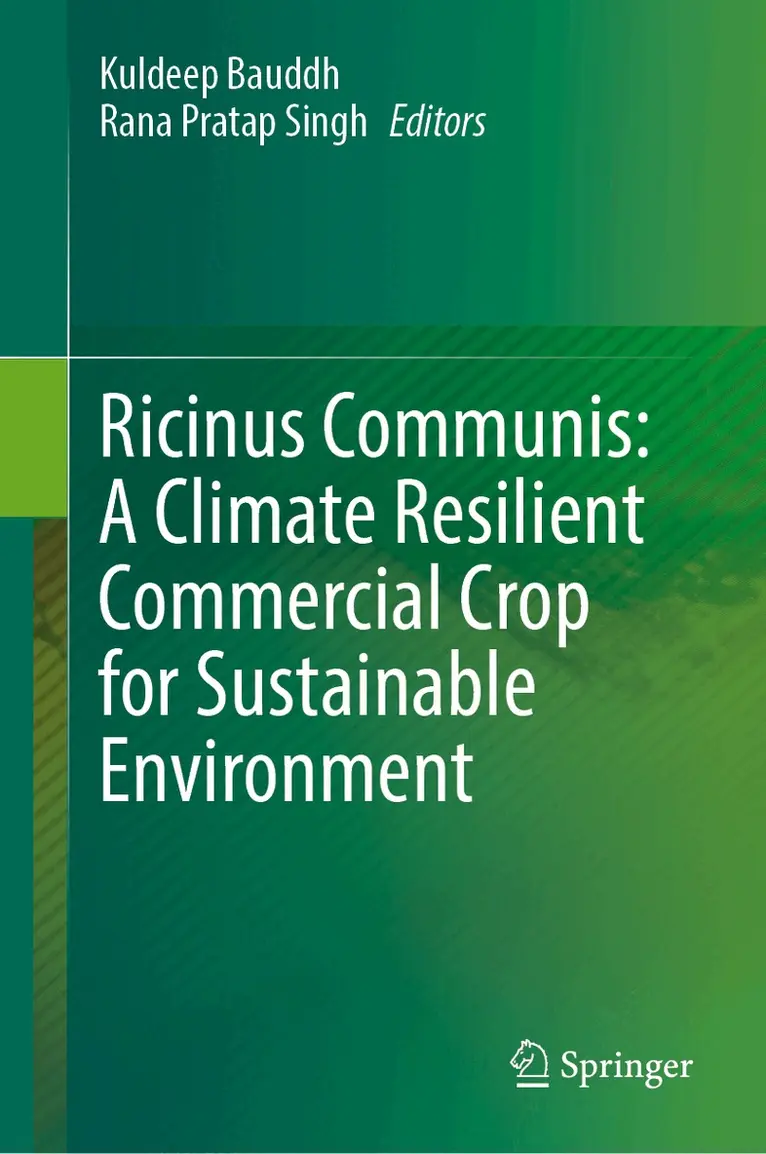
    Ricinus Communis: A Climate Resilient Commercial Crop for Sustainable Environment

    AvKuldeep Bauddh,Rana Pratap Singh

    Inbunden, Engelska, 2025

    2 381 kr

    Beställningsvara. Skickas inom 5-8 vardagar. Fri frakt över 249 kr.

    Beskrivning

    Due to the diverse properties of Ricinus communis (castor), this book provides a comprehensive account of castor as a ‘climate resilient and value-added crop.’ It explores the morphological variations, various cultivation techniques, genotypic differences, suitable soil types, and the crop’s yield. The book also discusses the phytoremediation efficiency of castor, focusing on its role in restoring degraded lands, abandoned mining sites, and lands contaminated by heavy metals.The application of suitable plants for the restoration of degraded lands is an efficient method due to its ecological and economic viability. Castor is a hardy angiosperm with multiple benefits. It serves the dual purpose of being an excellent phytoremediator and a source of bioenergy. Additionally, castor has proven effective in treating several human diseases. The castor plant's ability to thrive in stressed soils makes it particularly suitable for the phytoremediation of polluted lands in various climatic conditions. Given its wide range of industrial uses, castor has gained significant attention for further exploration of its biology, cultivation techniques, and genotypic variations.This book is of interest to teachers, researchers, botanists, capacity builders, and policymakers. It also serves as good reading material for undergraduate and master students of botany, ecology, and environmental sciences. National and international agricultural scientists, ecologists, and policymakers will also find it a valuable resource

    Produktinformation

    • Utgivningsdatum:2025-03-22
    • Mått:155 x 235 x 18 mm
    • Vikt:564 g
    • Format:Inbunden
    • Språk:Engelska
    • Antal sidor:233
    • Förlag:Springer Nature Switzerland AG
    • ISBN:9789819632237

    Utforska kategorier

    • Växtböcker inom Djur och Natur
    • Botanik inom Naturvetenskap och teknik
    • Agronomi inom Naturvetenskap och teknik

    Mer om författaren

    Dr. Kuldeep Bauddh is an Associate Professor at the Institute of Environment and Sustainable Development (IESD), Rajiv Gandhi South Campus, Banaras Hindu University, Uttar Pradesh, India. He earned his M.Sc. and Ph.D. in Environmental Science from B.B. Ambedkar University, Lucknow, India. Dr. Bauddh specializes in teaching core areas of environmental sciences, including Environmental Pollution and Management, Environmental Toxicology, and Environmental Impact Assessment. His research primarily focuses on phytoremediation and sustainable agriculture. Dr. Bauddh has edited nine books and published 65 research papers in national and international journals, along with 33 book chapters. He has been awarded three R&D projects sponsored by the University Grants Commission (UGC) and the Science and Engineering Research Board (SERB), Government of India.Dr. Rana Pratap Singh, a Senior Professor (Retired) from Department of Environmental Science, Babasaheb Bhimrao Ambedkar University, Lucknow, India, currently serves as the Director (Honorary) of The Center for Sustainable Agriculture and Environment, an R & D initiative of PHSS Foundation for Science and Society, Lucknow, India. He is fellow of National Academy of Sciences, India and 4 other scientific organizations. Professor Singh earned his Ph.D. in Life Sciences, specializing in Nitrogen Metabolism in Plants, from Devi Ahilya University, Indore, in 1985. He has held visiting scientist positions at AIIMS, New Delhi, the University of Guelph, Ontario, Canada, and Yunnan Agriculture University, Kunming, China. Recipient of eight national and state awards for his research and academic contributions, Prof. Singh has co-edited 18 books and authored over 180 research publications, garnering more than 7,600 citations (H-index: 44; i10-index: 109). He is the Editor-in-Chief of Physiology and Molecular Biology of Plants (PMBP, IF-3.4) and serves on the editorial boards of numerous scientific journals. Currently, his research focuses on Climate-Resilient Multifunctional Microbial Stimulants for sustainable agriculture, as well as designing integrated below-ground and above-ground agroecosystems to maximize ecological and economic benefits.

    Innehållsförteckning

    • .- Chapter 1:Plant and environment interaction: special reference to phytoremediation of heavy metals using Ricinus communis L.- Chapter 2: Botany, geographical distribution, cultivation techniques and crop productivity of Ricinus Communis L.- Chapter 3: Genetic variability and breeding opportunities in castor bean (Ricinus communis L).- Chapter 4: Nipping an innovative method to increase the yield of castor  .- Chapter 5: Medicinal properties of Ricinus communis L. oil and their applications: An overview.- Chapter 6: Optimizing biodiesel production from non-edible castor oil through the development of a bi-functional catalyst: a case study.- Chapter 7: Castor plant in Ericulture: opportunities and challenges.- Chapter 8: Ricinus communis: an abiotic stress-tolerant crop for reclamation of wasteland reclamation .- Chapter 9: Abandoned mine sites restoration using an industrially important crop, Ricinus communis L     .- Chapter 10: Phytoremediation of heavy metals from the metal-polluted soil using Ricinus communis .- Chapter 11:Assessing the Suitability of Cement Industry Effluent for Irrigating Eight Different Genetic Varieties of Castor bean (Ricinus communis L.): A Case Study.