• Fri frakt över 249 kr
  • •
  • Snabba leveranser
  • •
  • Billiga böcker
Kundservice

Du är på sajten för privatpersoner.

Företag, bibliotek eller offentlig verksamhet?

Du handlar på classic.bokus.com, där alla dina funktioner finns intakta.
Till classic.bokus.com
Bokus logotyp. Gå till startsidan.
  • Erbjudanden
  • Student
  • Topplistor
  • Barn & ungdom
  • Bokus Play
  • E-böcker
  • Ljudböcker
  • Pocketböcker
  • Spel & pussel

10% rabatt på allt med kod NYSTART10 →

Sidfot

Mina sidor

    Hjälp

    • Kundservice
    • Vanliga frågor och svar
    • Frakt och leverans
    • Retur vid ångerrätt
    • Reklamera vara
    • Betalning
    • Köpvillkor
    • Allmänna villkor
    • Information om webbplatsens tillgänglighet

    Om Bokus

    • Om oss
    • Pressrum
    • För studenter
    • För företag
    • För bibliotek och offentlig verksamhet
    • För leverantörer
    • Hållbarhet

    Populärt

    • Aktuella erbjudanden
    • Presentkort
    • Studentlitteratur
    • Nya böcker
    • Topplistor
    • Signerade böcker
    • Engelska böcker

    Inspiration

    • Boktips
    • BookTok
    • Populära bokserier
    • Barnbokskaraktärer
    • Populära författare
    Logotyp för Bokus
    Följ oss på Facebook (extern länk)Följ oss på Instagram (extern länk)Följ oss på YouTube (extern länk)Följ oss på TikTok (extern länk)
    bokus @ CookiesAnpassa cookiesIntegritetspolicyKöpvillkor
    Till Citymail hemsida (extern länk)Till Budbee hemsida (extern länk)Till Postnord hemsida (extern länk)Till Schenker hemsida (extern länk)Till Early Bird hemsida (extern länk)Till Walleys hemsida (extern länk)
    1. Kultur
    2. Konstböcker
    3. Konsthistoria

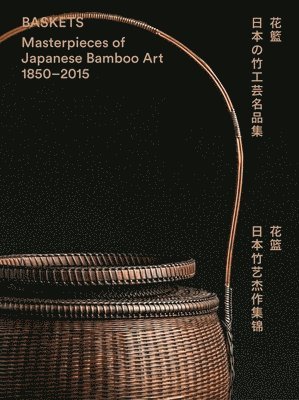
    Baskets

    Masterpieces of Japanese Bamboo Art 1850-2015

    AvJoe Earle

    Inbunden, Engelska, 2017

    1 599 kr

    Skickas . Fri frakt över 249 kr.

    Beskrivning

    These are exciting times for Japanese bamboo art. May 2017 saw the opening of Japan House Sao Paulo, whose inaugural exhibition 'Bamboo: The Material That Built Japan' drew over 300,000 visitors. From June 2017 to February 2018 the Metropolitan Museum of Art in New York mounted another bamboo show that was seen by about 400,000. From 27 November, the Musee du quai Branly in Paris will present the largest-ever exhibition on the subject. This authoritative catalogue of 323 works from the Naej Collection thus appears at a moment when a new global audience has emerged. The Naej Collection is especially strong in works by leading artists from 1850 to 1950, when great craft dynasties were established and first Osaka and then Tokyo emerged as major centres of artistic basketry. The catalogue breaks new ground by combining dramatic photography with precious documentary information drawn from signatures and inscriptions, making it not merely the visual record of a great collection but the essential reference work for a developing field of connoisseurship.Text in English, Japanese and simplified Chinese.

    Produktinformation

    • Utgivningsdatum:2017-06-30
    • Mått:225 x 300 x 52 mm
    • Vikt:4 200 g
    • Format:Inbunden
    • Språk:Engelska, Japanska, Kinesiska
    • Antal sidor:752
    • Förlag:Stark Studios Limited
    • Medarbetare:Bertrand Stark
    • ISBN:9789881375452

    Utforska kategorier

    • Konsthistoria inom Kultur
    • Övriga konstformer inom Kultur

    Mer om författaren

    Joe Earle was Director of Japan Society Gallery in New York until 2012 and has held leadership positions in Asian art departments at the Victoria and Albert Museum, London, and the Museum of Fine Arts, Boston. Over the past 38 years he has curated, organized, or written catalogues for numerous exhibitions of contemporary Japanese art, craft, and design, including Japan Style (London, 1980), Japanese Ceramics Today (the Kikuchi Collection, London, 1983), The Toshiba Gallery of Japanese Art (London, 1986), Visions of Japan (London, 1991), Splendors of Meiji: Treasures of Imperial Japan (Wilmington DE and Portland OR, 1999 and 2002), Contemporary Clay: Japanese Ceramics for the New Century (Boston and New York, 2005 and 2006), New Bamboo (Boston and New York, 2006 and 2008), Serizawa: Master of Japanese Textile Design, (New York, 2009), Bye Bye Kitty!!!: Between Heaven and Hell in Contemporary Japanese Art (New York, 2011), Fiber Futures: Japan's Textile Pioneers (New York, 2011), New Forms, New Voices: Japanese Ceramics from the Gitter-Yelen Collection (New Orleans, 2017). He is now based in London.Raised in Switzerland, Bertrand Stark set out on graduation from Paris University on a career with an investment bank which sent him straight to Hong Kong. From there his life as a banker took him to the top financial capitals of the world. When after ten years he was recalled to the bank's headquarters, he decided to become a photographer. He embarked on his new career by assisting leading photographers in Germany, the USA and France. After three years' intensive training, he set up his own freelance practice in fashion. Now back in Asia, he works in the world of fashion, beauty, and lifestyle photography, contributing to fashion magazines such as Vogue, Elle, Harper's Bazaar, Numero, as well as undertaking advertising assignments for brands like L'Oreal, Nivea, Wella, Opel, Schwarzkopf, and Shanghai Tang. His work has been exhibited at the Pin-Up Studio in Paris and at the Pingyao International Photography Festival and his photographs feature in a number of books on fashion and beauty. He teaches fashion photography at the Conde Nast Center for Fashion and Design in Shanghai.

    Innehållsförteckning

    • Following an essay outlining the evolution of bamboo art in Japan and a small section introducing earlier Chinese baskets and Japanese baskets in Chinese style, the bulk of the catalogue is organized by artistic lineages, starting with the founding father Hayakawa Shokosai I (1815-1897) and his successors and moving on to the other great craft dynasties based in Osaka, including large sections devoted to the Yamamoto Chikuryosai, Tanabe Chikuunsai, and Maeda Chikubosai lines. From catalogue number 192 the focus moves to the Iizuka line in Tochigi Prefecture and Tokyo, with numerous works by Hosai II, Rokansai, and Shokansai. The story is then continued into the post-war period when artistic basketry came to be practised in many other parts of Japan and a new generation of masters emerged, supported by patrons in both Japan and the United States. Each of the fourteen sections of dramatic colour plates (in most cases with both general and detail images) is followed by a section printed on matt paper with photographs of all the signatures and box inscriptions and biographies of each artist. The catalogue concludes with a bibliography, glossary, and artist index.