• Fri frakt över 249 kr
  • •
  • Snabba leveranser
  • •
  • Billiga böcker
Kundservice

Du är på sajten för privatpersoner.

Företag, bibliotek eller offentlig verksamhet?

Du handlar på classic.bokus.com, där alla dina funktioner finns intakta.
Till classic.bokus.com
Bokus logotyp. Gå till startsidan.
  • Erbjudanden
  • Nyheter
  • Student
  • Topplistor
  • Barn & ungdom
  • Bokus Play
  • E-böcker
  • Pocketböcker
  • Spel & pussel

10% studentrabatt med kod TERM26

Sidfot

Mina sidor

    Hjälp

    • Kundservice
    • Vanliga frågor och svar
    • Frakt och leverans
    • Retur vid ångerrätt
    • Reklamera vara
    • Betalning
    • Köpvillkor
    • Allmänna villkor
    • Information om webbplatsens tillgänglighet

    Om Bokus

    • Om oss
    • Pressrum
    • För studenter
    • För företag
    • För bibliotek och offentlig verksamhet
    • För leverantörer
    • Hållbarhet

    Populärt

    • Aktuella erbjudanden
    • Presentkort
    • Studentlitteratur
    • Nya böcker
    • Topplistor
    • Signerade böcker
    • Engelska böcker

    Inspiration

    • Boktips
    • BookTok
    • Populära bokserier
    • Barnbokskaraktärer
    • Populära författare
    Logotyp för Bokus
    Följ oss på Facebook (extern länk)Följ oss på Instagram (extern länk)Följ oss på YouTube (extern länk)Följ oss på TikTok (extern länk)
    bokus @ CookiesAnpassa cookiesIntegritetspolicyKöpvillkor
    Till Citymail hemsida (extern länk)Till Budbee hemsida (extern länk)Till Postnord hemsida (extern länk)Till Schenker hemsida (extern länk)Till Early Bird hemsida (extern länk)Till Walleys hemsida (extern länk)
    1. Historia och arkeologi
    2. Historia
    3. Europas historia

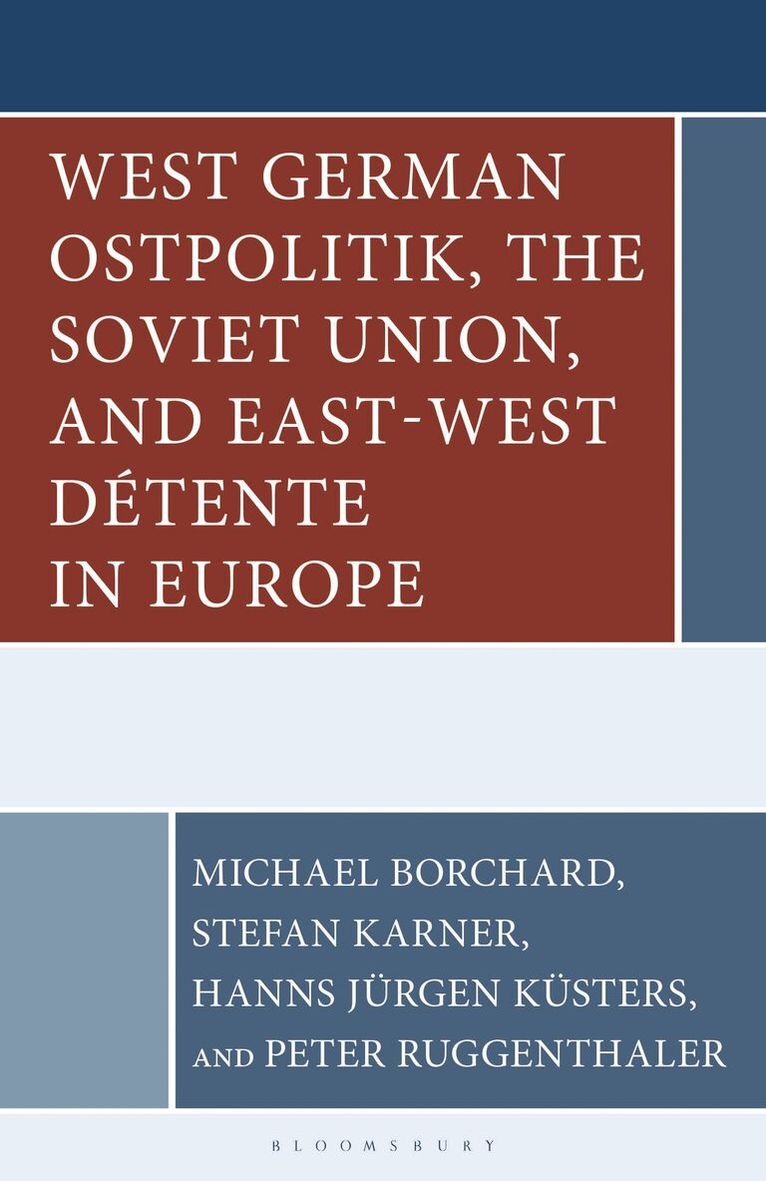
    West German Ostpolitik, the Soviet Union, and East-West Détente in Europe

    AvMichael Borchard,Stefan Karner

    Inbunden, Engelska, 2026

    Del i serien Harvard Cold War Studies Book Series

    1 366 kr

    Beställningsvara. Skickas inom 10-15 vardagar. Fri frakt över 249 kr.

    Beskrivning

    West German Ostpolitik, the Soviet Union, and East-West Détente in Europe explores how the détente policy changed the character of the Cold War.The Moscow files, now opened for the first time show 50 years later, reveal new insights and implications into the creation and implementation of the détente policy. This collection offers a detailed examination of European security from the mid-1960s to the mid-1970s with focus on five areas: 1) the first stirrings of détente in West German-Soviet relations, the framework conditions of domestic and foreign policy on the two sides and the extent to which interests ultimately enshrined in treaties were contradictory and/or compatible; 2) the preconditions of détente in the first half of the Brezhnev era; 3) economic interests as a driving force of political change; 4) the consequences of the Treaty of Moscow for East European states; and 5) the consequences of the Transatlantic partnership. The contributors highlight the complexity of domestic and international considerations that produced Ostpolitik and the subsequent emergence of long-term East-West détente in Europe, while offering the argument that Eastern policies and détente only came to fruition after the climax of the Cold War.

    Produktinformation

    • Utgivningsdatum:2026-01-08
    • Mått:160 x 232 x 32 mm
    • Vikt:855 g
    • Format:Inbunden
    • Språk:Engelska
    • Serie:Harvard Cold War Studies Book Series
    • Antal sidor:496
    • Förlag:Bloomsbury Publishing Plc
    • ISBN:9798765167670

    Utforska kategorier

    • Europas historia inom Historia och arkeologi

    Mer om författaren

    Michael Borchard is Head of the Department of Scientific Services and Archive for Christian Democratic Politics at the Konrad Adenauer Foundation.Stefan Karner is Director of the Institute for Economic, Social and Business History at the University of Graz.Hanns Jürgen Küsters is Professor of political science and contemporary history at the University of Bonn.Peter Ruggenthaler is Deputy Director and Senior Research Fellow at the Ludwig Boltzmann Institute for Research on Consequences of War.

    Innehållsförteckning

    • List of TablesAbout the EditorsAbout the ContributorsAcknowledgmentsList of AbbreviationsIntroductionMichael Borchard (Konrad Adenauer Foundation, Germany), Stefan Karner (University of Graz, Austria), Hanns Jürgen Küsters (University of Bonn, Germany), and Peter Ruggenthaler (Ludwig Boltzmann Institute for Research on Consequences of War, Austria)Part 1: East-West Détente – Times of Change in the Early Brezhnev Era1. Was the “Neue Ostpolitik” Really That New? The Establishment of Diplomatic Relations and Their Consequences and the Lines of Continuity Leading to Willy Brandt's PoliciesMichael Borchard (Konrad Adenauer Foundation, Germany)2. Germany's Legal Status in the Negotiations on the Treaties with Warsaw Pact States, the Basic Treaty and the CSCE in the Light of Soviet FilesHanns Jürgen Küsters (University of Bonn, Germany)3. The Soviet Economy in the Khrushchev and Brezhnev Years 1964–1975. Reforms, Doldrums and Paths Not TakenStefan Karner (University of Graz, Austria)4. The Brezhnev Doctrine and its Implications for OstpolitikMark Kramer (Harvard University, USA)5. Brezhnev and Brandt’s Neue OstpolitikMikhail Prozumenshchikov (Russian State Archives of Contemporary History, Russia)6. The Road to Helsinki: Defusing tensions with Bonn as the last stage on the road to the Conference on Security and Cooperation in EuropePeter Ruggenthaler and Anna Steiner (Ludwig Boltzmann Institute for Research on Consequences of War, Austria)7. The KGB’s Secret Channel and Its Actors, 1969–1981Nikita Petrov (Memorial International, Russia)8. The Soviet Union, China, and DétenteSergey Radchenko (Johns Hopkins School of Advanced International Studies Europe, Italy)Part 2: Western Allies and the West Germany’s Ostpolitik9. Interest and the Shared Purpose of the Western Alliance. The North Atlantic Alliance and the Runup to the Conference on Security and Cooperation in Europe 1964–1972Dieter Krüger (University of Potsdam, Germany)10. Complex Relations: Nixon, Kissinger, and Willy BrandtKlaus Larres (University of North Carolina at Chapel Hill, USA) and Ashley Low (University of North Carolina at Greensboro, USA)11. A Relic of the Cold War? The Nixon Administration, Brandt’s New Ostpolitik” and Radio Free Europe, 1969-73Douglas Selvage (Stasi Records Archive, Germany)12. The Basis of Ostpolitik and Détente: The Heath Government (1970-1974) and the Berlin QuestionAnne Deighton (University of Oxford, UK)13. French Détente Policy and “new Ostpolitik“Julien Genevois (Sorbonne Nouvelle University, France)Part 3: The Impacts of Détente in East Central Europe14. Anchoring the GDR in the Eastern Bloc as a Collateral Effect of DétenteManfred Wilke (Ludwig Boltzmann Institute for Research on Consequences of War, Austria)15. The People’s Republic of Poland and OstpolitikWanda Jarzabek (Polish Academy of Sciences, Poland)16. 1968, Czechoslovakia, U.S. Policy and DétenteOldrich Tuma (Czech Academy of Sciences, Czech Republic)17. Uncanny Leagues: Brandt, Ceau?escu, and the Cold War DétenteMarius Stan (University of Bucharest, Romania)18. Hungary in the Ostpolitik of the Federal Republic of GermanyMagdolna Baráth (Historical Archives of the Hungarian State Security, Hungary)19. Bulgaria, CSCE, and West German OstpolitikNadia Boyadjieva (Bulgarian Academy of Sciences, Bulgaria)Selected BibliographyPrinted SourcesIndex