• Fri frakt över 249 kr
  • •
  • Snabba leveranser
  • •
  • Billiga böcker
Kundservice

Du är på sajten för privatpersoner.

Företag, bibliotek eller offentlig verksamhet?

Du handlar på classic.bokus.com, där alla dina funktioner finns intakta.
Till classic.bokus.com
Bokus logotyp. Gå till startsidan.
  • Erbjudanden
  • Nyheter
  • Student
  • Topplistor
  • Barn & ungdom
  • Bokus Play
  • E-böcker
  • Pocketböcker
  • Spel & pussel

10% rabatt på allt med kod: NYSTART10 →

Sidfot

Mina sidor

    Hjälp

    • Kundservice
    • Vanliga frågor och svar
    • Frakt och leverans
    • Retur vid ångerrätt
    • Reklamera vara
    • Betalning
    • Köpvillkor
    • Allmänna villkor
    • Information om webbplatsens tillgänglighet

    Om Bokus

    • Om oss
    • Pressrum
    • För studenter
    • För företag
    • För bibliotek och offentlig verksamhet
    • För leverantörer
    • Hållbarhet

    Populärt

    • Aktuella erbjudanden
    • Presentkort
    • Studentlitteratur
    • Nya böcker
    • Topplistor
    • Signerade böcker
    • Engelska böcker

    Inspiration

    • Boktips
    • BookTok
    • Populära bokserier
    • Barnbokskaraktärer
    • Populära författare
    Logotyp för Bokus
    Följ oss på Facebook (extern länk)Följ oss på Instagram (extern länk)Följ oss på YouTube (extern länk)Följ oss på TikTok (extern länk)
    bokus @ CookiesAnpassa cookiesIntegritetspolicyKöpvillkor
    Till Citymail hemsida (extern länk)Till Budbee hemsida (extern länk)Till Postnord hemsida (extern länk)Till Schenker hemsida (extern länk)Till Early Bird hemsida (extern länk)Till Walleys hemsida (extern länk)
    1. Skönlitteratur
    2. Litteraturvetenskap
    3. Litteraturvetenskap

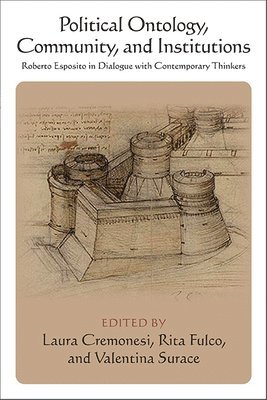
    Political Ontology, Community, and Institutions

    Roberto Esposito in Dialogue with Contemporary Thinkers

    AvLaura Cremonesi,Rita Fulco

    Häftad, Engelska, 2025

    Del i serien SUNY series in Contemporary Italian Philosophy

    401 kr

    Skickas . Fri frakt över 249 kr.

    Beskrivning

    Focuses on key aspects of Robert Esposito's thought and explores the ways in which some major contemporary thinkers have been crucial interlocutors in their elaboration.Political Ontology, Community, and Institutions offers a broad view of the current philosophical dialogue in Italy, both in relation to Robert Esposito's own thought and with respect to major issues and authors of crucial philosophical relevance. From his earliest works, Esposito questions the crisis of politics and why thought is unable to convincingly respond to it. He does so by distancing himself not only from political theology but also from those paradigms-destituent and constituent-that have lost nowadays much of their analytical and propositional capacity. However, his proposal is not only critical. Esposito's thought relates to our present through the creation of new categories-among the most recent, those of "instituting thought" and "common immunity"-capable of opening a breach in an apparently increasingly closed horizon. Therefore, dealing with his thought means, first of all, dealing with our present. This is the main goal of this volume, which focuses on Esposito's dialogue with major contemporary thinkers. Also included is an unpublished interview with Esposito conducted by the editors.

    Produktinformation

    • Utgivningsdatum:2025-11-02
    • Mått:152 x 229 x 16 mm
    • Vikt:340 g
    • Format:Häftad
    • Språk:Engelska
    • Serie:SUNY series in Contemporary Italian Philosophy
    • Antal sidor:244
    • Förlag:State University of New York Press
    • ISBN:9798855802092

    Utforska kategorier

    • Litteraturvetenskap inom Skönlitteratur
    • Europas historia inom Historia och arkeologi
    • Filosofiska discipliner inom Filosofi och religion

    Mer om författaren

    Laura Cremonesi is Researcher in Moral Philosophy at the Scuola Normale Superiore, Pisa, Italy, and Research Director at the Collège International de Philosophie, Paris, France. Rita Fulco is Associate Professor of Theoretical Philosophy at the University of Messina, Italy. Valentina Surace is a Postdoctoral Fellow in Theoretical Philosophy at the University of Messina, Italy.

    Recensioner i media

    "This volume not only constitutes an important contribution to contemporary Italian philosophy, and Italian political philosophy, but also to pandemic studies and post-pandemic philosophy, in particular in relation to the notion of the biopolitical. It will be invaluable to scholars interested in the current state of Esposito's work and in its development over the past several decades, in conversation and at times conflict with many of the most important figures in twentieth-century and contemporary European thought." — Pierre Lamarche, Utah Valley University

    Innehållsförteckning

    • AcknowledgmentsIntroductionLaura Cremonesi, Rita Fulco, Valentina SuracePart One: Politics and Institutions1. From the Impersonal to Instituting Thought: Esposito's Departure from DeleuzeStefania Achella2. From Biopolitics to Common Immunity: The Role of Michel Foucault in the Philosophy of Roberto EspositoLaura Cremonesi3. Conflict and Institution: Roberto Esposito and Claude LefortMattia Di Pierro4. Polis and Polemos: Esposito between Hannah Arendt and Simone WeilRita Fulco5. The Political in Roberto Esposito and Carl SchmittFrancesco MarchesiPart Two: Political Ontology and Community6. On Bodies: Perspectives of a Dialogue between Esposito and NancyDaniela Calabro7. The Impersonal between Ethics and Politics: Roberto Esposito and Emmanuel Levinas on the Third PersonSilvia Dada8. Assurance and Community: The Far Proximity between Esposito and HeideggerSandro Gorgone9. Roberto Esposito and Reiner Schurmann: A Political Ontology after HeideggerAlberto Martinengo, translated by Sarah De Sanctis10. Immunity and Community: A Note of Discord between Roberto Esposito and Jacques DerridaValentina Surace11. From the Neuter to the Instituting Praxis: The Role of Blanchot in Roberto Esposito's ThoughtMassimo VillaniAppendix: Institutions, Conflicts, Common Immunity: In Dialogue with Roberto EspositoInterview by Laura Cremonesi, Rita Fulco, and Valentina Surace, translated by Tijana OkicContributorsIndex