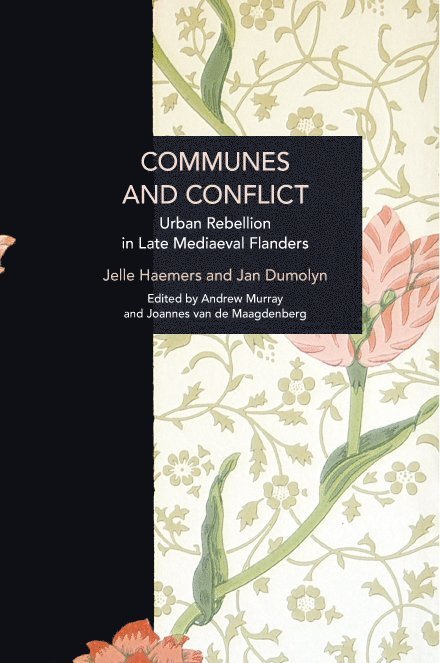
Häftad, Engelska, 2024
Communes and Conflict
Urban Rebellion in Late Medieval Flanders
Del i serien Historical Materialism
553 kr
Beställningsvara. Skickas inom 5-8 vardagar. Fri frakt över 249 kr.
Beskrivning
Produktinformation
- Utgivningsdatum: 2024-09-24
- Mått: 152 x 228 x 27 mm
- Vikt: 704 g
- Format: Häftad
- Språk: Engelska
- Serie: Historical Materialism
- Antal sidor: 488
- Förlag: Haymarket Books
- ISBN: 9798888903285
Utforska kategorier
Mer om författaren
Jan Dumolyn is a professor of history at Ghent University. He has published extensively on late medieval labour history, urban rebellion, politics, material culture and law, as well as more widely on Marxist theory and contemporary class struggle. This includes books on the Bruges uprising of 1436–1438, on Burgundian local governance, court societies and state-formation and on struggles from "the bottom-up" against globalizing neoliberalism..Jelle Haemers is a professor of medieval history at KU Leuven. He has written three books on urban revolts in the county of Flanders. In recent years his research interests have widened to encompass the social history of the late medieval town, notably in the Low Countries (1100–1600). He has also published on the use of social theory in history, the late medieval nobility, and women's history.
Recensioner i media
"Strictly speaking, [Communes and Conflict] is not a new monograph ... but it is a remarkably coherent whole. Due to its quality, it certainly makes an important contribution to the urban history of the Low Countries, social groups in Flanders (with interesting digressions on the rural classes) and phenomena such as opposition and revolt ... Because the book brings together fifteen years of publications, it is methodologically very valuable. It is like a flower that slowly opens until the petals show all their splendor. It is fascinating and instructive to see how the authors' conceptual foundation, based on archive material, is strengthened and expanded with each new contribution."—Michel de Waha, The Low Countries Journal of Social and Economic History
Betyg & recensioner
0 recensioner
Inga recensioner tillgängliga.