• Fri frakt över 249 kr
  • •
  • Snabba leveranser
  • •
  • Billiga böcker
Kundservice

Du är på sajten för privatpersoner.

Företag, bibliotek eller offentlig verksamhet?

Du handlar på classic.bokus.com, där alla dina funktioner finns intakta.
Till classic.bokus.com
Bokus logotyp. Gå till startsidan.
  • Erbjudanden
  • Nyheter
  • Student
  • Topplistor
  • Barn & ungdom
  • Bokus Play
  • E-böcker
  • Pocketböcker
  • Spel & pussel

10% studentrabatt med kod TERM26

Sidfot

Mina sidor

    Hjälp

    • Kundservice
    • Vanliga frågor och svar
    • Frakt och leverans
    • Retur vid ångerrätt
    • Reklamera vara
    • Betalning
    • Köpvillkor
    • Allmänna villkor
    • Information om webbplatsens tillgänglighet

    Om Bokus

    • Om oss
    • Pressrum
    • För studenter
    • För företag
    • För bibliotek och offentlig verksamhet
    • För leverantörer
    • Hållbarhet

    Populärt

    • Aktuella erbjudanden
    • Presentkort
    • Studentlitteratur
    • Nya böcker
    • Topplistor
    • Signerade böcker
    • Engelska böcker

    Inspiration

    • Boktips
    • BookTok
    • Populära bokserier
    • Barnbokskaraktärer
    • Populära författare
    Logotyp för Bokus
    Följ oss på Facebook (extern länk)Följ oss på Instagram (extern länk)Följ oss på YouTube (extern länk)Följ oss på TikTok (extern länk)
    bokus @ CookiesAnpassa cookiesIntegritetspolicyKöpvillkor
    Till Citymail hemsida (extern länk)Till Budbee hemsida (extern länk)Till Postnord hemsida (extern länk)Till Schenker hemsida (extern länk)Till Early Bird hemsida (extern länk)Till Walleys hemsida (extern länk)
    1. Samhälle och politik
    2. Politik och statsskick
    3. Statsskick och politiska processer
    4. Politiskt ledarskap

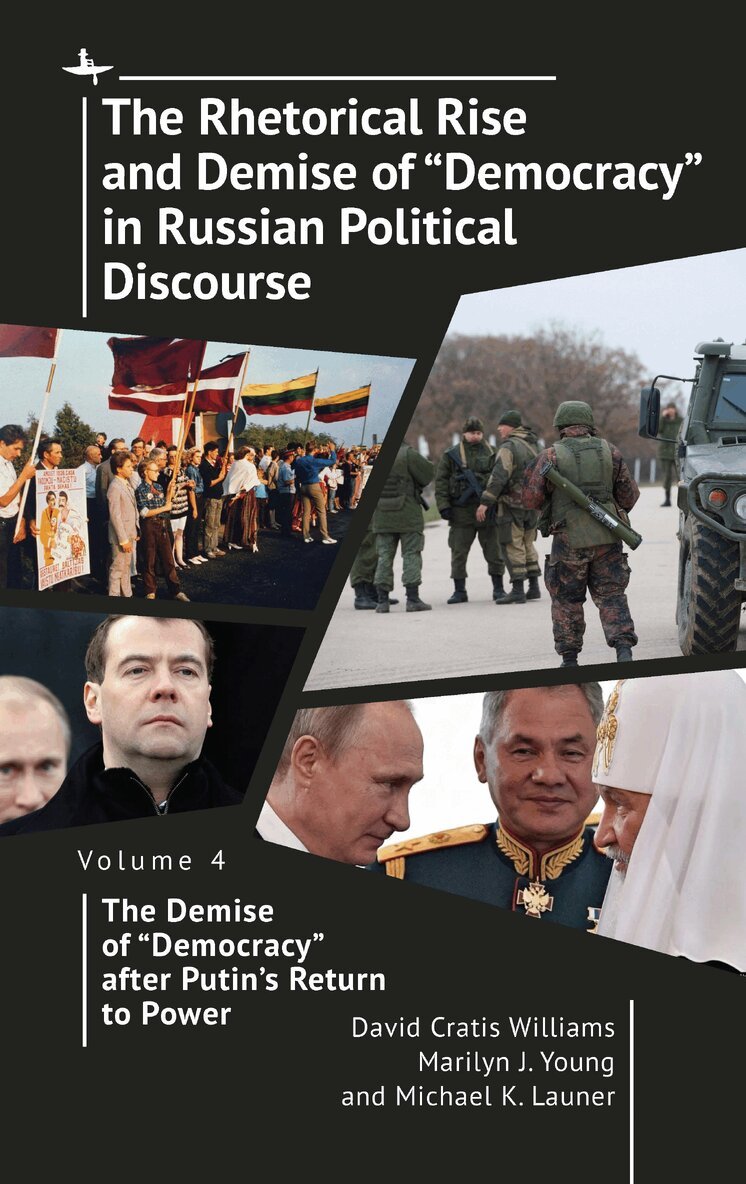
    Rhetorical Rise and Demise of “Democracy” in Russian Political Discourse Volume Four

    The Demise of “Democracy” after Putin’s Return to Power

    AvDavid Cratis Williams,Marilyn J. Young

    Inbunden, Engelska, 2025

    1 581 kr

    Beställningsvara. Skickas inom 5-8 vardagar. Fri frakt över 249 kr.

    Beskrivning

    In this volume we focus on the years following Putin’s return to the presidency in 2012. This has been a more active period than his first two terms, including the annexation of Crimea and, ultimately, the invasion of Ukraine. Thus, this period may be characterized as the run-up to that war. The core issue discussed in this volume is Putin’s redefinition of “democracy” as the foundation of society and government in the Russian Federation. Putin argues for a strong central government in which unity is characterized as the absence of dissent. In so doing, Putin seeks to recast Russian national identity, relying on a vision of Russia as the victim of Western aggression.

    Produktinformation

    • Utgivningsdatum:2025-12-04
    • Mått:155 x 233 x 35 mm
    • Vikt:1 112 g
    • Format:Inbunden
    • Språk:Engelska
    • Antal sidor:638
    • Förlag:Academic Studies Press
    • ISBN:9798897830367

    Utforska kategorier

    • Politiskt ledarskap inom Samhälle och politik
    • Statsskick: demokrati inom Samhälle och politik
    • Internationella relationer inom Samhälle och politik

    Mer om författaren

    David Cratis Williams is retired Professor of Communication and Rhetorical Studies at Florida Atlantic University. His scholarship focuses on argumentation, rhetorical theory, and criticism; he is a recognized authority on Kenneth Burke. His work on Russian political discourse began during a meeting in Russia in January 1992.Marilyn J. Young is the Wayne C. Minnick Professor of Communication Emerita at Florida State University. Her research has focused on political argument with an emphasis on the development of political rhetoric and argument in the former Soviet Union, particularly Russia. She remains an active scholar in retirement.Michael K. Launer is Professor Emeritus of Russian at Florida State University. In 1987 he interpreted for the first group of Soviet scientists visiting the United States following the Chernobyl nuclear accident. A State Department certified technical interpreter, he supported Nuclear Regulatory Commission and Department of Energy assistance programs through 2012.

    Recensioner i media

    “This fourth and final volume on the post-Soviet rise and demise of democracy in Russia, featuring democracy’s displacement during Putin’s presidency, provides a rhetorical history of discursive maneuvers to justify authoritarian rule, militarism, and the invasion of Ukraine. Even dictators need to supply the people they rule with a governing rationale. In multiple intersecting analyses, Professors Williams, Young, and Launer draw on a range of methods to identify and critique Putin’s redefinition of democracy and its related terms, his reconstruction of Russian history and articulation of a mythic Russia inclusive of Ukraine and Belarus, his emphasis on national unity and uniformity that renders dissent treasonous, and his advancement of a conspiracy theory that features Western-NATO-US collusion with Ukraine’s leaders aimed at undermining Russian sovereignty. This is a uniquely rhetorical study based on decades of research that elucidates the significance of Putin’s principal themes and explores the texture of his argumentation.” — Robert L. Ivie, Professor Emeritus, Indiana University, Bloomington“This is an important work by the three most distinguished experts on Soviet/Russian political discourse writing today, certainly in the West. Their broad backgrounds in rhetoric, argumentation, and Russian culture and language uniquely inform their collaboration to understand the mythic grounding and strategic deployment of language that has shaped the current Russian role in the world. Their four volume journey has covered a remarkable four decades in Russian history, during which a glimmer of democracy rose and then receded. The focus of this fourth volume is a deep analysis of the progression of discourse that has marked Putin’s move from democracy to autocracy. Today, when the Western alliance is in tatters, the newly emerging BRICS Group increases in coherence, and democracy is challenged by autocracy even in its strongest exemplars, this analysis is a must read for those interested in current world affairs.“ — James Klumpp, Professor Emeritus, Department of Communication, University of Maryland“This volume is a substantial and timely contribution to the ongoing academic and public discussion of the evolution of Putin’s domestic and foreign policy leading up to the full-scale invasion of Ukraine. Employing the lens of rhetorical and argumentation theory, the authors trace progression of the Kremlin’s rhetoric from Putin’s manipulation of “the lexicon of democracy” to assert the power vertical and stifle dissent at home to his invocation of the mythical “Russia-of-a-Thousand-Years” to justify foreign aggression. Compellingly argued and accessible written, the book is a must read for all those who are interested in international relations, Russia and Eastern Europe, and the war in Ukraine.” — Ekaterina V. Haskins, Penn State University, author of Remembering the War, Forgetting the Terror: Appeals to Family Memory in Putin's Russia (2024).

    Innehållsförteckning

    • List of PhotosAcknowledgementsContributorsNote to ReadersPrefaceIntroduction to Volume FourPart One: Introduction and OverviewExpansion and Contraction of Argumentative Space for Dissent in Russia fromGorbachev to the PresentRussian Democracy, the Russian State, and the Russian Nation: A LongitudinalArgument Analysis of Culturally Targeted Arguments in Presidential Addresses in the Russian FederationRule of Law, Freedom, and Democracy: Domestic and International BuildingBlocks of Contemporary Russian Political IdeologyPurity of Essence: Russian Exceptionalism and the Origins of Putin's Obsessionwith UkraineThe Lexicon of Democracy in Putin’s SpeechesThe Lexicon of Anti-Democracy in Putin’s SpeechesPart Two: Case StudiesMotivational Structures and Argument Resonance: The Rhetoric of PoliticalRenovation and National Identity in Post-Soviet Russia“Democracy” According to Putin: Explorations in Definitional Argument