Alexeis Garcia-Perez - Böcker
Visar alla böcker från författaren Alexeis Garcia-Perez. Handla med fri frakt och snabb leverans.
11 produkter
11 produkter
2 166 kr
Skickas inom 10-15 vardagar
This book explores the link between environmental knowledge management and the sustainability challenges being faced by organisations, individuals and society. Comprising both theoretical and empirical chapters, the volume describes how knowledge management and organisational learning can help achieve a sustainable tourism sector.Environmental knowledge has become one of the most important resources for organisations in the current competitive environment. Organisations need to turn their knowledge into agile structures to respond to the challenges resulting from current and future environmental challenges, and from increased competitiveness and social changes. It is therefore important for business decision-making processes to be based on environmental knowledge instead of relying on unconfirmed, often biased information. In this vein, reliable knowledge structures and a framework become an imperative for sustainable development. Development of these innovations shall be addressed through systematic mechanisms such as integration of sustainability and environmental issues, attention to technological innovation, improved absorptive capacity, targeting social challenges as well as investment in human resource development.The book will be of great value to students and researchers of social sciences with a focus on tourism, human geography, marketing, knowledge management and environmental studies. The chapters in this book were originally published as a special issue of Journal of Sustainable Tourism.
647 kr
Skickas inom 10-15 vardagar
This book explores the link between environmental knowledge management and the sustainability challenges being faced by organisations, individuals and society. Comprising both theoretical and empirical chapters, the volume describes how knowledge management and organisational learning can help achieve a sustainable tourism sector.Environmental knowledge has become one of the most important resources for organisations in the current competitive environment. Organisations need to turn their knowledge into agile structures to respond to the challenges resulting from current and future environmental challenges, and from increased competitiveness and social changes. It is therefore important for business decision-making processes to be based on environmental knowledge instead of relying on unconfirmed, often biased information. In this vein, reliable knowledge structures and a framework become an imperative for sustainable development. Development of these innovations shall be addressed through systematic mechanisms such as integration of sustainability and environmental issues, attention to technological innovation, improved absorptive capacity, targeting social challenges as well as investment in human resource development.The book will be of great value to students and researchers of social sciences with a focus on tourism, human geography, marketing, knowledge management and environmental studies. The chapters in this book were originally published as a special issue of Journal of Sustainable Tourism.
628 kr
Skickas inom 7-10 vardagar
Knowledge management metrics are one of the weakest areas of practice in the field. Overwhelmingly, the literature that exists focuses on case studies and incidents of metrics, rather than approaching the concept holistically. Addressing this lack, expert authors Alexeis Garcia-Perez, Farah Gheriss and Denise Bedford come together to supply a fundamental discussion of measurement cultures and philosophy, types of metrics, and how to use metrics to grow an organization. They offer a guide for knowledge management professionals to report on progress against goals and targets in terms that are understandable and comparable to their organizational peers, enabling professionals from across businesses to communicate with metrics and engage in wider discussion about the process of achieving organizational visions. Providing practical guidance for identifying different types of measurements and metrics, as well as methods for defining and collection information about metrics, this is an essential book for knowledge management professionals and researchers on the path to improving metric literacy across their organizations.
1 154 kr
Skickas inom 7-10 vardagar
Knowledge translation is a topic that originated in the field of health sciences where the need to move research to practice is of critical importance. In parallel, the field of knowledge sciences has developed a research base around knowledge transfer, knowledge sharing, knowledge exchange, knowledge articulation and knowledge absorption. This book brings these two important tracks together and synthesizes the fragmented literatures. It also draws from essential work on human communication and considers how these concepts are affected by the knowledge economy.The book raises awareness of the critical role that knowledge translation plays in every academic field of study, and in everyday life. To demonstrate this role, the book presents a grounding model that readers can use to better ‘see’ their knowledge translation challenges and opportunities. Drawing on the author team’s experience in a range of domains and sectors, the book explores knowledge translation in the fields of manufacturing, infectious diseases, automated call centers, regulatory development and compliance, financial lending, transportation safety, and doctor-patient discourse.
1 156 kr
Skickas inom 7-10 vardagar
The Mask Methodology and Knowledge Books enables an organization to develop knowledge books, which have proven to be easy to use, easy to store, find and manage, and easy to update as organizational knowledge changes. They have also proven to be highly effective self-study and training resources. Until now, application of the methodology has been limited to Europe – specifically French speaking countries, because the source documentation and in person training materials have not yet been translated to languages other than French.This compelling new contribution to the field comprises of: A review the types of knowledge capital, and highlight the critical role of tacit knowledge in business operations; an introduction to the economic context for identifying and valuing critical business knowledge; and explanation of the relationship of knowledge engineering to MASK (Method for Analyzing and Structuring Knowledge); a outline of the six models that comprise the MASK model; an explanation of the importance of focusing on expertise that is well recognized by and essential to an organization; instruction on how to design a Knowledge Book for self-study and training; and a guide to building a governance and maintenance process for knowledge books.
1 353 kr
Kommande
Over the past seventy years, the world has been transitioning from an advanced industrial society and economy to a knowledge society and economy. The term "knowledge society" has been used freely with little concrete definition or characterization. A society is a living thing – it is complex, constantly changing, and multifaceted. Invisible for many years, the pieces and effects of the transition are increasingly evident. Today, people sense that a change is afoot, but they do not have a clear understanding of the nature of the change or how it will affect them. They are challenged to see how they can position themselves to thrive in the new society. A fundamental myth about a knowledge society is that it is focused on people who work in high-profile roles, whose work is information and data-intensive. In fact, a knowledge society is one that values and leverages knowledge as capital and recognizes the knowledge capital of every member of that society. The book explains how spaces and places affect how knowledge capital is created, leveraged, shared, adapted and regenerated in everyday living, working and socializing. The authors draw on the rich thinking and literature on spaces and places to illustrate these ideas in everyday life. The book fills a long-standing gap in the field of knowledge sciences and knowledge economics. It provides an anchor point for understanding the importance of the other aspects and subfields of knowledge management.
1 154 kr
Skickas inom 7-10 vardagar
In 2025 the shift from an industrial to a knowledge economy is underway. The shift has introduced changes in our essential economic assumptions and models in how markets behave and the nature and sources of capital. The shift is affecting the way we do business and the ways we manage our organizations and operations. Over the past two hundred years, we have developed and perfected methods and tactics to help us analyze and cope with the economic environment. These established methods and tactics are no longer sufficient. The knowledge economy requires a new foundation of knowledge capital. To be strategic and intelligent the old analytical methods just adapt, and new methods are needed. The latest volume of Working Methods for Knowledge Management speaks to doing intelligence in the dynamic, chaotic and continuously changing environment of the 21st century. It is predicated on the understanding that every intelligence situation or dilemma is unique. It is predicated on the rapidly evolving shift in management and the changing nature and structures of organizations. The authors consider the changing nature of markets, economic transactions, and competition in the knowledge economy. What can we learn from exploring the new economic environment to design a new approach to strategic intelligence?The authors make a case for strategic intelligence grounded in knowledge capital assets and present a conceptual model and framework for managers and practitioners to consider in designing a new approach. The conceptual model considers eight critical factors when designing a new approach with the text providing in-depth explanation of these factors. By adapting the existing tools and developing new tools to transform this critical practice for the knowledge economy, strategic intelligence offers an indispensable guide for anyone working in the knowledge and business management spaces.
1 086 kr
Skickas inom 7-10 vardagar
The knowledge sciences field has long recognized the importance of communities of practice to the flow of knowledge and situational learning. However, the literature and research has focused mainly on communities in formal organizational contexts. This constraint has limited research and exploration and exposed only a small portion of the knowledge of communities of practice. Focusing only on organizational communities of practice further restricts what we have learned about the full range of knowledge capabilities.The Knowledge of Communities provides an inclusive and comprehensive conceptual framework for understanding the spectrum of communities of practice and their relationship to the development of knowledge capital. Presenting a core standpoint that incorporates the variant perspectives of community processes from social sciences, psychology, behavioral sciences, communication and economics, the authors review existing research, identifying areas where additional work is needed, and present the results as a practical field guide for managers that can be utilized for analyzing any community of practice.
887 kr
Skickas inom 7-10 vardagar
The 21st century economy is fuelled by knowledge. Today, knowledge is more than an idea - it is an economic commodity. An organization's knowledge capital is a competitive and comparative advantage. Every organization must now invest in the knowledge assets of all its employees. Learning is the engine that creates and renews knowledge capital.Learning Organizations delves into why learning is an essential business operation; how modern learning is different from industrial-era training; how to discover learning sources and opportunities; how to design a learning environment and learning strategies that optimize the potential of every employee.This is essential reading for business managers, human resource professionals, and academic researchers studying knowledge economies, knowledge, and intellectual capital.
1 068 kr
Skickas inom 5-8 vardagar
520 kr
Skickas inom 10-15 vardagar
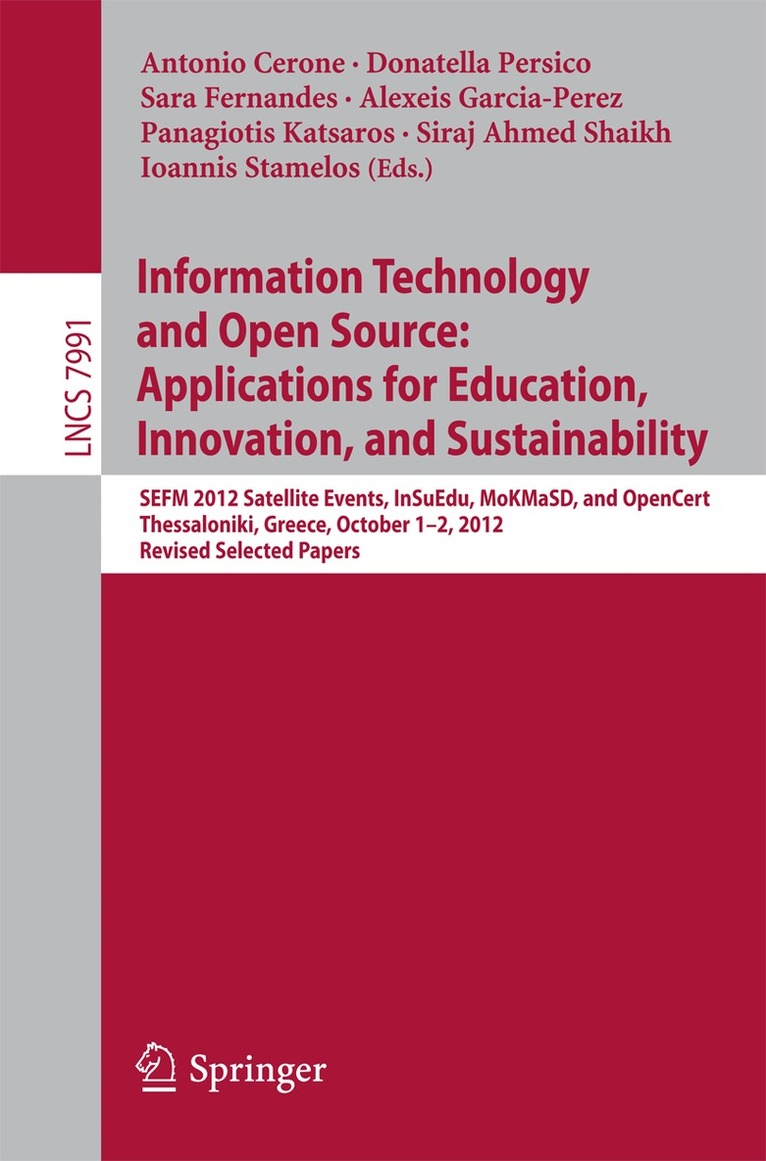
This book constitutes revised selected papers from the following SEFM 2012 satellite events: InSuEdu, the First International Symposium on Innovation and Sustainability in Education; MokMaSD, the First International Symposium on Modelling and Knowledge Management for Sustainable Development and Open Cert, the 6th International Workshop on Foundations and Techniques for Open Source Software Certification, held in Thessaloniki, Greece, in October 2012. The total of 14 regular papers and 7 short papers included in this volume were carefully reviewed and selected from 35 submissions. The papers cover the topics related to the use of Information and Communication Technology (ICT) and Open Source Software (OSS) as tools to foster and support Education, Innovation and Sustainability.