Alf Kimms – författare
Visar alla böcker från författaren Alf Kimms. Handla med fri frakt och snabb leverans.
8 produkter
8 produkter
Inbunden, Engelska, 2001
547 kr
Skickas inom 10-15 vardagar
Mathematical Programming and Financial Objectives for Scheduling Projects focuses on decision problems where the performance is measured in terms of money. As the title suggests, special attention is paid to financial objectives and the relationship of financial objectives to project schedules and scheduling. In addition, how schedules relate to other decisions is treated in detail. The book demonstrates that scheduling must be combined with project selection and financing, and that scheduling helps to give an answer to the planning issue of the amount of resources required for a project. The author makes clear the relevance of scheduling to cutting budget costs. The book is divided into six parts. The first part gives a brief introduction to project management. Part two examines scheduling projects in order to maximize their net present value. Part three considers capital rationing. Many decisions on selecting or rejecting a project cannot be made in isolation and multiple projects must be taken fully into account. Since the requests for capital resources depend on the schedules of the projects, scheduling taken on more complexity. Part four studies the resource usage of a project in greater detail. Part five discusses cases where the processing time of an activity is a decision to be made. Part six summarizes the main results that have been accomplished.
Häftad, Engelska, 2012
547 kr
Skickas inom 10-15 vardagar
Mathematical Programming and Financial Objectives for Scheduling Projects focuses on decision problems where the performance is measured in terms of money. As the title suggests, special attention is paid to financial objectives and the relationship of financial objectives to project schedules and scheduling. In addition, how schedules relate to other decisions is treated in detail. The book demonstrates that scheduling must be combined with project selection and financing, and that scheduling helps to give an answer to the planning issue of the amount of resources required for a project. The author makes clear the relevance of scheduling to cutting budget costs. The book is divided into six parts. The first part gives a brief introduction to project management. Part two examines scheduling projects in order to maximize their net present value. Part three considers capital rationing. Many decisions on selecting or rejecting a project cannot be made in isolation and multiple projects must be taken fully into account. Since the requests for capital resources depend on the schedules of the projects, scheduling taken on more complexity. Part four studies the resource usage of a project in greater detail. Part five discusses cases where the processing time of an activity is a decision to be made. Part six summarizes the main results that have been accomplished.
E-bok
PDF, Engelska, 2012687 kr
Läs direkt efter köp
Mathematical Programming and Financial Objectives for Scheduling Projects focuses on decision problems where the performance is measured in terms of money. As the title suggests, special attention is paid to financial objectives and the relationship of financial objectives to project schedules and scheduling. In addition, how schedules relate to other decisions is treated in detail. The book demonstrates that scheduling must be combined with project selection and financing, and that scheduling helps to give an answer to the planning issue of the amount of resources required for a project. The author makes clear the relevance of scheduling to cutting budget costs. The book is divided into six parts. The first part gives a brief introduction to project management. Part two examines scheduling projects in order to maximize their net present value. Part three considers capital rationing. Many decisions on selecting or rejecting a project cannot be made in isolation and multiple projects must be taken fully into account. Since the requests for capital resources depend on the schedules of the projects, scheduling taken on more complexity. Part four studies the resource usage of a project in greater detail. Part five discusses cases where the processing time of an activity is a decision to be made. Part six summarizes the main results that have been accomplished.
Inbunden, Engelska, 1998
1 123 kr
Skickas inom 10-15 vardagar
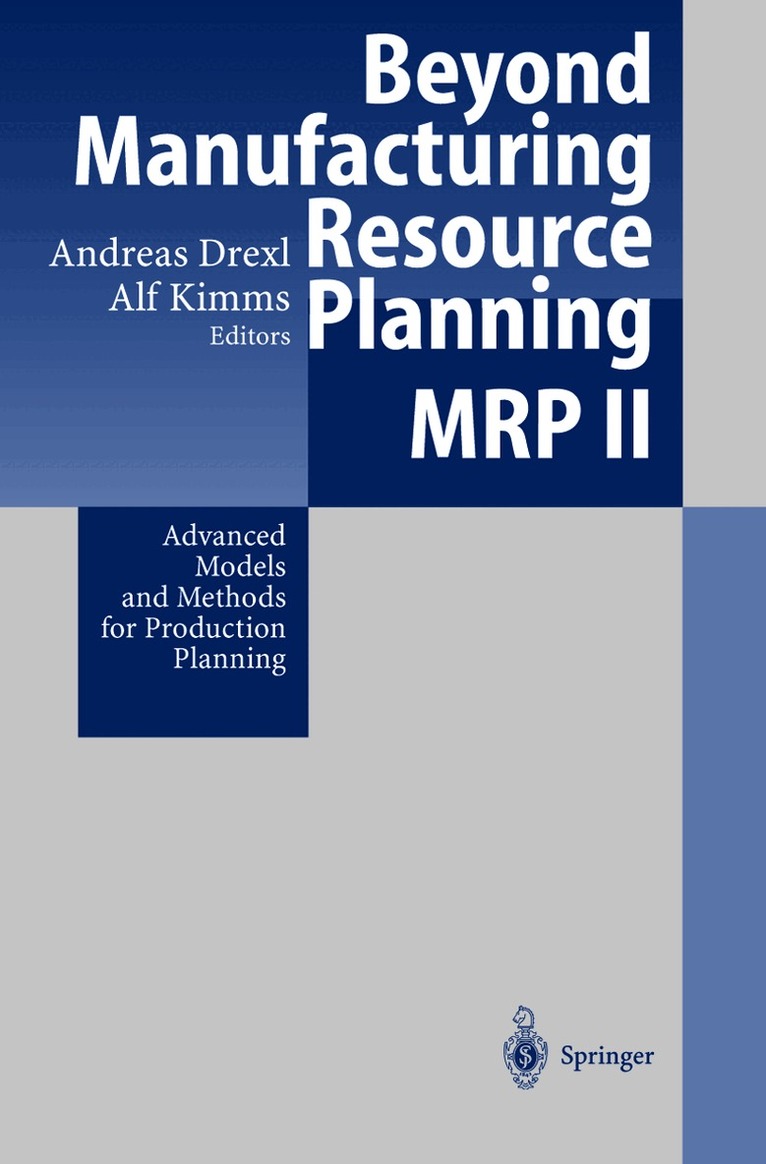
The logic of Manufacturing Resource Planning (MRP II) is im plemented in most commercial production planning software tools and is commonly accepted by practitioners. However, these peo ple are not satisfied with production planning and complain about long lead times, high work-in-process, and backlogging. As many researchers have pointed out, the reason for these shortcomings is inherent to the methods that are used. The research community is thus eager to find more sophisticated approaches. This book is an attempt to compile some state-of-the-art work in the field of production planning research. It includes mate rial that somehow dominates the existing MRP II concept. 15 ar ticles written by 36 authors from 10 countries cover many aspects related to MRP II. All papers went through a single-blind refere eing process before they were selected for being published in this book. When we received papers for this issue, we discovered that MRP II is a topic about which not only management scientists show interest. As the list of authors proves, industrial engineers, computer scientists, and-operations researchers from academia as well as practitioners have contributed to this book. This, we hope, makes the book of value for a broad audience. We thank all authors who submitted papers. And, we are in debted to Dr. Werner Muller from Springer for his support in this book project.
Häftad, Engelska, 2010
1 092 kr
Skickas inom 10-15 vardagar
The logic of Manufacturing Resource Planning (MRP II) is im plemented in most commercial production planning software tools and is commonly accepted by practitioners. However, these peo ple are not satisfied with production planning and complain about long lead times, high work-in-process, and backlogging. As many researchers have pointed out, the reason for these shortcomings is inherent to the methods that are used. The research community is thus eager to find more sophisticated approaches. This book is an attempt to compile some state-of-the-art work in the field of production planning research. It includes mate rial that somehow dominates the existing MRP II concept. 15 ar ticles written by 36 authors from 10 countries cover many aspects related to MRP II. All papers went through a single-blind refere eing process before they were selected for being published in this book. When we received papers for this issue, we discovered that MRP II is a topic about which not only management scientists show interest. As the list of authors proves, industrial engineers, computer scientists, and-operations researchers from academia as well as practitioners have contributed to this book. This, we hope, makes the book of value for a broad audience. We thank all authors who submitted papers. And, we are in debted to Dr. Werner Muller from Springer for his support in this book project.
E-bok
PDF, Engelska, 2012708 kr
Läs direkt efter köp
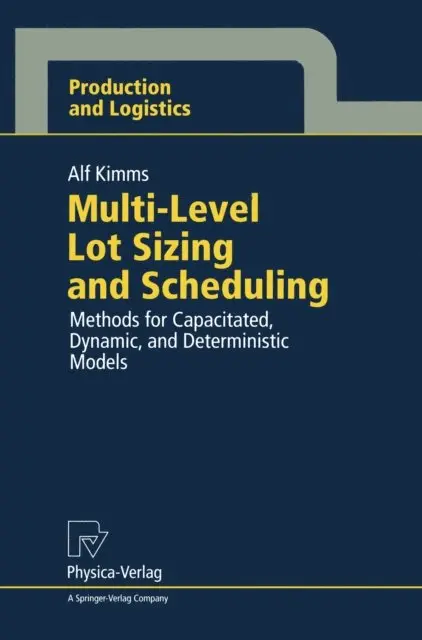
This book is the outcome of my research in the field of multi levellot sizing and scheduling which started in May 1993 at the Christian-Albrechts-University of Kiel (Germany). During this time I discovered more and more interesting aspects ab out this subject and I had to learn that not every promising idea can be thoroughly evaluated by one person alone. Nevertheless, I am now in the position to present some results which are supposed to be useful for future endeavors. Since April 1995 the work was done with partial support from the research project no. Dr 170/4-1 from the "Deutsche For schungsgemeinschaft" (D FG). The remaining space in this preface shaH be dedicated to those who gave me valuable support: First, let me express my deep gratitude towards my thesis ad visor Prof. Dr. Andreas Drexl. He certainly is a very outstanding advisor. Without his steady suggestions, this work would not have come that far. Despite his scarce time capacities, he never rejected proof-reading draft versions of working papers, and he was always willing to discuss new ideas - the good as weH as the bad ones. He and Prof. Dr. Gerd Hansen refereed this thesis. I am in debted to both for their assessment. I am also owing something to Dr. Knut Haase. Since we al most never had the same opinion when discussing certain lot sizing aspects, his comments and criticism gave stimulating input.
E-bok
PDF, Engelska, 20131 367 kr
Läs direkt efter köp
The logic of Manufacturing Resource Planning (MRP II) is im plemented in most commercial production planning software tools and is commonly accepted by practitioners. However, these peo ple are not satisfied with production planning and complain about long lead times, high work-in-process, and backlogging. As many researchers have pointed out, the reason for these shortcomings is inherent to the methods that are used. The research community is thus eager to find more sophisticated approaches. This book is an attempt to compile some state-of-the-art work in the field of production planning research. It includes mate rial that somehow dominates the existing MRP II concept. 15 ar ticles written by 36 authors from 10 countries cover many aspects related to MRP II. All papers went through a single-blind refere eing process before they were selected for being published in this book. When we received papers for this issue, we discovered that MRP II is a topic about which not only management scientists show interest. As the list of authors proves, industrial engineers, computer scientists, and-operations researchers from academia as well as practitioners have contributed to this book. This, we hope, makes the book of value for a broad audience. We thank all authors who submitted papers. And, we are in debted to Dr. Werner Muller from Springer for his support in this book project.
Häftad, Engelska, 1996
549 kr
Skickas inom 10-15 vardagar
This book is the outcome of my research in the field of multi levellot sizing and scheduling which started in May 1993 at the Christian-Albrechts-University of Kiel (Germany). During this time I discovered more and more interesting aspects ab out this subject and I had to learn that not every promising idea can be thoroughly evaluated by one person alone. Nevertheless, I am now in the position to present some results which are supposed to be useful for future endeavors. Since April 1995 the work was done with partial support from the research project no. Dr 170/4-1 from the "Deutsche For schungsgemeinschaft" (D FG). The remaining space in this preface shaH be dedicated to those who gave me valuable support: First, let me express my deep gratitude towards my thesis ad visor Prof. Dr. Andreas Drexl. He certainly is a very outstanding advisor. Without his steady suggestions, this work would not have come that far. Despite his scarce time capacities, he never rejected proof-reading draft versions of working papers, and he was always willing to discuss new ideas - the good as weH as the bad ones. He and Prof. Dr. Gerd Hansen refereed this thesis. I am in debted to both for their assessment. I am also owing something to Dr. Knut Haase. Since we al most never had the same opinion when discussing certain lot sizing aspects, his comments and criticism gave stimulating input.