Allan M. Maslove – författare
Visar alla böcker från författaren Allan M. Maslove. Handla med fri frakt och snabb leverans.
9 produkter
9 produkter
E-bok
PDF, Engelska, 2008346 kr
Läs direkt efter köp
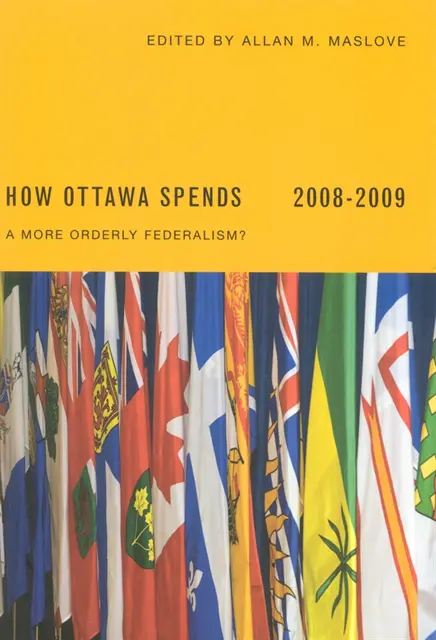
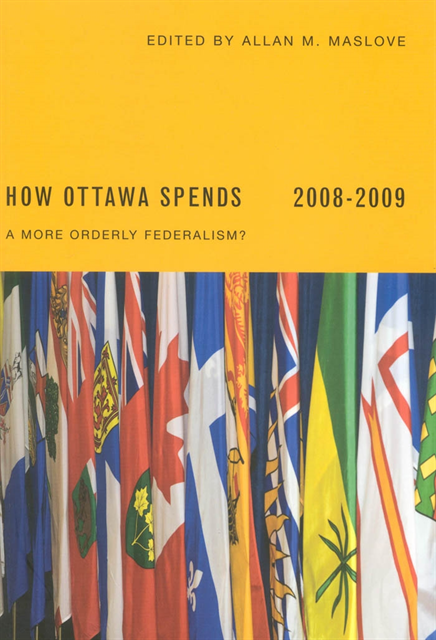
The twenty-ninth edition of How Ottawa Spends focuses on the policies of the Harper government and the course of federal-provincial relations. Leading scholars of Canadian public policy explore several key policy areas, including fiscal balance in the federation, tax policy, regulatory capacity, the federal funding of territorial and northern Aboriginal governments, child care policy, higher education policy, telecommunications policy, and the rapid appearance and disappearance of the federal social economy initiative - i.e., "how Ottawa doesn''t spend." Contributors include Frances Abele (Carleton & IRPP), Cheryl N. Collier (Carleton), Geoffrey Hale (University of Lethbridge), Walter Hettich (emeritus, California State), Edward T. Jackson (Carleton), Rianne Mahon (Carleton), Allan M. Maslove (Carleton), Clara Morgan (Carleton), Michael J. Prince (University of Victoria), Richard Schultz (McGill), Robert Slater (Carleton), Barry Stemshorn (University of Ottawa), and Stanley L. Winer (Carleton).
E-bok
PDF, Engelska, 2010333 kr
Läs direkt efter köp
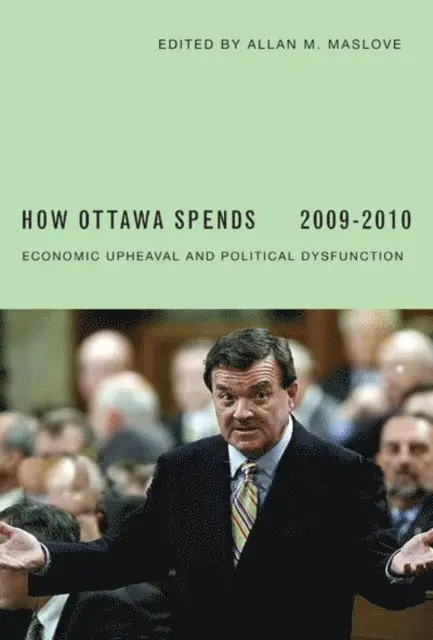
This is the thirtieth volume in the series How Ottawa Spends. It is arguable that never in these years have Canadians faced such serious economic upheaval and political dysfunction as the current climate. The dramatic and seemingly sudden changes in the economy occurred simultaneously with a political drama - one that was largely disassociated from the real and pressing economic challenge. Early Harper budgets delivered lower taxes for all Canadians partly through highly targeted but politically noticeable small tax breaks on textbooks for students, tools for apprentices in skilled trades, and public transit costs. The needs of the beleaguered average Canadian and the "swing voter in the swing constituencies" of an already strategized "next" election were a key part of Conservative agenda-setting. In the 2007 budget alone there were twenty-nine separate tax reductions and federal spending was projected to increase by $10 billion, including a 5.7 percent increase in program spending. A small surplus of $3.3 billion was planned, almost all of which would go to debt reduction. As Harper savoured his 14 October 2008 re-election with a strengthened minority government, although without his desired majority, he and his minister of Finance already knew that his surpluses were likely gone in the face of the crashing financial sector and a looming recession. Future deficits were firmly back on the agenda. Contributors include Malcolm G. Bird (Carleton University), Chris Brown (Carleton University), G. Bruce Doern (Carleton University and University of Exeter), Melissa Haussman (Carleton University), Robert Hilton (Carleton University), Ruth Hubbard (University of Ottawa), Edward T. Jackson (Carleton University), Kirsten Kozolanka (Carleton University), Evert Lindquist (University of Victoria), Allan M. Maslove (Carleton University), Peter Nares (Social and Enterprise Development Innovations), Gilles Paquet (University of Ottawa), L. Pauline Rankin (Carleton University), Jennifer Robson (Carleton University), Robert P. Shepherd (Carleton University), Richard Shillington (Informetrica Limited), and Chris Stoney (Carleton University).
E-bok
Engelska, 2009346 kr
Läs direkt efter köp
The twenty-ninth edition of How Ottawa Spends focuses on the policies of the Harper government and the course of federal-provincial relations. Leading scholars of Canadian public policy explore several key policy areas, including fiscal balance in the federation, tax policy, regulatory capacity, the federal funding of territorial and northern Aboriginal governments, child care policy, higher education policy, telecommunications policy, and the rapid appearance and disappearance of the federal social economy initiative - i.e., "how Ottawa doesn''t spend." Contributors include Frances Abele (Carleton & IRPP), Cheryl N. Collier (Carleton), Geoffrey Hale (University of Lethbridge), Walter Hettich (emeritus, California State), Edward T. Jackson (Carleton), Rianne Mahon (Carleton), Allan M. Maslove (Carleton), Clara Morgan (Carleton), Michael J. Prince (University of Victoria), Richard Schultz (McGill), Robert Slater (Carleton), Barry Stemshorn (University of Ottawa), and Stanley L. Winer (Carleton).
E-bok
PDF, Engelska, 2013358 kr
Läs direkt efter köp
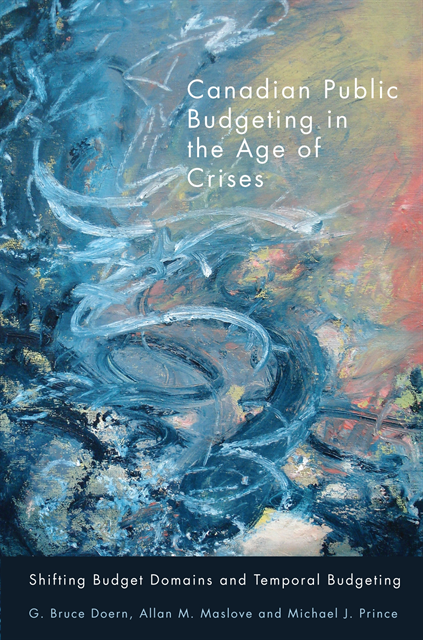
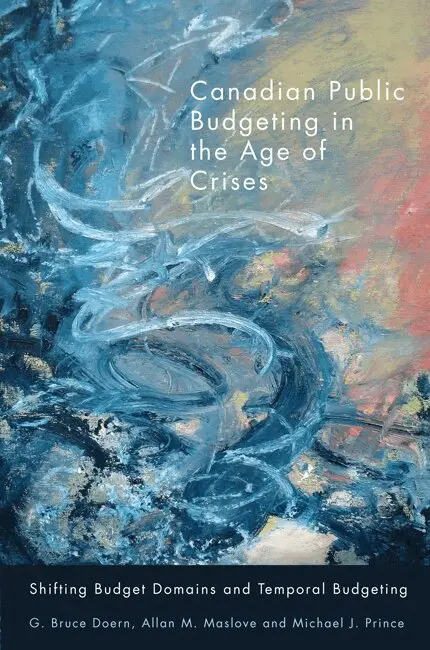
In the aftermath of the 2008 financial crunch, a pending era of budgetary austerity looms over Canada. Canadian Public Budgeting in the Age of Crises provides a roadmap through the difficult fiscal decisions that have characterized contemporary federal politics across four decades. The authors provide an accessible and comprehensive overview of the constraints that have affected budgetary outcomes in the recent past and that will affect the near future, with analysis spanning micro, macro, social, environmental, and intergenerational domains. They examine the current Harper government''s Conservative era, but also look at public budgeting under Chrétien, Mulroney, and Trudeau. Set in the crucial context of macroeconomic policy shifts and in a global comparative context, Canadian Public Budgeting in the Age of Crises broadens and deepens our understanding of government spending, borrowing, and taxing. Budgetary domains - complex realms of fiscal content, choice, and governance - are introduced and balanced against an analysis of these domains with pertinent and up-to-date discussions on institutional influences, dominant actors, and shifting power imbalances.
E-bok
Engelska, 2013358 kr
Läs direkt efter köp
In the aftermath of the 2008 financial crunch, a pending era of budgetary austerity looms over Canada. Canadian Public Budgeting in the Age of Crises provides a roadmap through the difficult fiscal decisions that have characterized contemporary federal politics across four decades. The authors provide an accessible and comprehensive overview of the constraints that have affected budgetary outcomes in the recent past and that will affect the near future, with analysis spanning micro, macro, social, environmental, and intergenerational domains. They examine the current Harper government''s Conservative era, but also look at public budgeting under Chrétien, Mulroney, and Trudeau. Set in the crucial context of macroeconomic policy shifts and in a global comparative context, Canadian Public Budgeting in the Age of Crises broadens and deepens our understanding of government spending, borrowing, and taxing. Budgetary domains - complex realms of fiscal content, choice, and governance - are introduced and balanced against an analysis of these domains with pertinent and up-to-date discussions on institutional influences, dominant actors, and shifting power imbalances.
Häftad, Engelska, 1994
458 kr
Skickas inom 3-6 vardagar
Häftad, Engelska, 1993
458 kr
Skickas inom 3-6 vardagar
Häftad, Engelska, 1994
534 kr
Skickas inom 3-6 vardagar
Häftad, Engelska, 1994
323 kr
Skickas inom 3-6 vardagar