Andrew G. Walder - Böcker
Visar alla böcker från författaren Andrew G. Walder. Handla med fri frakt och snabb leverans.
14 produkter
14 produkter
668 kr
Skickas inom 5-8 vardagar
China's post-Mao economic reforms have generated and sustained economic growth, unprecedented rises in real income and living standards, and have transformed a long-time insular economy into a major trading nation. China now figures prominently in international policy debates about what is to be done to transform the stagnating economies of Eastern Europe. As a gradual rather than an abrupt transition to the market, with public industry protected rather than subject to privatization, China's reform path has confounded the widespread and deeply held belief that gradual reform and public ownership simply cannot work.The contributions to this volume draw out the policy and theoretical implications of China's transitional economy. They lay out the notable features of China's reform path, analyse the successes and failures of the reform, and discuss whether they can be sustained, or whether the uncertain leadership transition, growing potential for social instability, and continuing problems of unemployment, uprooted rural populations, deepening political corruption, and declining central power point to a future fraught with risk and instability.After an introduction and overview by the editor, the first two chapters ask whether China enjoyed advantages that may have made its reform path easier than those of Eastern European countries. The next four chapters examine various dimensions of China's economy: agricultural commerce, property rights, foreign trade, and macroeconomic stability. Two subsequent chapters examine the role of political institutions, and the final chapter, synthesising the lessons of China's reforms, critiques the dogmatism of some economic analysis and calls for greater institutional and historical realism.
577 kr
Skickas inom 3-6 vardagar
Based on official Chinese sources as well as intensive interviews with Hong Kong residents formerly employed in mainland factories, Andrew Walder's neo-traditional image of communist society in China will be of interest not only to those concerned with China and other communist countries, but also to students of industrial relations and comparative social science.
267 kr
Tillfälligt slut
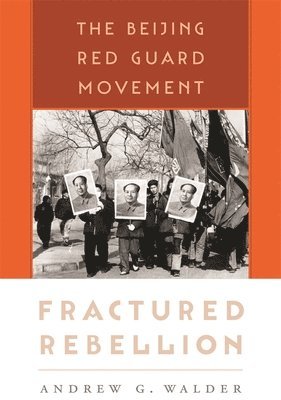
Fractured Rebellion is the first full-length account of the evolution of China’s Red Guard Movement in Beijing, the nation’s capital, from its beginnings in 1966 to its forcible suppression in 1968. Andrew Walder combines historical narrative with sociological analysis as he explores the radical student movement’s crippling factionalism, devastating social impact, and ultimate failure.Most accounts of the movement have portrayed a struggle among Red Guards as a social conflict that pitted privileged “conservative” students against socially marginalized “radicals” who sought to change an oppressive social and political system. Walder employs newly available documentary evidence and the recent memoirs of former Red Guard leaders and members to demonstrate that on both sides of the bitter conflict were students from comparable socioeconomic backgrounds, who shared similar—largely defensive—motivations. The intensity of the conflict and the depth of the divisions were an expression of authoritarian political structures that continued to exert an irresistible pull on student motives and actions, even in the midst of their rebellion.Walder’s nuanced account challenges the main themes of an entire generation of scholarship about the social conflicts of China’s Cultural Revolution, shedding light on the most tragic and poorly understood period of recent Chinese history.
462 kr
Skickas inom 10-15 vardagar
Why did the Chinese party state collapse so quickly after the onset of the Cultural Revolution? The award-winning author of China Under Mao offers a surprising answer that holds a powerful implicit warning for today’s governments.By May 1966, just seventeen years after its founding, the People’s Republic of China had become one of the most powerfully centralized states in modern history. But that summer everything changed. Mao Zedong called for students to attack intellectuals and officials who allegedly lacked commitment to revolutionary principles. Rebels responded by toppling local governments across the country, ushering in nearly two years of conflict that in places came close to civil war and resulted in nearly 1.6 million dead.How and why did the party state collapse so rapidly? Standard accounts depict a revolution instigated from the top down and escalated from the bottom up. In this pathbreaking reconsideration of the origins and trajectory of the Cultural Revolution, Andrew Walder offers a startling new conclusion: party cadres seized power from their superiors, setting off a chain reaction of violence, intensified by a mishandled army intervention. This inside-out dynamic explains how virulent factions formed, why the conflict escalated, and why the repression that ended the disorder was so much worse than the violence it was meant to contain.Based on over 2,000 local annals chronicling some 34,000 revolutionary episodes across China, Agents of Disorder offers an original interpretation of familiar but complex events and suggests a broader lesson for our times: forces of order that we count on to stanch violence can instead generate devastating bloodshed.
Del 11 - Harvard Contemporary China Series
Zouping in Transition
The Process of Reform in Rural North China
Häftad, Engelska, 1998
406 kr
Skickas inom 10-15 vardagar
Zouping offers important general lessons for the study of China's rural transformation. The authors in this volume, all participants in a unique field research project undertaken from 1988 to 1992, address questions that are far from simple and about which there is some controversy.The questions are grouped around two issues. The first is the role of local governments as economic actors. What is this role, how have they played it, and how can we explain their behavior? Have they dominated rural economies through public ownership of industry and local planning, or has the role of local governments diminished with the rise of market transactions and private ownership? The second issue is market reform and inequality. Have rural cadres enjoyed income advantages in the new market environment? Has the provision of such collective services as education and health care declined, leading to new forms of inequality?The chapters on the role of local government all point to a single conclusion: one cannot explain the rapid development of Zouping without reference to the role of local governments and of local government officials as economic actors. Scholarly writings about the "transitional economies" have often ignored or distorted this aspect of China's reform experience. On the second issue, changes in inequality owing to market reform, the authors present mixed findings but contribute rich new data to the research on this issue.
258 kr
Skickas inom 7-10 vardagar
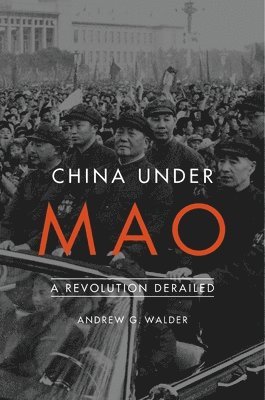
China’s Communist Party seized power in 1949 after a long period of guerrilla insurgency followed by full-scale war, but the Chinese revolution was just beginning. China Under Mao narrates the rise and fall of the Maoist revolutionary state from 1949 to 1976—an epoch of startling accomplishments and disastrous failures, steered by many forces but dominated above all by Mao Zedong.“Walder convincingly shows that the effect of Maoist inequalities still distorts China today…[It] will be a mind-opening book for many (and is a depressing reminder for others).”—Jonathan Mirsky, The Spectator“Andrew Walder’s account of Mao’s time in power is detailed, sophisticated and powerful…Walder takes on many pieces of conventional wisdom about Mao’s China and pulls them apart…What was it that led so much of China’s population to follow Mao’s orders, in effect to launch a civil war against his own party? There is still much more to understand about the bond between Mao and the wider population. As we try to understand that bond, there will be few better guides than Andrew Walder’s book. Sober, measured, meticulous in every deadly detail, it is an essential assessment of one of the world’s most important revolutions.”—Rana Mitter, Times Literary Supplement
291 kr
Skickas inom 7-10 vardagar
A revealing exploration of political disruption and violence in a rural Chinese county during the Cultural RevolutionA Decade of Upheaval chronicles the surprising and dramatic political conflicts of a rural Chinese county over the course of the Cultural Revolution. Drawing on an unprecedented range of sources—including work diaries, interviews, internal party documents, and military directives—Dong Guoqiang and Andrew Walder uncover a previously unimagined level of strife in the countryside that began with the Red Guard Movement in 1966 and continued unabated until the death of Mao Zedong in 1976.Showing how the upheavals of the Cultural Revolution were not limited to urban areas, but reached far into isolated rural regions, Dong and Walder reveal that the intervention of military forces in 1967 encouraged factional divisions in Feng County because different branches of China’s armed forces took various sides in local disputes. The authors also lay bare how the fortunes of local political groups were closely tethered to unpredictable shifts in the decisions of government authorities in Beijing. Eventually, a backlash against suppression and victimization grew in the early 1970s and resulted in active protests, which presaged the settling of scores against radical Maoism.A meticulous look at how one overlooked region experienced the Cultural Revolution, A Decade of Upheaval illuminates the all-encompassing nature of one of the most unstable periods in modern Chinese history.
899 kr
Skickas inom 7-10 vardagar
A revealing exploration of political disruption and violence in a rural Chinese county during the Cultural RevolutionA Decade of Upheaval chronicles the surprising and dramatic political conflicts of a rural Chinese county over the course of the Cultural Revolution. Drawing on an unprecedented range of sources—including work diaries, interviews, internal party documents, and military directives—Dong Guoqiang and Andrew Walder uncover a previously unimagined level of strife in the countryside that began with the Red Guard Movement in 1966 and continued unabated until the death of Mao Zedong in 1976.Showing how the upheavals of the Cultural Revolution were not limited to urban areas, but reached far into isolated rural regions, Dong and Walder reveal that the intervention of military forces in 1967 encouraged factional divisions in Feng County because different branches of China’s armed forces took various sides in local disputes. The authors also lay bare how the fortunes of local political groups were closely tethered to unpredictable shifts in the decisions of government authorities in Beijing. Eventually, a backlash against suppression and victimization grew in the early 1970s and resulted in active protests, which presaged the settling of scores against radical Maoism.A meticulous look at how one overlooked region experienced the Cultural Revolution, A Decade of Upheaval illuminates the all-encompassing nature of one of the most unstable periods in modern Chinese history.
1 724 kr
Skickas inom 10-15 vardagar
China's rapid economic growth during the past two decades has occurred without the systematic privatization programs once urged upon the former Communist regimes of Europe and the USSR. Some observers have argued that this shows that changes in property rights are not important in reforming a command economy; others insist that in China a façade of public ownership hides a variety of ownership forms that are essentially private in nature. This volume seeks to adjudicate these opposing views by clarifying conceptually and factually the pattern of property rights changes in the contemporary Chinese economy.The contributors to this volume, from the fields of anthropology, economics, political science, and sociology, have all conducted fieldwork in China on specific economic sectors or enterprise types. Working with a common definitional framework derived from the work of the institutional economist Harold Demsetz, they seek to establish which actors exercise what kinds of rights in practice over what kinds of economic assets, documenting changes through time. Most of the essays examine the rural industrial economy—the fastest-growing sector—or the "spin-off" economic enterprises and activities of public enterprises and institutions.The research presented in this volume supports several specific conclusions. First, industrializing rural regions have emerged with diametrically opposed property rights regimes: in one kind of region public ownership only marginally different in form from that of the Mao years has predominated; in other regions wholly new forms of private household and foreign-funded enterprise have arisen. Second, the regimes of all the examined regions and sectors have evolved continually since the outset of reform, and in recent years change has accelerated because of the increased pressures of competitive markets. Third, in the evolution of property rights the distinction between public and private is not crucial in differentiating the key arrangements; instead, a more finely differentiated set of gradations from "public" to "private" prove central to the story of the Chinese economy.
427 kr
Skickas inom 7-10 vardagar
China's rapid economic growth during the past two decades has occurred without the systematic privatization programs once urged upon the former Communist regimes of Europe and the USSR. Some observers have argued that this shows that changes in property rights are not important in reforming a command economy; others insist that in China a façade of public ownership hides a variety of ownership forms that are essentially private in nature. This volume seeks to adjudicate these opposing views by clarifying conceptually and factually the pattern of property rights changes in the contemporary Chinese economy.The contributors to this volume, from the fields of anthropology, economics, political science, and sociology, have all conducted fieldwork in China on specific economic sectors or enterprise types. Working with a common definitional framework derived from the work of the institutional economist Harold Demsetz, they seek to establish which actors exercise what kinds of rights in practice over what kinds of economic assets, documenting changes through time. Most of the essays examine the rural industrial economy—the fastest-growing sector—or the "spin-off" economic enterprises and activities of public enterprises and institutions.The research presented in this volume supports several specific conclusions. First, industrializing rural regions have emerged with diametrically opposed property rights regimes: in one kind of region public ownership only marginally different in form from that of the Mao years has predominated; in other regions wholly new forms of private household and foreign-funded enterprise have arisen. Second, the regimes of all the examined regions and sectors have evolved continually since the outset of reform, and in recent years change has accelerated because of the increased pressures of competitive markets. Third, in the evolution of property rights the distinction between public and private is not crucial in differentiating the key arrangements; instead, a more finely differentiated set of gradations from "public" to "private" prove central to the story of the Chinese economy.
1 307 kr
Skickas inom 7-10 vardagar
Based on a wide variety of unusual and only recently available sources, this book covers the entire Cultural Revolution decade (1966-76) and shows how the Cultural Revolution was experienced by ordinary Chinese at the base of urban and rural society. The contributors emphasize the complex interaction of state and society during this tumultuous period, exploring the way events originating at the center of political power changed people's lives and how, in turn, people's responses took the Cultural Revolution in unplanned and unanticipated directions. This approach offers a more fruitful way to understand the Cultural Revolution and its historical legacies.The book provides a new look at the student Red Guard movements, the effort to identify and cultivate potential "revolutionary" leaders in outlying provinces, stubborn resistance to campaigns to destroy the old culture, and the violence and mass killings in rural China.
318 kr
Skickas
Based on a wide variety of unusual and only recently available sources, this book covers the entire Cultural Revolution decade (1966-76) and shows how the Cultural Revolution was experienced by ordinary Chinese at the base of urban and rural society. The contributors emphasize the complex interaction of state and society during this tumultuous period, exploring the way events originating at the center of political power changed people's lives and how, in turn, people's responses took the Cultural Revolution in unplanned and unanticipated directions. This approach offers a more fruitful way to understand the Cultural Revolution and its historical legacies.The book provides a new look at the student Red Guard movements, the effort to identify and cultivate potential "revolutionary" leaders in outlying provinces, stubborn resistance to campaigns to destroy the old culture, and the violence and mass killings in rural China.
982 kr
Skickas inom 7-10 vardagar
Guangxi, a region on China's southern border with Vietnam, has a large population of ethnic minorities and a history of rebellion and intergroup conflict. In the summer of 1968, during the high tide of the Cultural Revolution, it became notorious as the site of the most severe and extensive violence observed anywhere in China during that period of upheaval. Several cities saw urban combat resembling civil war, while waves of mass killings in rural communities generated enormous death tolls. More than one hundred thousand died in a few short months.These events have been chronicled in sensational accounts that include horrific descriptions of gruesome murders, sexual violence, and even cannibalism. Only recently have scholars tried to explain why Guangxi was so much more violent than other regions. With evidence from a vast collection of classified materials compiled during an investigation by the Chinese government in the 1980s, this book reconsiders explanations that draw parallels with ethnic cleansing in Rwanda, Bosnia, and other settings. It reveals mass killings as the byproduct of an intense top-down mobilization of rural militia against a stubborn factional insurgency, resembling brutal counterinsurgency campaigns in a variety of settings. Moving methodically through the evidence, Andrew Walder provides a groundbreaking new analysis of one the most shocking chapters of the Cultural Revolution.
319 kr
Skickas inom 7-10 vardagar
Guangxi, a region on China's southern border with Vietnam, has a large population of ethnic minorities and a history of rebellion and intergroup conflict. In the summer of 1968, during the high tide of the Cultural Revolution, it became notorious as the site of the most severe and extensive violence observed anywhere in China during that period of upheaval. Several cities saw urban combat resembling civil war, while waves of mass killings in rural communities generated enormous death tolls. More than one hundred thousand died in a few short months.These events have been chronicled in sensational accounts that include horrific descriptions of gruesome murders, sexual violence, and even cannibalism. Only recently have scholars tried to explain why Guangxi was so much more violent than other regions. With evidence from a vast collection of classified materials compiled during an investigation by the Chinese government in the 1980s, this book reconsiders explanations that draw parallels with ethnic cleansing in Rwanda, Bosnia, and other settings. It reveals mass killings as the byproduct of an intense top-down mobilization of rural militia against a stubborn factional insurgency, resembling brutal counterinsurgency campaigns in a variety of settings. Moving methodically through the evidence, Andrew Walder provides a groundbreaking new analysis of one the most shocking chapters of the Cultural Revolution.