Andrew Howes – författare
Visar alla böcker från författaren Andrew Howes. Handla med fri frakt och snabb leverans.
5 produkter
5 produkter
E-bok
PDF, Engelska, 2018668 kr
Läs direkt efter köp
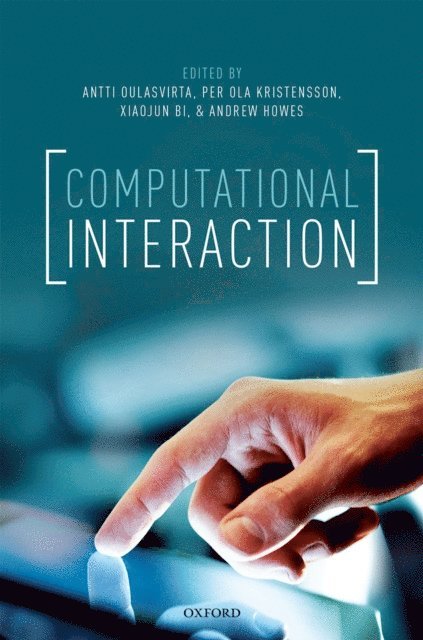
This book presents computational interaction as an approach to explaining and enhancing the interaction between humans and information technology. Computational interaction applies abstraction, automation, and analysis to inform our understanding of the structure of interaction and also to inform the design of the software that drives new and exciting human-computer interfaces. The methods of computational interaction allow, for example, designers to identify user interfaces that are optimal against some objective criteria. They also allow software engineers to build interactive systems that adapt their behaviour to better suit individual capacities and preferences.Embedded in an iterative design process, computational interaction has the potential to complement human strengths and provide methods for generating inspiring and elegant designs. Computational interaction does not exclude the messy and complicated behaviour of humans, rather it embraces it by, for example, using models that are sensitive to uncertainty and that capture subtle variations between individual users. It also promotes the idea that there are many aspects of interaction that can be augmented by algorithms. This book introduces computational interaction design to the reader by exploring a wide range of computational interaction techniques, strategies and methods. It explains how techniques such as optimisation, economic modelling, machine learning, control theory, formal methods, cognitive models and statistical language processing can be used to model interaction and design more expressive, efficient and versatile interaction.
Inbunden, Engelska, 2018
1 848 kr
Skickas inom 5-8 vardagar
This book presents computational interaction as an approach to explaining and enhancing the interaction between humans and information technology. Computational interaction applies abstraction, automation, and analysis to inform our understanding of the structure of interaction and also to inform the design of the software that drives new and exciting human-computer interfaces. The methods of computational interaction allow, for example, designers to identify user interfaces that are optimal against some objective criteria. They also allow software engineers to build interactive systems that adapt their behaviour to better suit individual capacities and preferences.Embedded in an iterative design process, computational interaction has the potential to complement human strengths and provide methods for generating inspiring and elegant designs. Computational interaction does not exclude the messy and complicated behaviour of humans, rather it embraces it by, for example, using models that are sensitive to uncertainty and that capture subtle variations between individual users. It also promotes the idea that there are many aspects of interaction that can be augmented by algorithms. This book introduces computational interaction design to the reader by exploring a wide range of computational interaction techniques, strategies and methods. It explains how techniques such as optimisation, economic modelling, machine learning, control theory, formal methods, cognitive models and statistical language processing can be used to model interaction and design more expressive, efficient and versatile interaction.
Häftad, Engelska, 2018
846 kr
Skickas inom 7-10 vardagar
This book presents computational interaction as an approach to explaining and enhancing the interaction between humans and information technology. Computational interaction applies abstraction, automation, and analysis to inform our understanding of the structure of interaction and also to inform the design of the software that drives new and exciting human-computer interfaces. The methods of computational interaction allow, for example, designers to identify user interfaces that are optimal against some objective criteria. They also allow software engineers to build interactive systems that adapt their behaviour to better suit individual capacities and preferences.Embedded in an iterative design process, computational interaction has the potential to complement human strengths and provide methods for generating inspiring and elegant designs. Computational interaction does not exclude the messy and complicated behaviour of humans, rather it embraces it by, for example, using models that are sensitive to uncertainty and that capture subtle variations between individual users. It also promotes the idea that there are many aspects of interaction that can be augmented by algorithms. This book introduces computational interaction design to the reader by exploring a wide range of computational interaction techniques, strategies and methods. It explains how techniques such as optimisation, economic modelling, machine learning, control theory, formal methods, cognitive models and statistical language processing can be used to model interaction and design more expressive, efficient and versatile interaction.
Häftad, Engelska, 2013
318 kr
Skickas inom 10-15 vardagar
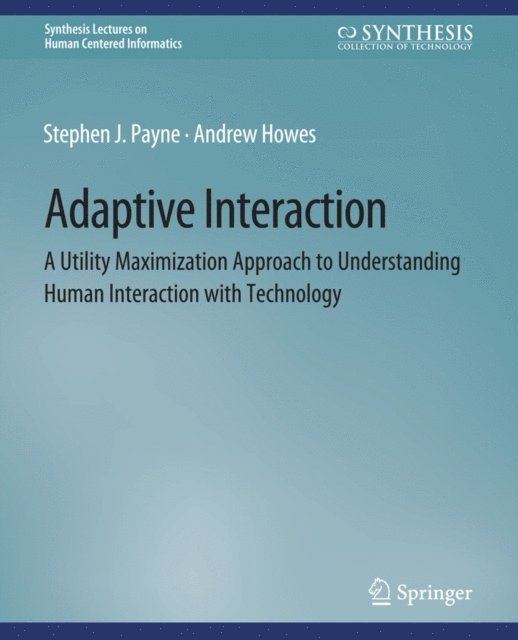
This lecture describes a theoretical framework for the behavioural sciences that holds high promise for theory-driven research and design in Human-Computer Interaction. The framework is designed to tackle the adaptive, ecological, and bounded nature of human behaviour. It is designed to help scientists and practitioners reason about why people choose to behave as they do and to explain which strategies people choose in response to utility, ecology, and cognitive information processing mechanisms. A key idea is that people choose strategies so as to maximise utility given constraints. The framework is illustrated with a number of examples including pointing, multitasking, skim-reading, online purchasing, Signal Detection Theory and diagnosis, and the influence of reputation on purchasing decisions. Importantly, these examples span from perceptual/motor coordination, through cognition to social interaction. Finally, the lecture discusses the challenging idea that people seek to find optimal strategies and also discusses the implications for behavioral investigation in HCI.
E-bok
PDF, Engelska, 2022408 kr
Läs direkt efter köp
This lecture describes a theoretical framework for the behavioural sciences that holds high promise for theory-driven research and design in Human-Computer Interaction. The framework is designed to tackle the adaptive, ecological, and bounded nature of human behaviour. It is designed to help scientists and practitioners reason about why people choose to behave as they do and to explain which strategies people choose in response to utility, ecology, and cognitive information processing mechanisms. A key idea is that people choose strategies so as to maximise utility given constraints. The framework is illustrated with a number of examples including pointing, multitasking, skim-reading, online purchasing, Signal Detection Theory and diagnosis, and the influence of reputation on purchasing decisions. Importantly, these examples span from perceptual/motor coordination, through cognition to social interaction. Finally, the lecture discusses the challenging idea that people seek to find optimal strategies and also discusses the implications for behavioral investigation in HCI.