Antti Oulasvirta - Böcker
Visar alla böcker från författaren Antti Oulasvirta. Handla med fri frakt och snabb leverans.
6 produkter
6 produkter
1 823 kr
Skickas inom 5-8 vardagar
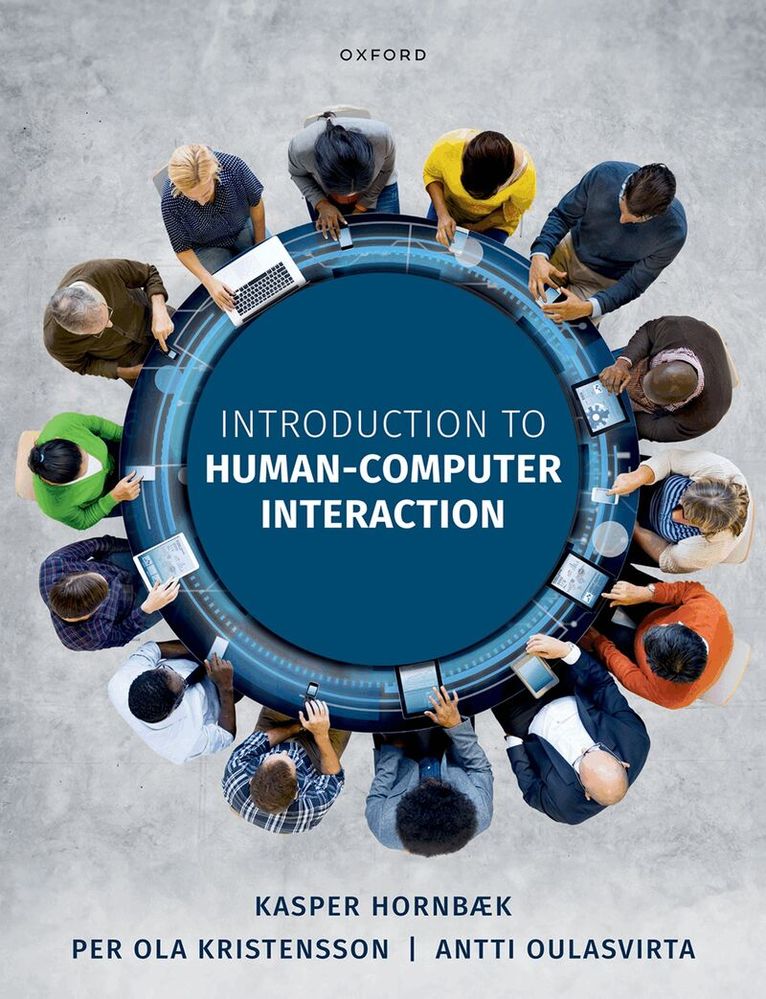
This is an open access title available under the terms of a CC BY-NC-ND 4.0 International licence. It is free to read on the Oxford Academic platform and offered as a free PDF download from OUP and selected open access locations.Aimed at undergraduate students in computer science, design, and engineering programs, and master students in dedicated programs, this is the first comprehensive textbook for students of human-computer interaction. While HCI is primarily a research-driven field, the book focuses not only on scientific principles of interaction, but also on the very concrete goal of designing better computing systems. The book revises and synthesizes topics that have been previously scattered across multiple books and papers, including design, engineering, empirical methods, and technology. Although it covers emerging topics like VR and AI, the book places its emphasis on the more time-enduring principles and methods. The book is open access and comes with associated materials for teachers and students, available on the book's companion website.
769 kr
Skickas inom 5-8 vardagar
This is an open access title available under the terms of a CC BY-NC-ND 4.0 International licence. It is free to read on the Oxford Academic platform and offered as a free PDF download from OUP and selected open access locations.Aimed at undergraduate students in computer science, design, and engineering programs, and master students in dedicated programs, this is the first comprehensive textbook for students of human-computer interaction. While HCI is primarily a research-driven field, the book focuses not only on scientific principles of interaction, but also on the very concrete goal of designing better computing systems. The book revises and synthesizes topics that have been previously scattered across multiple books and papers, including design, engineering, empirical methods, and technology. Although it covers emerging topics like VR and AI, the book places its emphasis on the more time-enduring principles and methods. The book is open access and comes with associated materials for teachers and students, available on the book's companion website.
1 810 kr
Skickas inom 5-8 vardagar
This book presents computational interaction as an approach to explaining and enhancing the interaction between humans and information technology. Computational interaction applies abstraction, automation, and analysis to inform our understanding of the structure of interaction and also to inform the design of the software that drives new and exciting human-computer interfaces. The methods of computational interaction allow, for example, designers to identify user interfaces that are optimal against some objective criteria. They also allow software engineers to build interactive systems that adapt their behaviour to better suit individual capacities and preferences.Embedded in an iterative design process, computational interaction has the potential to complement human strengths and provide methods for generating inspiring and elegant designs. Computational interaction does not exclude the messy and complicated behaviour of humans, rather it embraces it by, for example, using models that are sensitive to uncertainty and that capture subtle variations between individual users. It also promotes the idea that there are many aspects of interaction that can be augmented by algorithms. This book introduces computational interaction design to the reader by exploring a wide range of computational interaction techniques, strategies and methods. It explains how techniques such as optimisation, economic modelling, machine learning, control theory, formal methods, cognitive models and statistical language processing can be used to model interaction and design more expressive, efficient and versatile interaction.
788 kr
Skickas inom 7-10 vardagar
This book presents computational interaction as an approach to explaining and enhancing the interaction between humans and information technology. Computational interaction applies abstraction, automation, and analysis to inform our understanding of the structure of interaction and also to inform the design of the software that drives new and exciting human-computer interfaces. The methods of computational interaction allow, for example, designers to identify user interfaces that are optimal against some objective criteria. They also allow software engineers to build interactive systems that adapt their behaviour to better suit individual capacities and preferences.Embedded in an iterative design process, computational interaction has the potential to complement human strengths and provide methods for generating inspiring and elegant designs. Computational interaction does not exclude the messy and complicated behaviour of humans, rather it embraces it by, for example, using models that are sensitive to uncertainty and that capture subtle variations between individual users. It also promotes the idea that there are many aspects of interaction that can be augmented by algorithms. This book introduces computational interaction design to the reader by exploring a wide range of computational interaction techniques, strategies and methods. It explains how techniques such as optimisation, economic modelling, machine learning, control theory, formal methods, cognitive models and statistical language processing can be used to model interaction and design more expressive, efficient and versatile interaction.
474 kr
Skickas inom 7-10 vardagar
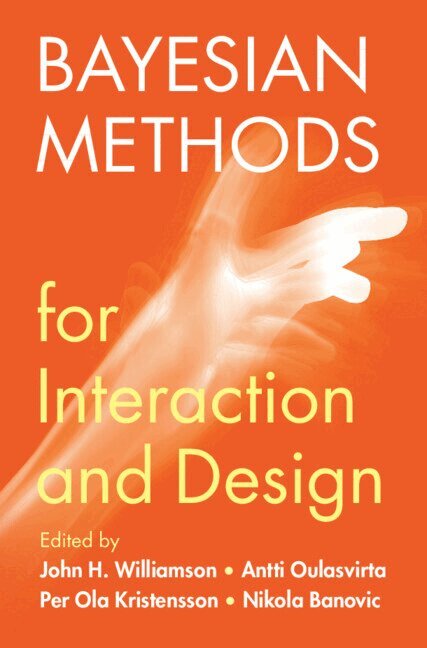
Intended for researchers and practitioners in interaction design, this book shows how Bayesian models can be brought to bear on problems of interface design and user modelling. It introduces and motivates Bayesian modelling and illustrates how powerful these ideas can be in thinking about human-computer interaction, especially in representing and manipulating uncertainty. Bayesian methods are increasingly practical as computational tools to implement them become more widely available, and offer a principled foundation to reason about interaction design. The book opens with a self-contained tutorial on Bayesian concepts and their practical implementation, tailored for the background and needs of interaction designers. The contributed chapters cover the use of Bayesian probabilistic modelling in a diverse set of applications, including improving pointing-based interfaces; efficient text entry using modern language models; advanced interface design using cutting-edge techniques in Bayesian optimisation; and Bayesian approaches to modelling the cognitive processes of users.
1 238 kr
Skickas inom 7-10 vardagar
Intended for researchers and practitioners in interaction design, this book shows how Bayesian models can be brought to bear on problems of interface design and user modelling. It introduces and motivates Bayesian modelling and illustrates how powerful these ideas can be in thinking about human-computer interaction, especially in representing and manipulating uncertainty. Bayesian methods are increasingly practical as computational tools to implement them become more widely available, and offer a principled foundation to reason about interaction design. The book opens with a self-contained tutorial on Bayesian concepts and their practical implementation, tailored for the background and needs of interaction designers. The contributed chapters cover the use of Bayesian probabilistic modelling in a diverse set of applications, including improving pointing-based interfaces; efficient text entry using modern language models; advanced interface design using cutting-edge techniques in Bayesian optimisation; and Bayesian approaches to modelling the cognitive processes of users.