Anita Graser - Böcker
Visar alla böcker från författaren Anita Graser. Handla med fri frakt och snabb leverans.
9 produkter
9 produkter
518 kr
Skickas inom 5-8 vardagar
782 kr
Skickas inom 3-6 vardagar
2 170 kr
Skickas inom 10-15 vardagar
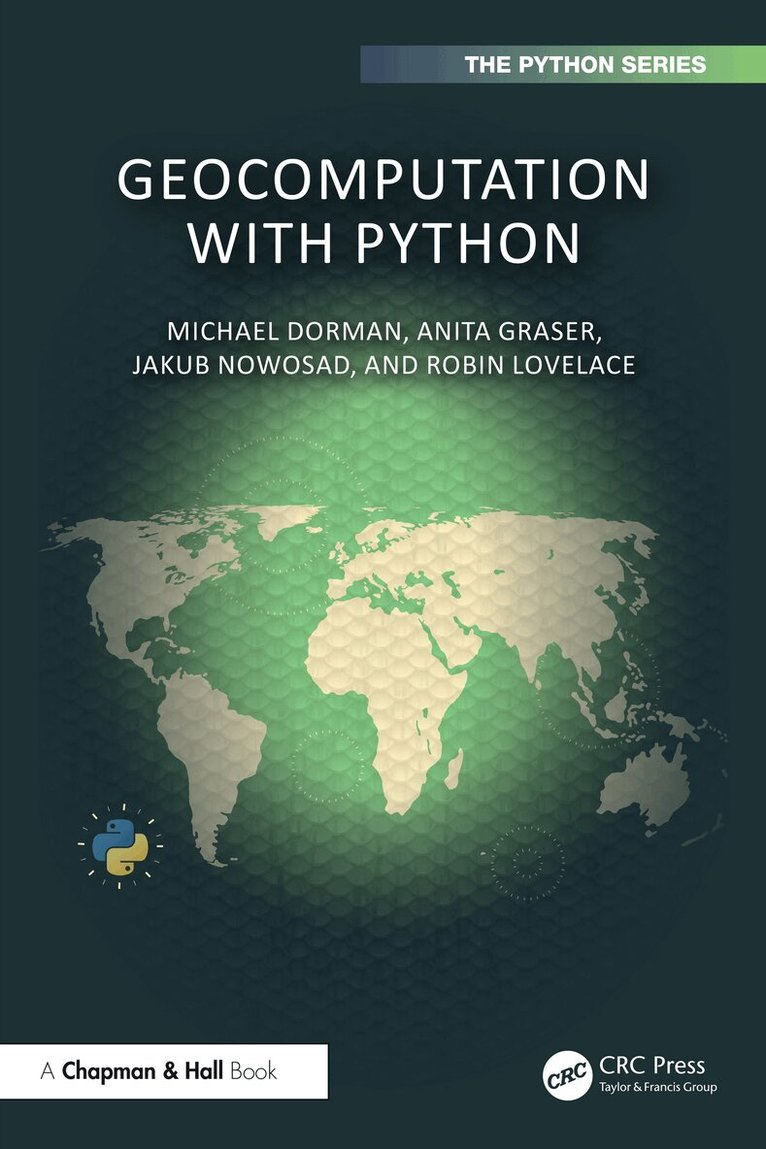
Geocomputation with Python is a comprehensive resource for working with geographic data with the most popular programming language in the world. The book gives an overview of Python's capabilities for spatial data analysis, as well as dozens of worked-through examples covering the entire range of standard GIS operations. A unique selling point of the book is its cohesive and joined-up coverage of both vector and raster geographic data models and consistent learning curve. This book is an excellent starting point for those new to working with geographic data with Python, making it ideal for students and practitioners beginning their journey with Python.Key features:Showcases the integration of vector and raster datasets operations.Provides explanation of each line of code in the book to minimize surprises.Includes example datasets and meaningful operations to illustrate the applied nature of geographic research.Another unique feature is that this book is part of a wider community. Geocomputation with Python is a sister project of Geocomputation with R (Lovelace, Nowosad, and Muenchow 2019), a book on geographic data analysis, visualization, and modeling using the R programming language that has numerous contributors and an active community.The book teaches how to import, process, examine, transform, compute, and export spatial vector and raster datasets with Python, the most widely used language for data science and many other domains. Reading the book and running the reproducible code chunks within will make you a proficient user of key packages in the ecosystem, including shapely, geopandas, and rasterio. The book also demonstrates how to make use of dozens of additional packages for a wide range of tasks, from interactive map making to terrain modeling. Geocomputation with Python provides a firm foundation for more advanced topics, including spatial statistics, machine learning involving spatial data, and spatial network analysis, and a gateway into the vibrant and supportive community developing geographic tools in Python and beyond.
812 kr
Skickas inom 10-15 vardagar
Geocomputation with Python is a comprehensive resource for working with geographic data with the most popular programming language in the world. The book gives an overview of Python's capabilities for spatial data analysis, as well as dozens of worked-through examples covering the entire range of standard GIS operations. A unique selling point of the book is its cohesive and joined-up coverage of both vector and raster geographic data models and consistent learning curve. This book is an excellent starting point for those new to working with geographic data with Python, making it ideal for students and practitioners beginning their journey with Python.Key features:Showcases the integration of vector and raster datasets operations.Provides explanation of each line of code in the book to minimize surprises.Includes example datasets and meaningful operations to illustrate the applied nature of geographic research.Another unique feature is that this book is part of a wider community. Geocomputation with Python is a sister project of Geocomputation with R (Lovelace, Nowosad, and Muenchow 2019), a book on geographic data analysis, visualization, and modeling using the R programming language that has numerous contributors and an active community.The book teaches how to import, process, examine, transform, compute, and export spatial vector and raster datasets with Python, the most widely used language for data science and many other domains. Reading the book and running the reproducible code chunks within will make you a proficient user of key packages in the ecosystem, including shapely, geopandas, and rasterio. The book also demonstrates how to make use of dozens of additional packages for a wide range of tasks, from interactive map making to terrain modeling. Geocomputation with Python provides a firm foundation for more advanced topics, including spatial statistics, machine learning involving spatial data, and spatial network analysis, and a gateway into the vibrant and supportive community developing geographic tools in Python and beyond.
325 kr
Skickas inom 5-8 vardagar
A short book with a lot of hands-on examples to help you learn in a practical way. This book is great for users, developers, and consultants who know the basic functions and processes of a GIS but want to know how to use QGIS to achieve the results they are used to a full-fledged GIS.
Learning QGIS - Third Edition
Häftad, 2023
462 kr
Skickas inom 5-8 vardagar
1 001 kr
Skickas inom 5-8 vardagar
Master data management, visualization, and spatial analysis techniques in QGIS and become a GIS power userAbout This Book* Learn how to work with various types of data and create beautiful maps using this easy-to-follow guide* Give a touch of professionalism to your maps, both for functionality and look and feel, with the help of this practical guide* This progressive, hands-on guide builds on a geo-spatial data and adds more reactive maps using geometry tools.Who This Book Is ForIf you are a user, developer, or consultant and want to know how to use QGIS to achieve the results you are used to from other types of GIS, then this learning path is for you. You are expected to be comfortable with core GIS concepts. This Learning Path will make you an expert with QGIS by showing you how to develop more complex, layered map applications. It will launch you to the next level of GIS users.What You Will Learn* Create your first map by styling both vector and raster layers from different data sources* Use parameters such as precipitation, relative humidity, and temperature to predict the vulnerability of fields and crops to mildew* Re-project vector and raster data and see how to convert between different style formats* Use a mix of web services to provide a collaborative data system* Use raster analysis and a model automation tool to model the physical conditions for hydrological analysis* Get the most out of the cartographic tools to in QGIS to reveal the advanced tips and tricks of cartographyIn DetailThe first module Learning QGIS, Third edition covers the installation and configuration of QGIS. You'll become a master in data creation and editing, and creating great maps. By the end of this module, you'll be able to extend QGIS with Python, getting in-depth with developing custom tools for the Processing Toolbox.The second module QGIS Blueprints gives you an overview of the application types and the technical aspects along with few examples from the digital humanities. After estimating unknown values using interpolation methods and demonstrating visualization and analytical techniques, the module ends by creating an editable and data-rich map for the discovery of community information.The third module QGIS 2 Cookbook covers data input and output with special instructions for trickier formats. Later, we dive into exploring data, data management, and preprocessing steps to cut your data to just the important areas. At the end of this module, you will dive into the methods for analyzing routes and networks, and learn how to take QGIS beyond the out-of-the-box features with plug-ins, customization, and add-on tools.This Learning Path combines some of the best that Packt has to offer in one complete, curated package. It includes content from the following Packt products:? Learning QGIS, Third Edition by Anita Graser? QGIS Blueprints by Ben Mearns? QGIS 2 Cookbook by Alex Mandel, Victor Olaya Ferrero, Anita Graser, Alexander BruyStyle and approachThis Learning Path will get you up and running with QGIS. We start off with an introduction to QGIS and create maps and plugins. Then, we will guide you through Blueprints for geographic web applications, each of which will teach you a different feature by boiling down a complex workflow into steps you can follow. Finally, you'll turn your attention to becoming a QGIS power user and master data management, visualization, and spatial analysis techniques of QGIS.
510 kr
Skickas inom 5-8 vardagar
Learn to view, edit and analyse geospatial data using QGIS and Python 3Key FeaturesLeverage the power of QGIS to add professionalism to your mapsExplore and work with the newly released features like Python 3, GeoPackage, 3D views, Print layouts in QGIS 3.4Build your own plugins and customize maps using QT designerBook DescriptionQGIS 3.4 is the first LTR (long term release) of QGIS version 3. This is a giant leap forward for the project with tons of new features and impactful changes. Learn QGIS is fully updated for QGIS 3.4, covering its processing engine update, Python 3 de-facto coding environment, and the GeoPackage format.This book will help you get started on your QGIS journey, guiding you to develop your own processing pathway. You will explore the user interface, loading your data, editing, and then creating data. QGIS often surprises new users with its mapping capabilities; you will discover how easily you can style and create your first map. But that’s not all! In the final part of the book, you’ll learn about spatial analysis and the powerful tools in QGIS, and conclude by looking at Python processing options.By the end of the book, you will have become proficient in geospatial analysis using QGIS and Python.What you will learnExplore various ways to load data into QGISUnderstand how to style data and present it in a mapCreate maps and explore ways to expand themGet acquainted with the new processing toolbox in QGIS 3.4Manipulate your geospatial data and gain quality insightsUnderstand how to customize QGIS 3.4Work with QGIS 3.4 in 3DWho this book is forIf you are a developer or consultant familiar with the basic functions and processes of GIS and want to learn how to use QGIS to analyze geospatial data and create rich mapping applications, this book is for you. You’ll also find this book useful if you’re new to QGIS and wish to grasp its fundamentals
557 kr
Skickas inom 5-8 vardagar
Gain a deep understanding of QGIS, the world's most popular free and open-source GIS tool for spatial analysis and mappingKey FeaturesFind out how to effectively use QGIS by exploring its features in depthPractice real-world scenarios for spatial data extraction, analysis, and mappingExplore cutting-edge topics in the geospatial industry, such as machine learning and artificial intelligencePurchase of the print or Kindle book includes a free PDF eBookBook DescriptionSpatial data is everywhere, requiring professionals from various fields to capture, visualize, and analyze spatial datasets from a myriad of sources. In this fifth edition of Learn QGIS, the authors draw from their vast experience in geospatial technologies to guide you through the most essential data editing, mapping, and analysis tools available in the world’s most popular free and open-source geographic information system (GIS) software.This updated edition incorporates the latest advancements in QGIS, comprehensively guiding you through creating, visualizing, and analyzing spatial datasets. Starting with data creation and editing, the book explores map projections, spatial data sources, and visualization techniques. You’ll develop expertise in cartographic principles, conduct spatial analysis for environmental and socioeconomic applications, and work with Earth Observation data from Copernicus and NASA.The addition of new topics such as field data collection, data security, and ethical considerations ensures that you stay ahead of modern GIS challenges. The book also introduces AI in GIS, enabling you to leverage machine learning for geospatial data science tasks.By the end of this QGIS book, you’ll have become proficient in geospatial analysis using QGIS and Python.What you will learnGrasp the core concepts of spatial data importing, managing, and analysisAccess geospatial data sources from public organizationsFind out how to handle different map projections and regulationsGet to grips with the basics of map design and common map typesUnderstand spatial data analysis and problem solving through using real-world scenariosCapture, download, and analyze Earth Observation dataBuild mobile projects for data collection on the goIntegrate the power of AI and ML, and learn the ethical aspects of their use in GISWho this book is forThis fully updated edition is for GIS professionals, developers, researchers, and students in environmental management, urban studies, transportation, and spatial planning. Educators can integrate step-by-step exercises into their technical training as this book provides a hands-on approach to spatial data collection, management, and analysis, incorporating new QGIS capabilities.