Anne Dodd – författare
Visar alla böcker från författaren . Handla med fri frakt och snabb leverans.
5 produkter
5 produkter
Del 16 - Thames Valley Landscapes Monograph
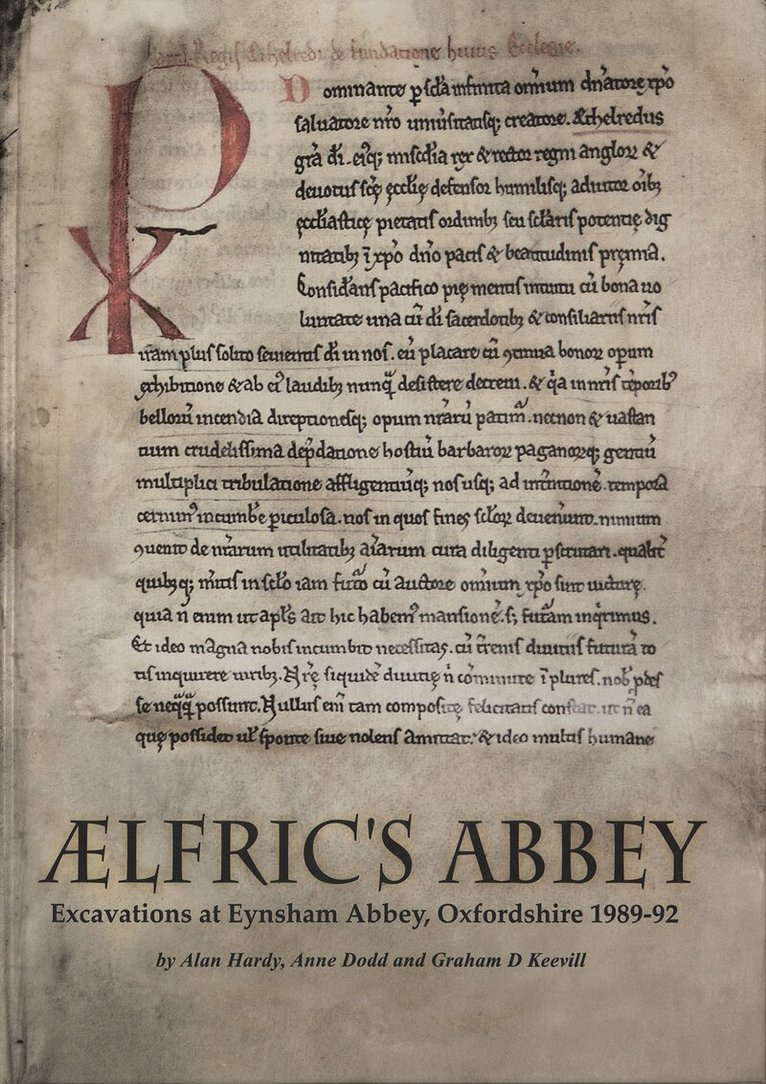
Aelfric’s Abbey
Excavations at Eynsham Abbey, Oxfordshire, 1989-92
Inbunden, Engelska, 2003
770 kr
Skickas
Oxford Archaeology excavated an area of approximately 1800 sq m within the inner ward or court of the precinct of Eynsham Abbey between 1989 and 1992. The excavation area straddled the modern churchyards of the Roman Catholic St Peter's Church and the Anglican St Leonard's Church, both of which were planning to extend their cemeteries. This factor was the immediate stimulus for the excavations, which were wholly funded by English Heritage.Occupation of the site commenced with the construction of a large enclosure in the late Neolithic period. This is reported elsewhere. A hiatus of some 1500 years was followed by the establishment of an early Saxon settlement represented by a number of sunken-featured buildings and associated pits and hearths. This settlement was superseded by u more organised pattern of occupation, represented by timber halls and boundary ditches possibly associated with the minster church which documentary sources suggest was founded in the 7th or 8th century. In 1005 the minster was refounded as a Benedictine abbey, and substantial traces of some of its principal buildings were found. Following a period of instability after the Norman Conquest, the abbey was refounded in 1109. Buildings relating to this transitional period, and temporary structures from the early 12th century were found. The abbey prospered for most of the medieval period before the Dissolution in 1538-9. Precinct buildings revealed in the excavation included part of the Great Cloister (garth, lavatoria and the west and south walks), refectory, kitchens, cellars, domestic range and latrines. Some of these buildings were reused after the Dissolution. Also found were elements of the water supply and waste disposal systems. Extensive and significant assemblages of pottery, tile, architectural masonry, small finds, animal bone and carbonised environmental remains were recovered.To augment the potential of the main excavation, a further programme of geophysical survey, evaluation and selected excavation work was carried out by Oxford Archaeology, or under their supervision, during 1997-8. The intention of the work was to study as much as possible of the abbey's inner and outer wards within the constraints of resources and the Scheduled Ancient Monument status of part of the precinct, in order to place the main abbey excavations in their context. The evidence from the excavations both major and minor - and the surveys, combined with a study of the varied documentary sources, have allowed a rare opportunity to study in depth the development and economy of a major religious house from its origins through to its demise.
Del 27 - Thames Valley Landscapes Monograph
Archaeology of the Gravel Terraces of the Upper and Middle Thames
The Early Historical Period: AD1-1000
Inbunden, Engelska, 2007
542 kr
Skickas
The gravel terraces of the river Thames have revealed a wealth of archaeological information about the evolution of the landscape of the region, the development of the settlement pattern, and past human occupation. Much of this has come to light in the course of gravel quarrying, which has been so extensive that the Thames Valley now provides one of the richest resources of archaeological data in the country. This volume provides an up to date overview of the archaeological evidence from the valley for the late Iron Age, Roman and Anglo-Saxon periods, broadly speaking the first millennium AD. The area studied in detail comprises the Upper Thames Valley, from the source of the river to the Goring Gap, and the Middle Thames Valley, from the Goring Gap to the start of the tidal zone at Teddington Lock. A summary of evidence for the character of the river and the vegetation and environment of its floodplain is followed by a detailed account of the evolving settlement pattern as currently understood from archaeological evidence. The authors then consider what archaeology can reveal about the late Iron Age, Roman and Anglo-Saxon populations of the valley, and their changing lifestyles, culture, identities and beliefs. This is followed by a review of the evidence for production, trade, transport and communication, and the archaeology of power and politics. The volume concludes with a discussion of the state of knowledge today and its limitations, and emerging themes and problem areas for future research.
Del 29 - Thames Valley Landscapes Monograph
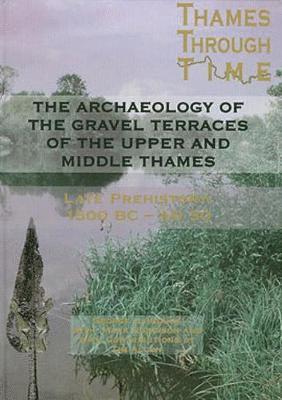
Archaeology of the Gravel Terraces of the Upper and Middle Thames
Late Prehistory 1500 BC-AD 50
Inbunden, Engelska, 2009
450 kr
Skickas
In common with other volumes in the Thames Through Time series, this account of the Thames Valley in the millennium and a half before the Roman conquest seeks to examine change in human society from a thematic point of view. The geographical and chronological framework for this volume is established in Chapters 1 and 2, but thereafter we have tried to get away from the traditional, somewhat artificial pigeon-holes of 'periods' 'ages' 'eras' and 'phases' to look much harder at how change in human society actually works. In a period when the 20th century has come to dominate secondary school history and much popular TV, the notion that the first foundations of modern society can be traced back more than 3000 years may seem a rather surprising proposition. But some fundamental patterns of settlement and landuse, political boundaries, human impact on the environment, and even the specific use and form of a few places can be traced back to late prehistoric times despite millennia of subsequent change - even though otherwise we may now have very little in common with those remote ancestors. Exploring these issues on a thematic basis should help us to gain a better understanding of how human society evolves and also of how people have altered their natural environment, providing a better long term perspective on what we are doing to the planet.
Del 1 - Oxfordshire Arch and Hist Society Occasional Paper
Archaeology of Oxford in the 21st Century
Investigations in the City by Oxford Archaeology, 2006-16
Häftad, Engelska, 2020
397 kr
Skickas inom 5-8 vardagar
Shedding fresh light on medieval and early modern Oxford, this is a significant contribution to the knowledge of the city’s archaeology and history. This volume presents the results of eleven excavations carried out by Oxford Archaeology within the historic walled city of Oxford and in the extramural area just to the north. The investigations shed fresh light on the character of medieval Oxford, both before and after the Norman Conquest, and on the early modern city, including its Civil War defences. Of special interest are remains which supply the first very likely medieval Jewish signature in British zooarchaeology. The findings are set within a larger context by a chapter outlining the key findings (by Anne Dodd), a new synthesis of current knowledge of Oxford's archaeology (by David Radford), and an examination of the changing aims and methods of archaeology carried out in the city over the last fifty years (by Tom Hassall).
Inbunden, Engelska, 2017
389 kr
Skickas
Excavations in advance of gravel quarrying in the Upper Thames Valley at Horcott Quarry, Fairford, and nearby Arkell’s Land, Kempsford, revealed contrasting pictures. At Horcott, on the second terrace, there was periodic activity from the early Mesolithic onwards. A major earlier Iron Age settlement contained roundhouses and at least 135 four-post structures, suggesting an exceptional focus on grain storage. An early–middle Roman farmstead incorporated a small stone-founded building, while from c AD 250–350 a large cemetery lay in an adjacent enclosure. Two further groups of burials were contemporary with a substantial Anglo-Saxon settlement including a timber hall and 33 sunken-featured buildings. By contrast, at Arkell’s Land, on the first gravel terrace, activity on a significant scale only began in the later 1st century AD. It comprised enclosures, field systems and trackways, with the most intensive settlement, as at Horcott, in the middle Roman period. The site was probably linked to an adjacent estate centre at Claydon Pike. There was no post-Roman occupation.