Annica Kronsell - Böcker
Visar alla böcker från författaren Annica Kronsell. Handla med fri frakt och snabb leverans.
9 produkter
9 produkter
1 312 kr
Skickas inom 5-8 vardagar
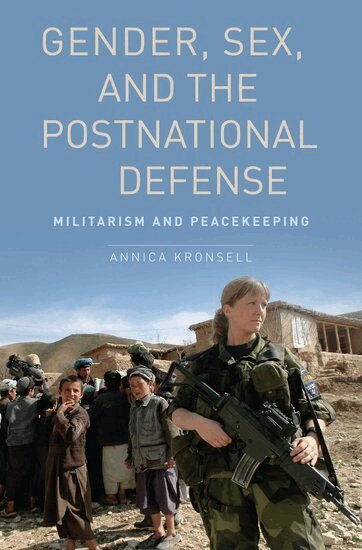
Scholars have argued that the end of the Cold War and the War on Terror have radically changed the context of war and defense, diminished the role of nation-states in favor of multi-lateral defense activities, and placed a new focus on human security. In addition to the traditional act of war-making, peacekeeping and nation-building have emerged as important defense strategies among wealthy, liberal-democratic nations. Per UN Security Council Resolution 1325, adopted in 2000, all member nations must consider the needs of women and girls during repatriation, resettlement, and post-conflict reconstruction efforts. Kronsell's book looks at the way that a post-national defense influenced by SC 1325 and focused on human security affects gender relations in militaries. Interestingly, despite the successful implementation of gender mainstreaming in training, the number of women involved in military peacekeeping remains low. Contradicting much of the gender mainstreaming literature, Kronsell shows that increasing gender parity in the military is a more achievable task than increasing women's participation.Employing a feminist constructivist institutional approach, her book questions whether "feminism " must always be equated with peace and anti-militarism, if military violence committed with the purpose of enhancing human security can be performed according to a feminist ethics, and if military institutions can ever be gender neutral. Kronsell builds her theoretical argument on a case study of Sweden and the E.U.
2 088 kr
Skickas inom 10-15 vardagar
This book explores how climate institutions in industrialized countries work to further the recognition of social differences and integrate this understanding in climate policy making.With contributions from a range of expert scholars in the field, this volume investigates policy-making in climate institutions from the perspective of power as it relates to gender. It also considers other intersecting social factors at different levels of governance, from the global to the local level and extending into climate-relevant sectors. The authors argue that a focus on climate institutions is important since they not only develop strategies and policies, they also (re)produce power relations, promote specific norms and values, and distribute resources. The chapters throughout draw on examples from various institutions including national ministries, transport and waste management authorities, and local authorities, as well as the European Union and the UNFCCC regime. Overall, this book demonstrates how feminist institutionalist theory and intersectionality approaches can contribute to an increased understanding of power relations and social differences in climate policy-making and in climate-relevant sectors in industrialized states. In doing so, it highlights the challenges of path dependencies, but also reveals opportunities for advancing gender equality, equity, and social justice.Gender, Intersectionality and Climate Institutions in Industrialized States will be of great interest to students and scholars of climate politics, international relations, gender studies and policy studies.The Open Access version of this book, available at https://doi.org/10.4324/9781003052821, has been made available under a Creative Commons Attribution-Non Commercial-No Derivatives 4.0 license.
807 kr
Skickas inom 10-15 vardagar
Making Gender, Making War is a unique interdisciplinary edited collection which explores the social construction of gender, war-making and peacekeeping. It highlights the institutions and processes involved in the making of gender in terms of both men and women, masculinity and femininity. The "war question for feminism" marks a thematic red thread throughout; it is a call to students and scholars of feminism to take seriously and engage with the task of analyzing war. Contributors analyze how war-making is intertwined with the making of gender in a diversity of empirical case studies, organized around four themes: gender, violence and militarism; how the making of gender is connected to a (re)making of the nation through military practices; UN SCR 1325 and gender mainstreaming in institutional practices; and gender subjectivities in the organization of violence, exploring the notion of violent women and non-violent men.
2 289 kr
Skickas inom 10-15 vardagar
Making Gender, Making War is a unique interdisciplinary edited collection which explores the social construction of gender, war-making and peacekeeping. It highlights the institutions and processes involved in the making of gender in terms of both men and women, masculinity and femininity. The "war question for feminism" marks a thematic red thread throughout; it is a call to students and scholars of feminism to take seriously and engage with the task of analyzing war. Contributors analyze how war-making is intertwined with the making of gender in a diversity of empirical case studies, organized around four themes: gender, violence and militarism; how the making of gender is connected to a (re)making of the nation through military practices; UN SCR 1325 and gender mainstreaming in institutional practices; and gender subjectivities in the organization of violence, exploring the notion of violent women and non-violent men.
576 kr
Skickas inom 10-15 vardagar
This book explores how climate institutions in industrialized countries work to further the recognition of social differences and integrate this understanding in climate policy making.With contributions from a range of expert scholars in the field, this volume investigates policy-making in climate institutions from the perspective of power as it relates to gender. It also considers other intersecting social factors at different levels of governance, from the global to the local level and extending into climate-relevant sectors. The authors argue that a focus on climate institutions is important since they not only develop strategies and policies, they also (re)produce power relations, promote specific norms and values, and distribute resources. The chapters throughout draw on examples from various institutions including national ministries, transport and waste management authorities, and local authorities, as well as the European Union and the UNFCCC regime. Overall, this book demonstrates how feminist institutionalist theory and intersectionality approaches can contribute to an increased understanding of power relations and social differences in climate policy-making and in climate-relevant sectors in industrialized states. In doing so, it highlights the challenges of path dependencies, but also reveals opportunities for advancing gender equality, equity, and social justice.Gender, Intersectionality and Climate Institutions in Industrialized States will be of great interest to students and scholars of climate politics, international relations, gender studies and policy studies.The Open Access version of this book, available at https://doi.org/10.4324/9781003052821, has been made available under a Creative Commons Attribution-Non Commercial-No Derivatives 4.0 license.
Rethinking the Green State
Environmental governance towards climate and sustainability transitions
Häftad, Engelska, 2017
725 kr
Skickas inom 10-15 vardagar
This innovative book is one of the first to conduct a systematic comprehensive analysis of the ideals and practices of the evolving green state. It draws on elements of political theory, feminist theory, post-structuralism, governance and institutional theory to conceptualise the green state and advances thinking on how to understand its emergence in the context of climate and sustainability transitions. Focusing on the state as an actor in environmental, climate and sustainability politics, the book explores different principles guiding the emergence of the green state and examines the performance of states and institutional responses to the sustainable and climate transitions in the European and Nordic context in particular. The book’s unique focus on the Nordic countries underlines the important to learn from Nordics, which are perceived to be in the forefront of climate and sustainability governance as well as historically strong welfare states.With chapter contributions from leading international scholars in political science, sociology, economics, energy and environmental systems and climate policy studies, this book will be of great value to postgraduate students and researchers working on sustainability transitions, environmental politics and governance, and those with an area studies focus on the Nordic countries.
Rethinking the Green State
Environmental governance towards climate and sustainability transitions
Inbunden, Engelska, 2015
2 155 kr
Skickas inom 10-15 vardagar
This innovative book is one of the first to conduct a systematic comprehensive analysis of the ideals and practices of the evolving green state. It draws on elements of political theory, feminist theory, post-structuralism, governance and institutional theory to conceptualise the green state and advances thinking on how to understand its emergence in the context of climate and sustainability transitions. Focusing on the state as an actor in environmental, climate and sustainability politics, the book explores different principles guiding the emergence of the green state and examines the performance of states and institutional responses to the sustainable and climate transitions in the European and Nordic context in particular. The book’s unique focus on the Nordic countries underlines the important to learn from Nordics, which are perceived to be in the forefront of climate and sustainability governance as well as historically strong welfare states.With chapter contributions from leading international scholars in political science, sociology, economics, energy and environmental systems and climate policy studies, this book will be of great value to postgraduate students and researchers working on sustainability transitions, environmental politics and governance, and those with an area studies focus on the Nordic countries.
3 499 kr
Skickas inom 7-10 vardagar
The Handbook on Gender and Security presents a comprehensive overview of the connections between gender and (in)security in international relations. Authors from various disciplines showcase their innovative research, illustrating how past and recent developments have shaped our understandings of this relationship.Contributors adopt novel theoretical approaches and empirical methods to explore the effects and dynamics of security threats. They highlight the significant diversity in definitions of both gender and security, introducing refined ways of understanding the connection between the two, focusing on topics including war, violence, climate change, pandemics, and criminal networks, as well as feminist action. The Handbook identifies fruitful avenues for future research in the field, surveying gender-related security policy at the international, national and regional levels.The Handbook on Gender and Security is an essential resource for students and scholars of International Relations, Security Studies, and Gender Politics. It is also a vital read for policy-makers seeking to understand the significant impact of gender on experiences of and vulnerabilities to security threats.
Environmental Politics and Deliberative Democracy
Examining the Promise of New Modes of Governance
Inbunden, Engelska, 2010
1 786 kr
Skickas inom 7-10 vardagar
Can new modes of governance, such as public-private partnerships, stakeholder consultations and networks, promote effective environmental policy performance as well as increased deliberative and participatory quality? This book argues that in academic inquiry and policy practice there has been a deliberative turn, manifested in a revitalized interest in deliberative democracy coupled with calls for novel forms of public-private governance. By linking theory and practice, the contributors critically examine the legitimacy and effectiveness of new modes of governance, using a range of case studies on climate, forestry, water and food safety policies from local to global levels.>Environmental Politics and Deliberative Democracy will appeal to scholars, both advanced undergraduate and postgraduate, as well as researchers of environmental politics, international relations, environmental studies and political science. It will also interest practitioners involved in the actual design and implementation of new governance modes in areas of sustainable development, food safety, forestry and climate change.