Anthony Charles - Böcker
Visar alla böcker från författaren Anthony Charles. Handla med fri frakt och snabb leverans.
7 produkter
7 produkter
Governance of Marine Fisheries and Biodiversity Conservation
Interaction and Co-evolution
Inbunden, Engelska, 2014
2 337 kr
Skickas inom 11-20 vardagar
Governance of Marine Fisheries and Biodiversity Conservation explores governance of the world’s oceans with a focus on the impacts of two inter-connected but historically separate streams of governance: one for fisheries, the other for biodiversity conservation. Chapters, most co-authored by leading experts from both streams, investigate the interaction of these governance streams from ecological, economic, social and legal perspectives, with emphasis on policies, institutions processes, and outcomes on scales from the global to the local community, and with coverage of a range of themes and regions of the world. The book opens with chapters setting the historical context for the two marine governance streams, and framing the book’s exploration of whether, as the streams increasingly interact, there will be merger or collision, convergence or co-evolution. The concluding chapter synthesizes the insights from throughout the book, relative to the questions posed in the opening chapters. It also draws conclusions about future needs and directions in the governance of marine fisheries and biodiversity, vital to the future of the world’s oceans. With cutting edge chapters written by many leading international experts in fisheries management and biodiversity conservation, and edited by three leading figures in this crucially important subject, Governance of Marine Fisheries and Biodiversity Conservation is an essential purchase for fisheries scientists, economists, resource managers and policymakers, and all those working in fields of biodiversity conservation, marine ecology, and coastal livelihoods. Libraries in all universities and research establishments where environmental and/or marine studies, conservation, ocean policy and law, biological and life sciences, and fisheries management are studied and taught, should have copies of this most important book.
1 792 kr
Skickas inom 7-10 vardagar
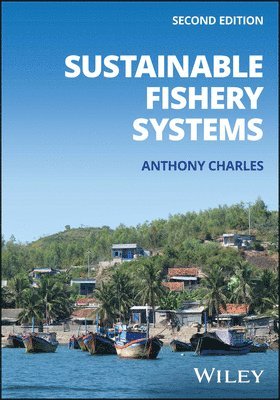
SUSTAINABLE FISHERY SYSTEMS An up-to-date and interdisciplinary guide to sustainable fisheriesFisheries, whether small-scale or large-scale, are filled with complexity and uncertainty. Making the right decisions to successfully manage fisheries for sustainability and resilience requires a systems approach — including both natural and human elements, and their many interactions. To understand fisheries, and how they change over time, a diverse range of fishery knowledge must be brought together.Sustainable Fishery Systems, 2nd edition meets these needs. The new edition provides essential information that can be readily applied within government, community, industrial, academic and research settings.Sustainable Fishery Systems, 2nd edition retains the first edition’s emphasis on themes such as sustainability, resilience, uncertainty, complexity, and conflict, and expands its treatment of topics that have, since the first edition’s publication, become crucial to consider in the field of fisheries. As a result, readers will find: Updated and expanded coverage of topics including coastal conservation, ecosystem-based management, co-management, community-based management, and moreNew chapters covering connections between fisheries and marine protected areas, biodiversity conservation, climate and fisheries, and multi-sectoral managementA more detailed introduction to the “systems” perspective of fisheries, reflecting the substantial growth in that subject’s importance, and covering in detail the natural, human and governance aspects of fisheries.Sustainable Fishery Systems, 2nd edition is an indispensable interdisciplinary resource for educators, researchers, government agencies, and fisheries managers.
2 088 kr
Skickas inom 10-15 vardagar
Coastal communities depend on the marine environment for their livelihoods, but the common property nature of marine resources poses major challenges for the governance of such resources. Through detailed cases and consideration of broader global trends, this volume examines how coastal communities are adapting to environmental change, and the attributes of governance that foster deliberate transformations and help to build resilience of social and ecological systems. Governance here reflects how communities, societies and organisations (e.g. fisher cooperatives, government agencies) choose to organise themselves to make decisions about important issues, such as the use and protection of coastal commons (e.g. fishery resources). The book shows how a governance approach generates insights into the specific forms and arrangements that enable coastal communities to steer away from unsustainable pathways. It also provides an analytical lens to consider important questions of power, knowledge and legitimacy in linked social-ecological systems. Chapters highlight examples in which communities are engaging in deliberative transformations to build resilience and enhance their well-being. These transformations and efforts to build resilience are emerging through multi-level collaboration, shared learning, innovative policies and institutional arrangements (such as new property rights regimes and co-management), methodologies that engage with indigenous cultural practices, and entrepreneurial activities, including income and livelihood diversification. Case studies are included from a range of countries including Canada, Japan, Brazil, Indonesia, Mexico, South Africa, Thailand, the South Pacific and Europe. The authors integrate theory with practical examples to improve coastal marine policy and governance, and draw upon emerging concepts from social-ecological resilience and transformations, adaptive governance and the scholarship on the commons.
807 kr
Skickas inom 10-15 vardagar
Coastal communities depend on the marine environment for their livelihoods, but the common property nature of marine resources poses major challenges for the governance of such resources. Through detailed cases and consideration of broader global trends, this volume examines how coastal communities are adapting to environmental change, and the attributes of governance that foster deliberate transformations and help to build resilience of social and ecological systems. Governance here reflects how communities, societies and organisations (e.g. fisher cooperatives, government agencies) choose to organise themselves to make decisions about important issues, such as the use and protection of coastal commons (e.g. fishery resources). The book shows how a governance approach generates insights into the specific forms and arrangements that enable coastal communities to steer away from unsustainable pathways. It also provides an analytical lens to consider important questions of power, knowledge and legitimacy in linked social-ecological systems. Chapters highlight examples in which communities are engaging in deliberative transformations to build resilience and enhance their well-being. These transformations and efforts to build resilience are emerging through multi-level collaboration, shared learning, innovative policies and institutional arrangements (such as new property rights regimes and co-management), methodologies that engage with indigenous cultural practices, and entrepreneurial activities, including income and livelihood diversification. Case studies are included from a range of countries including Canada, Japan, Brazil, Indonesia, Mexico, South Africa, Thailand, the South Pacific and Europe. The authors integrate theory with practical examples to improve coastal marine policy and governance, and draw upon emerging concepts from social-ecological resilience and transformations, adaptive governance and the scholarship on the commons.
Other Effective Area-based Conservation Measures (OECM) in Marine Capture Fisheries
Identification, Use and Performance Assessment
Inbunden, Engelska, 2025
1 388 kr
Skickas inom 7-10 vardagar
With threats to global biodiversity growing, it is increasingly necessary to examine the frameworks we employ to ensure conservation is successful and effective. Conservation of the ocean and its biodiversity can thus take many forms and area-based fisheries management has been used for centuries to improve the performance of fisheries and reduce their ecological impact. Such measures have also developed and in 2010 the Convention on Biological Diversity (CBD) recognized the importance of protected areas and Other Effective Area-based Conservation Measures (OECMs) in reversing biodiversity loss. Other Effective Area-based Conservation Measures (OECMs) are thus geographically defined sites outside of protected areas that can achieve the sustained long-term conservation of biodiversity and they can be managed by government organisations, indigenous peoples or local communities. The book is an updated version of a report prepared by members of the IUCN Fisheries Expert Group in 2021, following their close involvement in the elaboration and adoption of the concept of OECMs, and subsequent developments at international and national levels. This book focuses on OECMs as applied in marine capture fisheries, referred to as "fishery-OECMs". Included in the book are: A detailed description of this new instrument for managing fisheries and conservation. A complete account of the background and development of the OECM concept. Identification of how OECMs can be used to further economic and conservation goals. This book describes the OECM concept in the context of marine capture fisheries to inform those working, interested or involved in fisheries, conservation and the environment. It also reviews the opportunities and challenges presented when identifying, using and maintaining effective long-term fishery-OECMs, thus ensuring the effective management of fisheries and the conservation of marine biodiversity.
1 343 kr
Skickas inom 10-15 vardagar
This book discusses the role and impact of ‘Public Criminology’. It brings together a collection of key scholars who have been at the fore of empirical and practice work in relation to understanding how ‘Public Criminology’ can engender academic activism. Split into two parts, it focusses on academic activism and research methodologies, and public criminology and pedagogical practice. It includes chapters on a range of topics including Inside-Out teaching, it discusses the role of social scientists and stepping outside of established research practices, and how students, the public and children can be engaged in criminological learning and issues to become agents of social change. It includes a reflection on how ‘Public Criminology’ has developed both in the UK and USA. It speaks to students, researchers and academics alike involved in teaching and learning within the discipline of Criminology and those who wish to evaluate practice and ensure their interventions have impact on commissioners and policymakers.
1 381 kr
Skickas inom 10-15 vardagar
It includes chapters on a range of topics including Inside-Out teaching, it discusses the role of social scientists and stepping outside of established research practices, and how students, the public and children can be engaged in criminological learning and issues to become agents of social change.