Børge Obel - Böcker
Visar alla böcker från författaren Børge Obel. Handla med fri frakt och snabb leverans.
4 produkter
4 produkter
542 kr
Kommande
Today's organizations face rapid change, digital disruption, and rising demands for sustainability and resilience. This fifth edition text equips executives, students, and educators with a proven framework for designing effective organizations in complex environments. Built on decades of research, the multi-contingency model provides a step-by-step guide from diagnosis to design and implementation-now expanded to include knowledge interdependence, AI integration, sustainable development, and organizational resilience. Rich with real-world cases from LEGO, Microsoft, Haier, and Blackberry, the book blends theory with practice and offers clear visuals, intuitive 2x2 models, and tools to support hands-on learning and application. It helps readers understand who should do what, talk to whom, and-crucially-know what, in today's increasingly dynamic settings. Whether used in executive education or as a core text in MBA and business school courses, this updated edition is a comprehensive, accessible, and globally trusted guide to modern organizational design.
1 204 kr
Kommande
Today's organizations face rapid change, digital disruption, and rising demands for sustainability and resilience. This fifth edition text equips executives, students, and educators with a proven framework for designing effective organizations in complex environments. Built on decades of research, the multi-contingency model provides a step-by-step guide from diagnosis to design and implementation-now expanded to include knowledge interdependence, AI integration, sustainable development, and organizational resilience. Rich with real-world cases from LEGO, Microsoft, Haier, and Blackberry, the book blends theory with practice and offers clear visuals, intuitive 2x2 models, and tools to support hands-on learning and application. It helps readers understand who should do what, talk to whom, and-crucially-know what, in today's increasingly dynamic settings. Whether used in executive education or as a core text in MBA and business school courses, this updated edition is a comprehensive, accessible, and globally trusted guide to modern organizational design.
1 053 kr
Skickas inom 7-10 vardagar
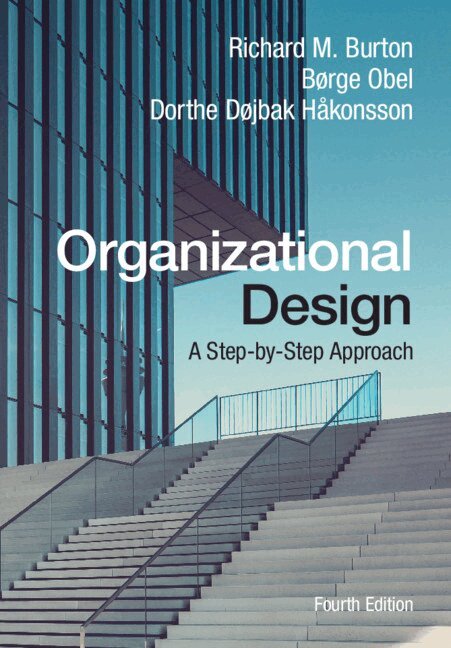
Now in its fourth edition, this is the definitive step-by-step 'how to' guide to designing an organization. Building on information processing theory, the book proposes a holistic, multi-contingency model of the organization. This textbook communicates the fundamentals of traditional and new organizational forms, including up-to-date analysis of self-organizing, boss-less, digital, and sustainable organizations. Providing a framework for the practical implementation of organizational design changes, the authors break the process down into seven basic steps: (1) Assessing Goals, (2) Assessing Strategy, (3) Analyzing Structure, (4) Assessing Process and People, (5) Analyzing Coordination, Control and Incentives, (6) Designing the Architecture, and (7) Implementing the Architecture. Each step connects with one of the nine interdependent components of the multi-contingency model, and the authors also provide a logical query process for approaching each of these components. This is an ideal guide for managers or executives interested in assessing their organization and taking steps to redesign it for success, as well as for MBA and executive MBA students looking for an introduction to organizational design.
486 kr
Skickas inom 7-10 vardagar
Now in its fourth edition, this is the definitive step-by-step 'how to' guide to designing an organization. Building on information processing theory, the book proposes a holistic, multi-contingency model of the organization. This textbook communicates the fundamentals of traditional and new organizational forms, including up-to-date analysis of self-organizing, boss-less, digital, and sustainable organizations. Providing a framework for the practical implementation of organizational design changes, the authors break the process down into seven basic steps: (1) Assessing Goals, (2) Assessing Strategy, (3) Analyzing Structure, (4) Assessing Process and People, (5) Analyzing Coordination, Control and Incentives, (6) Designing the Architecture, and (7) Implementing the Architecture. Each step connects with one of the nine interdependent components of the multi-contingency model, and the authors also provide a logical query process for approaching each of these components. This is an ideal guide for managers or executives interested in assessing their organization and taking steps to redesign it for success, as well as for MBA and executive MBA students looking for an introduction to organizational design.