Richard M. Burton - Böcker
Visar alla böcker från författaren Richard M. Burton. Handla med fri frakt och snabb leverans.
13 produkter
13 produkter
1 749 kr
Skickas inom 10-15 vardagar
Organization Design: The Evolving State-of-the-Art outlines the larger role that organizational design is increasingly playing in management theory and practice. The book's chapters review the main theoretical perspectives on organization design, identify important theoretical and practical issues currently facing the field, and suggest ways for valuable research to be conducted in the future. The chapters include sections that describe how the theoretical argument or empirical study specifically informs organization design theory and practice.The volume is organized in four sections: (1) Theoretical and Practical Issues, (2) Fit, Contingency and Configuration, (3) Design and Performance, and (4) The Dynamics of Adaptation and Change. The book will be a broad discussion of topics in the field, but each individual paper will provide in depth analysis of the topic. A common element and theme is a focus on core theories in organization design and emerging perspectives.The book will be a 2005-benchmark publication of organization design theory, principles and concepts, and it will be an important step in creating better models and stronger empirical analyses.
Del 7 - Information and Organization Design Series
Designing Organizations
21st Century Approaches
Inbunden, Engelska, 2008
1 749 kr
Skickas inom 10-15 vardagar
Designing Organizations: 21st Century Approaches is a benchmark publication in the field of organization design. The recent development in organization design has been sporadic; hence, this book will be an important step in creating more thoughtful research and stronger empirical analyses that take advantage of advances in estimation methods allowing for more complex causal modeling and stimulation technologies.Featured in the book are the more practical elements of implementing OD in organizations. The chapter material is organized into five sections: (1) Putting Contingency Theory in its Place, (2) Focus on Individuals who make up the Organization, (3) Innovation Processes and Organization Design, (4) Adaptation and Technology, and (5) Design for Performance. The book will be a broad discussion of topics in the field, but still each individual chapter will provide in-depth analysis of the topic.
Design Models for Hierarchical Organizations
Computation, Information, and Decentralization
Inbunden, Engelska, 1995
1 640 kr
Skickas inom 10-15 vardagar
This text provides research on organizational design models, and in particular on mathematical models. Each chapter views the organization as an information processing entity. Thus, mathematical models are used to examine information flow and decision procedures, which in turn, form the basis for evaluating organization designs. Each chapter stands alone as a contribution to organization design and the modelling approach to design.
542 kr
Kommande
Today's organizations face rapid change, digital disruption, and rising demands for sustainability and resilience. This fifth edition text equips executives, students, and educators with a proven framework for designing effective organizations in complex environments. Built on decades of research, the multi-contingency model provides a step-by-step guide from diagnosis to design and implementation-now expanded to include knowledge interdependence, AI integration, sustainable development, and organizational resilience. Rich with real-world cases from LEGO, Microsoft, Haier, and Blackberry, the book blends theory with practice and offers clear visuals, intuitive 2x2 models, and tools to support hands-on learning and application. It helps readers understand who should do what, talk to whom, and-crucially-know what, in today's increasingly dynamic settings. Whether used in executive education or as a core text in MBA and business school courses, this updated edition is a comprehensive, accessible, and globally trusted guide to modern organizational design.
1 204 kr
Kommande
Today's organizations face rapid change, digital disruption, and rising demands for sustainability and resilience. This fifth edition text equips executives, students, and educators with a proven framework for designing effective organizations in complex environments. Built on decades of research, the multi-contingency model provides a step-by-step guide from diagnosis to design and implementation-now expanded to include knowledge interdependence, AI integration, sustainable development, and organizational resilience. Rich with real-world cases from LEGO, Microsoft, Haier, and Blackberry, the book blends theory with practice and offers clear visuals, intuitive 2x2 models, and tools to support hands-on learning and application. It helps readers understand who should do what, talk to whom, and-crucially-know what, in today's increasingly dynamic settings. Whether used in executive education or as a core text in MBA and business school courses, this updated edition is a comprehensive, accessible, and globally trusted guide to modern organizational design.
1 053 kr
Skickas inom 7-10 vardagar
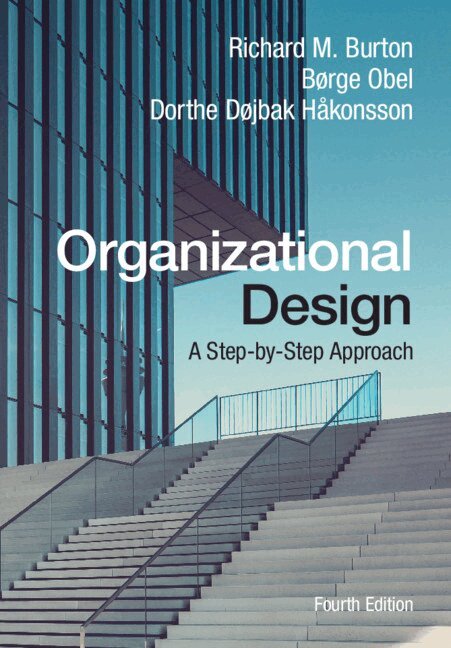
Now in its fourth edition, this is the definitive step-by-step 'how to' guide to designing an organization. Building on information processing theory, the book proposes a holistic, multi-contingency model of the organization. This textbook communicates the fundamentals of traditional and new organizational forms, including up-to-date analysis of self-organizing, boss-less, digital, and sustainable organizations. Providing a framework for the practical implementation of organizational design changes, the authors break the process down into seven basic steps: (1) Assessing Goals, (2) Assessing Strategy, (3) Analyzing Structure, (4) Assessing Process and People, (5) Analyzing Coordination, Control and Incentives, (6) Designing the Architecture, and (7) Implementing the Architecture. Each step connects with one of the nine interdependent components of the multi-contingency model, and the authors also provide a logical query process for approaching each of these components. This is an ideal guide for managers or executives interested in assessing their organization and taking steps to redesign it for success, as well as for MBA and executive MBA students looking for an introduction to organizational design.
486 kr
Skickas inom 7-10 vardagar
Now in its fourth edition, this is the definitive step-by-step 'how to' guide to designing an organization. Building on information processing theory, the book proposes a holistic, multi-contingency model of the organization. This textbook communicates the fundamentals of traditional and new organizational forms, including up-to-date analysis of self-organizing, boss-less, digital, and sustainable organizations. Providing a framework for the practical implementation of organizational design changes, the authors break the process down into seven basic steps: (1) Assessing Goals, (2) Assessing Strategy, (3) Analyzing Structure, (4) Assessing Process and People, (5) Analyzing Coordination, Control and Incentives, (6) Designing the Architecture, and (7) Implementing the Architecture. Each step connects with one of the nine interdependent components of the multi-contingency model, and the authors also provide a logical query process for approaching each of these components. This is an ideal guide for managers or executives interested in assessing their organization and taking steps to redesign it for success, as well as for MBA and executive MBA students looking for an introduction to organizational design.
1 640 kr
Skickas inom 10-15 vardagar
There are two very contrasting approaches to reading this book and learning about organizational design. The more traditional approach is to read the book, and then use the OrgCon on cases and applications. The second approach is to begin with the OrgCon software and only examine the book as you find it helpful. Which approach is better? It is your choice, not ours. In our experience, students in organizational design prefer to start with the OrgCon and a case, rather than with the book itself. Readers who have more background in organization theory and design usually examine the book first.There are numerous changes in the third edition. The literature review in each chapter has been updated. The information processing approach is strengthened and applied more comprehensively as the theoretical underpinnings. Throughout we have rewritten the text beyond normal editing in an attempt to make the presentation clearer and easier to read.
1 422 kr
Skickas inom 10-15 vardagar
There are two very contrasting approaches to reading this book and learning about organizational design. The more traditional approach is to read the book, and then use the OrgCon on cases and applications. The second approach is to begin with the OrgCon software and only examine the book as you find it helpful. Which approach is better? It is your choice, not ours. In our experience, students in organizational design prefer to start with the OrgCon and a case, rather than with the book itself. Readers who have more background in organization theory and design usually examine the book first.There are numerous changes in the third edition. The literature review in each chapter has been updated. The information processing approach is strengthened and applied more comprehensively as the theoretical underpinnings. Throughout we have rewritten the text beyond normal editing in an attempt to make the presentation clearer and easier to read.
1 259 kr
Skickas inom 10-15 vardagar
Organization Design: The Evolving State-of-the-Art outlines the larger role that organizational design is increasingly playing in management theory and practice. The book's chapters review the main theoretical perspectives on organization design, identify important theoretical and practical issues currently facing the field, and suggest ways for valuable research to be conducted in the future. The chapters include sections that describe how the theoretical argument or empirical study specifically informs organization design theory and practice.The volume is organized in four sections: (1) Theoretical and Practical Issues, (2) Fit, Contingency and Configuration, (3) Design and Performance, and (4) The Dynamics of Adaptation and Change. The book will be a broad discussion of topics in the field, but each individual paper will provide in depth analysis of the topic. A common element and theme is a focus on core theories in organization design and emerging perspectives.The book will be a 2005-benchmark publication of organization design theory, principles and concepts, and it will be an important step in creating better models and stronger empirical analyses.
Del 7 - Information and Organization Design Series
Designing Organizations
21st Century Approaches
Häftad, Engelska, 2010
1 223 kr
Skickas inom 10-15 vardagar
Designing Organizations: 21st Century Approaches is a benchmark publication in the field of organization design. The recent development in organization design has been sporadic; hence, this book will be an important step in creating more thoughtful research and stronger empirical analyses that take advantage of advances in estimation methods allowing for more complex causal modeling and stimulation technologies.Featured in the book are the more practical elements of implementing OD in organizations. The chapter material is organized into five sections: (1) Putting Contingency Theory in its Place, (2) Focus on Individuals who make up the Organization, (3) Innovation Processes and Organization Design, (4) Adaptation and Technology, and (5) Design for Performance. The book will be a broad discussion of topics in the field, but still each individual chapter will provide in-depth analysis of the topic.
Design Models for Hierarchical Organizations
Computation, Information, and Decentralization
Häftad, Engelska, 2012
1 593 kr
Skickas inom 10-15 vardagar
Design Models for Hierarchical Organizations: Computation, Information, and Decentralization provides state-of-the-art research on organizational design models, and in particular on mathematical models. Each chapter views the organization as an information processing entity. Thus, mathematical models are used to examine information flow and decision procedures, which in turn, form the basis for evaluating organization designs. Each chapters stands alone as a contribution to organization design and the modeling approach to design. Moreover, the chapters fit together and that totality gives us a good understanding of where we are with this approach to organizational design issues and where we should focus our research efforts in the future.
1 331 kr
Skickas inom 7-10 vardagar
This volume of Advances in Strategic Management explores emerging trends and contemporary research in the field of organization design. It reflects a renewed focus on the universal problems of organizing—the division of labor and the integration of effort. At the same time, it incorporates new ideas on designs for cooperation in organizations.The studies published here employ a wide variety of theories and research designs to contribute to this renewal of organization design research, considering collaborative ways of working, organizational learning, and strategic innovation.