Barbara Scott Nelson - Böcker
Visar alla böcker från författaren Barbara Scott Nelson. Handla med fri frakt och snabb leverans.
5 produkter
5 produkter
535 kr
Skickas inom 10-15 vardagar
This book addresses the need of professional development leaders and policymakers for scholarly knowledge about influencing teachers to modify mathematical instruction to bring it more in alignment with the recommendations of the current reform movement initiated by the National Council of Teachers of Mathematics. The book presents: * theoretical perspectives for studying, analyzing, and understanding teacher change; * descriptions of contextual variables to be considered as one studies and attempts to understand teacher change; and * descriptions of professional development programs that resulted in teacher change. One chapter builds a rationale for looking to developmental psychology for guidance in constructing models of reconstructing new forms of mathematical instruction. Another highlights the relevance to mathematics teacher development of research-based knowledge about how children construct mathematical ideas. Other chapters explore the relationships between the various contexts of schooling and instructional change. Included also are chapters that describe and analyze major reform efforts designed to assist teachers in modifying their instructional practices (Cognitively Guided Instruction, Math-Cubed, Project Impact, Mathematics in Context, and the Case-Based Project). Finally, the current state of knowledge about encouraging teachers to modify their instruction is discussed, the implications of major research and implementation findings are suggested, and some of the major questions that need to be addressed are identified, such as what we have learned about teacher change.
346 kr
Skickas inom 10-15 vardagar
This book addresses the need of professional development leaders and policymakers for scholarly knowledge about influencing teachers to modify mathematical instruction to bring it more in alignment with the recommendations of the current reform movement initiated by the National Council of Teachers of Mathematics. The book presents: * theoretical perspectives for studying, analyzing, and understanding teacher change; * descriptions of contextual variables to be considered as one studies and attempts to understand teacher change; and * descriptions of professional development programs that resulted in teacher change. One chapter builds a rationale for looking to developmental psychology for guidance in constructing models of reconstructing new forms of mathematical instruction. Another highlights the relevance to mathematics teacher development of research-based knowledge about how children construct mathematical ideas. Other chapters explore the relationships between the various contexts of schooling and instructional change. Included also are chapters that describe and analyze major reform efforts designed to assist teachers in modifying their instructional practices (Cognitively Guided Instruction, Math-Cubed, Project Impact, Mathematics in Context, and the Case-Based Project). Finally, the current state of knowledge about encouraging teachers to modify their instruction is discussed, the implications of major research and implementation findings are suggested, and some of the major questions that need to be addressed are identified, such as what we have learned about teacher change.
2 029 kr
Skickas inom 10-15 vardagar
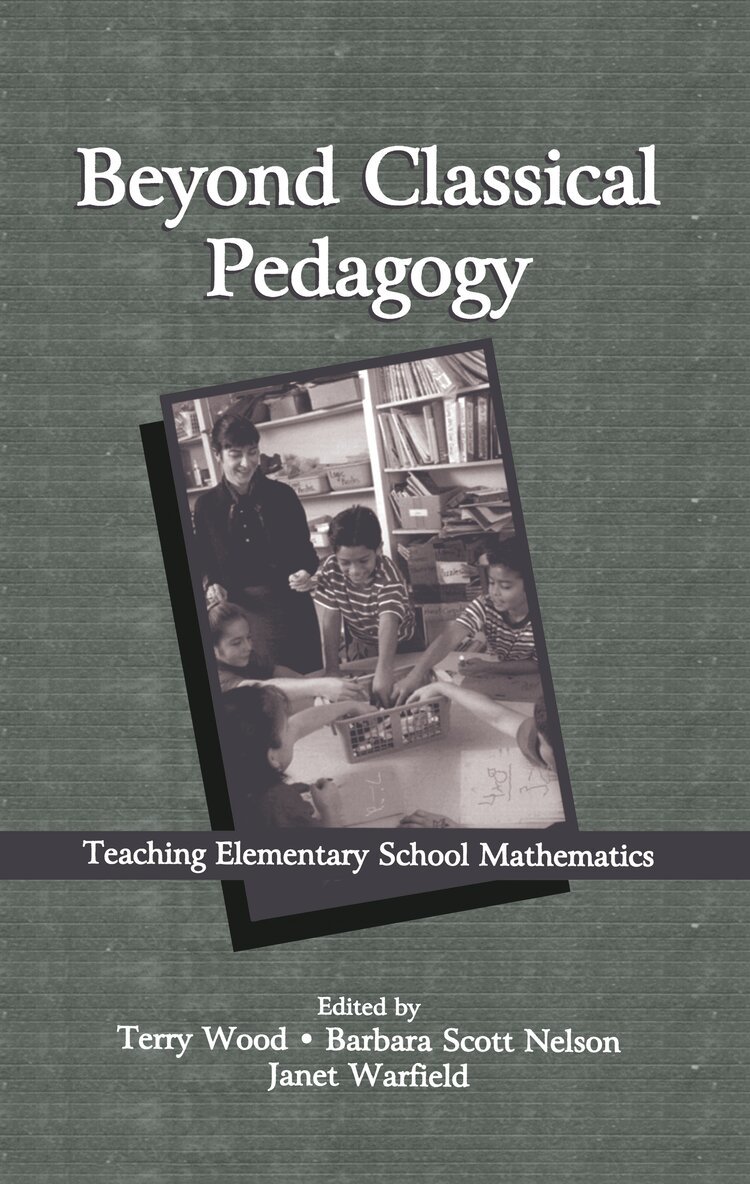
The emergence of the National Council of Teachers of Mathematics Standards in 1989 sparked a sea change in thinking about the nature and quality of mathematics instruction in U.S. schools. Much is known about transmission forms of mathematics teaching and the influence of this teaching on students' learning, but there is still little knowledge about the alternative forms of instruction that have evolved from the recent widespread efforts to reform mathematics education. Beyond Classical Pedagogy: Teaching Elementary School Mathematics reports on the current state of knowledge about these new instructional practices, which differ in significant ways from the traditional pedagogy that has permeated mathematics education in the past. This book provides a research-based view of the nature of facilitative teaching in its relatively mature form, along with opposing views and critique of this form of pedagogy. The focus is on elementary school mathematics classrooms, where the majority of the reform-based efforts have occurred, and on the micro level of teaching (classroom interaction) as a source for revealing the complexity involved in teaching, teachers' learning, and the impact of both on children's learning. The work in elementary mathematics teaching is situated in the larger context of research on teaching. Research and insights from three disciplinary perspectives are presented: the psychological perspective centers on facilitative teaching as a process of teachers' learning; the mathematical perspective focuses on the nature of the mathematical knowledge teachers need in order to engage in this form of teaching; the sociological perspective attends to the interactive process of meaning construction as teachers and students create intellectual communities in their classrooms. The multidisciplinary perspectives presented provide the editors with the necessary triangulation to provide confirming evidence and rich detail about the nature of facilitative teaching. Audiences for this book include scholars in mathematics education and teacher education, teacher educators, staff developers, and classroom teachers. It is also appropriate as a text for graduate courses in mathematics education, teacher education, elementary mathematics teaching methods, and methods of research in mathematics education.Chapter 5 of this book is freely available as a downloadable Open Access PDF at http://www.taylorfrancis.com under a Creative Commons [Attribution-Non Commercial-No Derivatives (CC-BY-NC-ND)] 4.0 license.
692 kr
Skickas inom 10-15 vardagar
The emergence of the National Council of Teachers of Mathematics Standards in 1989 sparked a sea change in thinking about the nature and quality of mathematics instruction in U.S. schools. Much is known about transmission forms of mathematics teaching and the influence of this teaching on students' learning, but there is still little knowledge about the alternative forms of instruction that have evolved from the recent widespread efforts to reform mathematics education. Beyond Classical Pedagogy: Teaching Elementary School Mathematics reports on the current state of knowledge about these new instructional practices, which differ in significant ways from the traditional pedagogy that has permeated mathematics education in the past. This book provides a research-based view of the nature of facilitative teaching in its relatively mature form, along with opposing views and critique of this form of pedagogy. The focus is on elementary school mathematics classrooms, where the majority of the reform-based efforts have occurred, and on the micro level of teaching (classroom interaction) as a source for revealing the complexity involved in teaching, teachers' learning, and the impact of both on children's learning. The work in elementary mathematics teaching is situated in the larger context of research on teaching. Research and insights from three disciplinary perspectives are presented: the psychological perspective centers on facilitative teaching as a process of teachers' learning; the mathematical perspective focuses on the nature of the mathematical knowledge teachers need in order to engage in this form of teaching; the sociological perspective attends to the interactive process of meaning construction as teachers and students create intellectual communities in their classrooms. The multidisciplinary perspectives presented provide the editors with the necessary triangulation to provide confirming evidence and rich detail about the nature of facilitative teaching. Audiences for this book include scholars in mathematics education and teacher education, teacher educators, staff developers, and classroom teachers. It is also appropriate as a text for graduate courses in mathematics education, teacher education, elementary mathematics teaching methods, and methods of research in mathematics education.Chapter 5 of this book is freely available as a downloadable Open Access PDF at http://www.taylorfrancis.com under a Creative Commons [Attribution-Non Commercial-No Derivatives (CC-BY-NC-ND)] 4.0 license.
Secondary Lenses on Learning Participant Book
Team Leadership for Mathematics in Middle and High Schools
Inbunden, Engelska, 2009
1 433 kr
Skickas inom 3-6 vardagar
"What is so exciting about the Secondary Lenses on Learning materials is how the process brings together a team to collect and analyze data and form an action plan."—Dan Chazan, Associate Professor of Curriculum and InstructionUniversity of Maryland"To quote the principal from one school team that participated in our pilot program: ′Unlike most schools in the state, my school saw growth in our mathematics student achievement this year. The Secondary Lenses on Learning seminar was extremely valuable in improving skills for staff and learning for students.′"—Linda Foreman, DirectorTeachers Development GroupLead a successful mathematics program to help all students realize their full potential!This participant book, in combination with the facilitator′s guide, forms a comprehensive professional development program designed to improve the efforts of site-based mathematics leadership teams for middle and high schools. Secondary Lenses on Learning prepares leaders to explore concepts in middle and high school algebra as a window into content, instruction, and assessment. You will learn how to assess the strengths and needs of your mathematics programs, set goals, and generate plans for ongoing improvement by engaging in extended explorations and conversations based on readings, problem-based activities, cases, and videos. The participant book contains:Three observation and reflection toolsIntroductory essays and Big Ideas corresponding to each of the six sessions of the seminarRelevant, accessible, and thought-provoking readings that bring current research and knowledge into the seminarA comprehensive set of data collection and reflection tools designed to inform leaders′ plans for improving the mathematics program at their siteThis innovative program provides the tools to examine the leadership tasks and responsibilities that contribute to an effective mathematics program and authentic reform within any school district.