Bettina Berendt – författare
Visar alla böcker från författaren Bettina Berendt. Handla med fri frakt och snabb leverans.
13 produkter
Privacy Technologies and Policy
Third Annual Privacy Forum, APF 2015, Luxembourg, Luxembourg, October 7-8, 2015, Revised Selected Papers
Av Bettina Berendt, Thomas Engel m. fl.
Häftad, 2016
551 kr
Lägg i varukorg
This book constitutes the thoroughly refereedpost-conference proceedings of the Third Annual Privacy Forum, APF 2015, heldin Luxembourg, Luxembourg, in October 2015.The 11 revised full papers presented in this volume werecarefully reviewed and selected from 24 submissions. The topics focus …
Privacy Technologies and Policy
Third Annual Privacy Forum, APF 2015, Luxembourg, Luxembourg, October 7-8, 2015, Revised Selected Papers
Av Stefan Schiffner, Daniel Le Metayer m. fl.
E-bok, 2016
755 kr
Lägg i varukorg
This book constitutes the thoroughly refereedpost-conference proceedings of the Third Annual Privacy Forum, APF 2015, heldin Luxembourg, Luxembourg, in October 2015. The 11 revised full papers presented in this volume werecarefully reviewed and selected from 24 submissions. The topics focus …
Machine Learning and Knowledge Discovery in Databases
European Conference, ECML PKDD 2016, Riva del Garda, Italy, September 19-23, 2016, Proceedings, Part III
Av Bettina Berendt, Björn Bringmann m. fl.
Häftad, 2016
567 kr
Lägg i varukorg
The three volume set LNAI 9851, LNAI 9852, and LNAI 9853 constitutes the refereed proceedings of the European Conference on Machine Learning and Knowledge Discovery in Databases, ECML PKDD 2016, held in Riva del Garda, Italy, in September 2016. The 123 full papers and 16 short papers presented were …
Machine Learning and Knowledge Discovery in Databases
European Conference, ECML PKDD 2016, Riva del Garda, Italy, September 19-23, 2016, Proceedings, Part III
Av Volker Tresp, Nikolaj Tatti m. fl.
E-bok, 2016
755 kr
Lägg i varukorg
The three volume set LNAI 9851, LNAI 9852, and LNAI 9853 constitutes the refereed proceedings of the European Conference on Machine Learning and Knowledge Discovery in Databases, ECML PKDD 2016, held in Riva del Garda, Italy, in September 2016. The 123 full papers and 16 short papers presented were …
Web Mining: From Web to Semantic Web
First European Web Mining Forum, EWMF 2003, Cavtat-Dubrovnik, Croatia, September 22, 2003, Revised Selected and Invited Papers
Av Bettina Berendt, Andreas Hotho m. fl.
Häftad, 2004
567 kr
Lägg i varukorg
In the last years, research on Web mining has reached maturity and has broadened in scope. Two different but interrelated research threads have emerged, based on the dual nature of the Web: – The Web is a practically in?nite collection of documents: The acquisition and - ploitation of information …
Web Mining: From Web to Semantic Web
First European Web Mining Forum, EWMF 2003, Cavtat-Dubrovnik, Croatia, September 22, 2003, Revised Selected and Invited Papers
Av Gerd Stumme, Myra Spiliopoulou m. fl.
E-bok, 2011
755 kr
Lägg i varukorg
In the last years, research on Web mining has reached maturity and has broadened in scope. Two different but interrelated research threads have emerged, based on the dual nature of the Web: – The Web is a practically in?nite collection of documents: The acquisition and - ploitation of information …
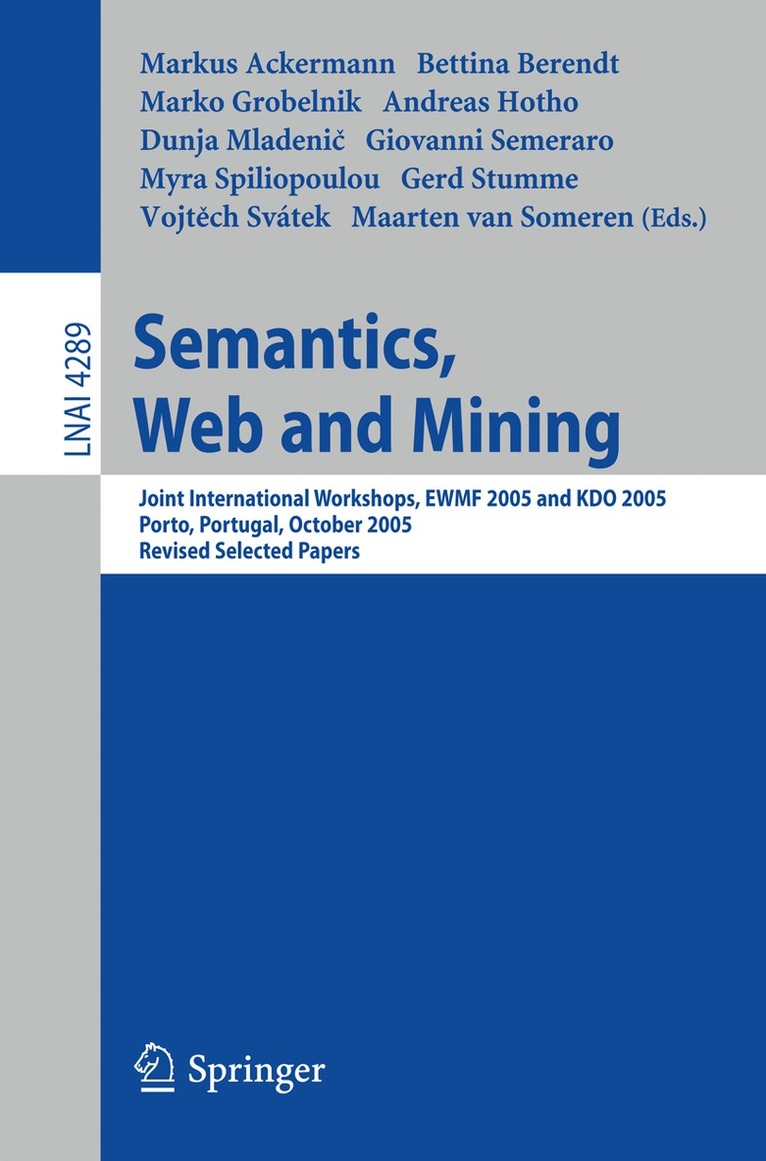
Semantics, Web and Mining
Joint International Workshop, EWMF 2005 and KDO 2005, Porto, Portugal, October 3-7, 2005, Revised Selected Papers
Av Markus Ackermann, Bettina Berendt m. fl.
Häftad, 2006
543 kr
Lägg i varukorg
Finding knowledge – or meaning – in data is the goal of every knowledge d- covery e?ort. Subsequent goals and questions regarding this knowledge di?er amongknowledgediscovery(KD) projectsandapproaches. Onecentralquestion is whether and to what extent the meaning extracted from the data is expressed …
Semantics, Web and Mining
Joint International Workshop, EWMF 2005 and KDO 2005, Porto, Portugal, October 3-7, 2005, Revised Selected Papers
Av Maarten van Someren, Vojtech Svatek m. fl.
E-bok, 2006
732 kr
Lägg i varukorg
Finding knowledge – or meaning – in data is the goal of every knowledge d- covery e?ort. Subsequent goals and questions regarding this knowledge di?er amongknowledgediscovery(KD) projectsandapproaches. Onecentralquestion is whether and to what extent the meaning extracted from the data is expressed …
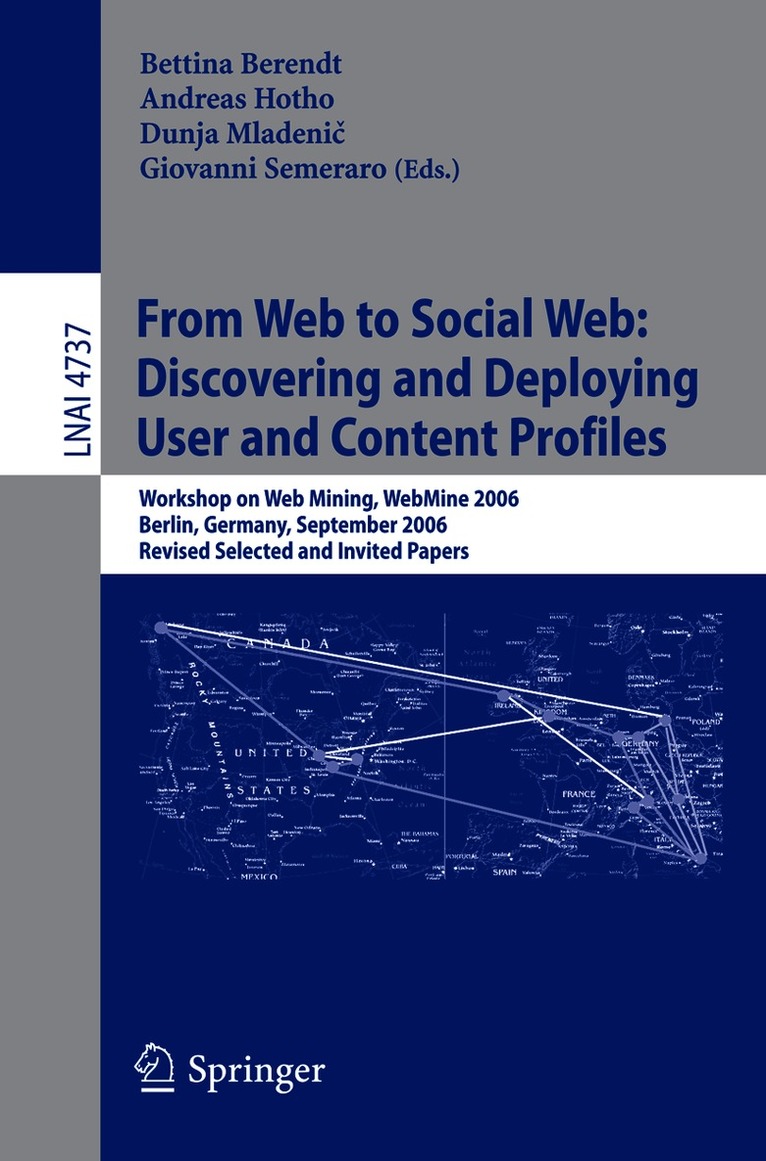
From Web to Social Web: Discovering and Deploying User and Content Profiles
Workshop on Web Mining, WebMine 2006, Berlin, Germany, September 18, 2006
Av Bettina Berendt, Andreas Hotho m. fl.
Häftad, 2007
567 kr
Lägg i varukorg
The World Wide Web is a rich source of information about human behavior. It containslarge amount of data organizedvia interconnected Web pages,traces of information search, user feedback on items of interest, etc. In addition to large data volumes, one of the important characteristics of the Web is …
From Web to Social Web: Discovering and Deploying User and Content Profiles
Workshop on Web Mining, WebMine 2006, Berlin, Germany, September 18, 2006
Av Giovanni Semeraro, Dunja Mladenic m. fl.
E-bok, 2007
734 kr
Lägg i varukorg
The World Wide Web is a rich source of information about human behavior. It containslarge amount of data organizedvia interconnected Web pages,traces of information search, user feedback on items of interest, etc. In addition to large data volumes, one of the important characteristics of the Web is …
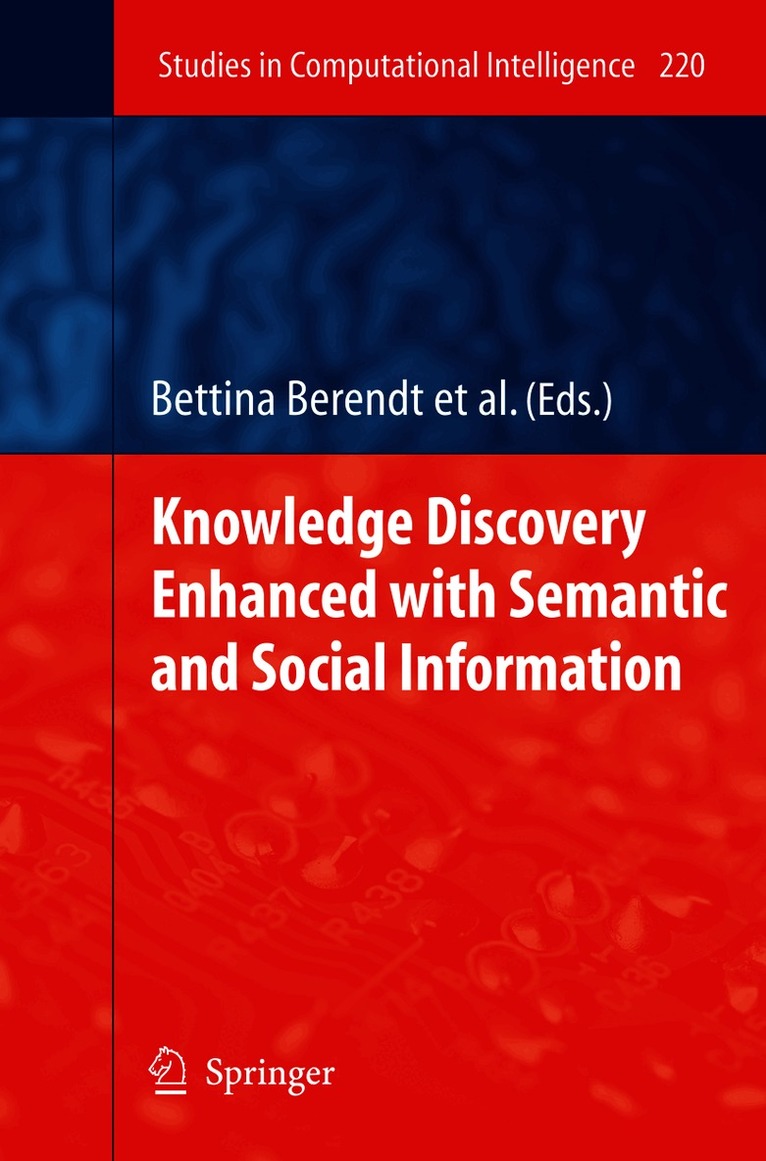
Knowledge Discovery Enhanced with Semantic and Social Information
Av Bettina Berendt, Dunja Mladenic m. fl.
Inbunden, 2009
1127 kr
Lägg i varukorg
There is generalagreementthat the quality of Machine Learning and Kno- edgeDiscoveryoutputstronglydependsnotonlyonthequalityofsourcedata andsophisticationoflearningalgorithms,butalsoonadditional,task/domain speci?c input provided by domain experts for the particular session. There is however less …
Knowledge Discovery Enhanced with Semantic and Social Information
Av Filip Zelezny, Vojtech Svatek m. fl.
E-bok, 2009
1470 kr
Lägg i varukorg
Knowledge Discovery Enhanced with Semantic and Social Information
Av Bettina Berendt, Dunja Mladenic m. fl.
Häftad, 2014
1131 kr
Lägg i varukorg
There is generalagreementthat the quality of Machine Learning and Kno- edgeDiscoveryoutputstronglydependsnotonlyonthequalityofsourcedata andsophisticationoflearningalgorithms,butalsoonadditional,task/domain speci?c input provided by domain experts for the particular session. There is however less …