Braunmuller Kurt Braunmuller – författare
Visar alla böcker från författaren Braunmuller Kurt Braunmuller. Handla med fri frakt och snabb leverans.
4 produkter
4 produkter
E-bok
PDF, Engelska, 20141 305 kr
Läs direkt efter köp
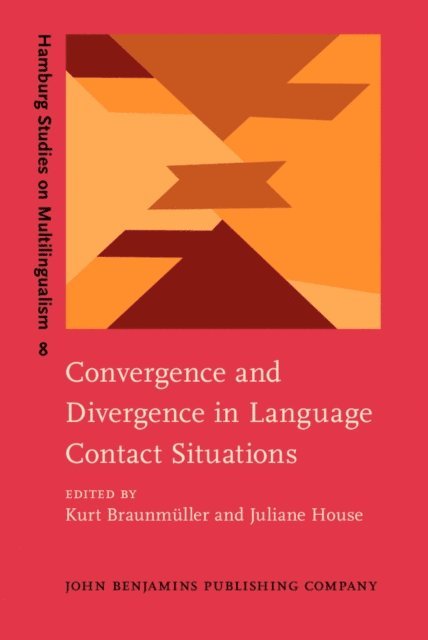
Convergence, i.e. the increase of inter-systemic similarities, is usually considered the default development in language contact situations. This volume focuses on the other logical possibilities of diachronic development, namely stability and divergence – two well-attested, but under-researched phenomena. The contributions investigate the sociolinguistic and structural factors and mechanisms that lead to or at least reinforce both types of non-convergence, despite of language contact. The contributions cover a wide range of language contact situations, including standard and non-standard varieties.
E-bok
PDF, Engelska, 2012991 kr
Läs direkt efter köp
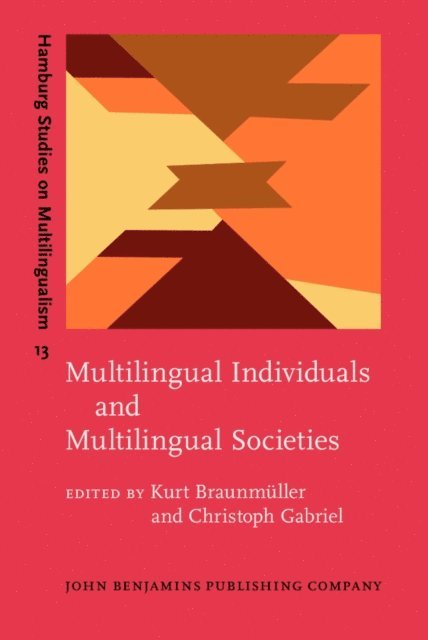
The 25 contributions of this volume represent a selection from the more than 120 papers originally presented at the International Conference on “Multilingual Individuals and Multilingual Societies” (MIMS), held in Hamburg (October 2010) and organized by the Collaborative Research Center “Multilingualism” after twelve years of successful research. It presents a panorama of contemporary research in multilingualism covering three fields of investigation: (1) the simultaneous and successive acquisition of more than one language, including language attrition in multilingual settings, (2) historical aspects of multilingualism and variance, and (3) multilingual communication. The papers cover a vast variety of linguistic phenomena including morphology, syntax, segmental and prosodic phonology as well as discourse production and language use, taking both individual and societal aspects of multilingualism into account. The languages addressed include numerous Romance, Slavic and Germanic varieties as well as Welsh, Hungarian, Turkish, and several South African autochthonous languages.
E-bok
PDF, Engelska, 2009991 kr
Läs direkt efter köp
This book deals with the consequences of converging and diverging processes and their development in language contact situations. It provides insights into the various forms of language contact and the conditions under which bilingual speakers master their every-day life in bilingual communities. Its nine contributions cover both theoretical and typological aspects, such as the classification of languages, the role of language contact, linguistic complexity and spontaneous speech innovations, and convergence and divergence processes in translation, (morpho)syntax and phonology/phonetics. Taken together, these studies provide challenges for linguistic theories that generalize from situations of monolingualism suggesting instead that a sound linguistic theory cannot be a theory for just one single, isolated language but must be a theory for at least two languages. It must also account for the fact that some structures involved in contact situations are not kept apart but develop in such a way that the distance decreases between the languages involved.
E-bok
PDF, Engelska, 2003909 kr
Läs direkt efter köp
This volume gives an up-to-date account of various situations of language contact and multilingualism in Europe especially from a historical point of view. Its ten contributions present newly collected data from different parts of the continent seen through diverse theoretical perspectives. They show a richness of topics and data that not only reveal numerous historical and sociological facts but also afford considerable insight into possible effects multilingualism and language contact might have on language change. The collection begins its journey through Europe in the British Isles. Then it turns to northern Europe and looks at how multilingualism worked in three towns that are all marked by border and contact situations. The journey continues with linguistic-historical and political-historical visits to Sweden and to Lithuania before the reader is taken to central Europe, where we will deal with the influence of Latin on written German. As far as southern Europe is concerned, the study continues on the Iberian peninsula, where the relationship between Portuguese and Spanish is focused, to be followed by Sardinia and Malta, two islands whose unique geohistorical positions give rise to some consideration of multilingualism in the Mediterranean.