543 kr
Skickas inom 5-8 vardagar
543 kr
Skickas inom 5-8 vardagar
1 543 kr
Skickas inom 5-8 vardagar
49 kr
Läs direkt efter köp
107 kr
Läs direkt efter köp
239 kr
Skickas inom 5-8 vardagar
271 kr
Skickas inom 5-8 vardagar
11 kr
Läs direkt efter köp
172 kr
Skickas inom 5-8 vardagar
256 kr
Skickas inom 5-8 vardagar
180 kr
Skickas inom 5-8 vardagar
Stranger at Mullán Bán
253 kr
Skickas inom 5-8 vardagar
185 kr
Skickas inom 5-8 vardagar
The Swallowed
255 kr
Skickas inom 5-8 vardagar
228 kr
Skickas inom 5-8 vardagar
(Quint Adler Book 2)
206 kr
Skickas inom 5-8 vardagar
206 kr
Skickas inom 5-8 vardagar
215 kr
Skickas inom 5-8 vardagar
192 kr
Skickas inom 5-8 vardagar
207 kr
Skickas inom 5-8 vardagar
633 kr
Läs direkt efter köp
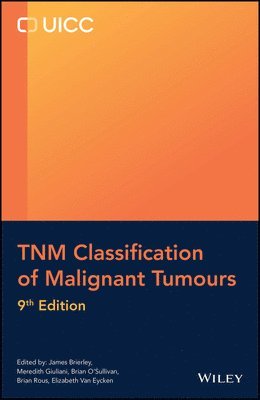
The essential reference on cancer stage returns as a fully revised edition
Describing cancer stage is one of the most important elements of oncological practice. Clinical research and clinical care depend on an accurate assessment of cancer stage and prognostic factors. The TNM Classification of Malignant Tumours serves as the globally recognised standard reference for describing cancer stage and assessing treatment results. Now fully updated to reflect the results of the latest clinical research, it is indispensable for all clinicians, cancer registrars and researchers who work with malignant tumours.
Readers of the ninth edition of TNM Classification of Malignant Tumours will find:
Updates in many tumour sites including, nasopharynx, HPV associated oropharynx, lung, thymus, mesothelioma, appendix, anal canal, cervix, vulva and prostate carcinoma; Revised and updated sections on Essential TNM and paediatric cancer staging; New classifications for medulloblastoma, cutaneous lymphoma, parathyroid carcinoma, adrenal medulla and extra-adrenal paraganglia tumours; Revised classification of prognostic factors for many malignancies.TNM Classification of Malignant Tumours is an essential resource for anyone involved in cancer care, research or cancer control.
633 kr
Läs direkt efter köp
The essential reference on cancer stage returns as a fully revised edition
Describing cancer stage is one of the most important elements of oncological practice. Clinical research and clinical care depend on an accurate assessment of cancer stage and prognostic factors. The TNM Classification of Malignant Tumours serves as the globally recognised standard reference for describing cancer stage and assessing treatment results. Now fully updated to reflect the results of the latest clinical research, it is indispensable for all clinicians, cancer registrars and researchers who work with malignant tumours.
Readers of the ninth edition of TNM Classification of Malignant Tumours will find:
Updates in many tumour sites including, nasopharynx, HPV associated oropharynx, lung, thymus, mesothelioma, appendix, anal canal, cervix, vulva and prostate carcinoma; Revised and updated sections on Essential TNM and paediatric cancer staging; New classifications for medulloblastoma, cutaneous lymphoma, parathyroid carcinoma, adrenal medulla and extra-adrenal paraganglia tumours; Revised classification of prognostic factors for many malignancies.TNM Classification of Malignant Tumours is an essential resource for anyone involved in cancer care, research or cancer control.
58 kr
Läs direkt efter köp
207 kr
Skickas inom 5-8 vardagar
207 kr
Skickas inom 5-8 vardagar
896 kr
Skickas inom 10-15 vardagar
563 kr
Skickas inom 10-15 vardagar
563 kr
Skickas inom 10-15 vardagar
452 kr
Skickas inom 10-15 vardagar
1 451 kr
Skickas inom 10-15 vardagar
1 788 kr
Läs direkt efter köp
This book is the first comprehensive history of the British Trade Corporation, which was constituted under a Royal Charter on 21st April 1917. Its charter was meant to last for sixty years, but in 1926, after a turbulent existence of only nine years, it was amalgamated with the Anglo-Austrian Bank, and absorbed into the Anglo-International Bank.
The corporation together with its two main subsidiaries, the Levant Company and the National Bank of Turkey, conducted business not only in Britain but in Russia, Turkey, the Middle East and in Continental Europe. Although the corporation was not an agent of empire, it reflected Britain’s imperialistic ambitions after the First World War. As a result, it invested in some of the most unstable regions of the world. It was also severely affected by British foreign policy, which was often misjudged and, at times, duplicitous, resulting in serious damage to British trade. Within five years of its launch, the British Trade Corporation needed to be refinanced. The economic downturn in the early 1920s and ongoing hostilities in Eastern Europe and the Near East meant that it struggled to survive. Its difficulties reflected many of those faced by Britain in general after the war and the need to come to terms with the new realities of the post-war world.
Despite its innovative attempt to address the perceived deficiencies in Britain’s financial system, especially in respect of industrial finance, the British Trade Corporation has been largely ignored by financial historians. Based on substantial archival research, this book rectifies this neglect and makes an important contribution to the financial history of interwar Britain.