Calvin O. Qualset – författare
Visar alla böcker från författaren Calvin O. Qualset. Handla med fri frakt och snabb leverans.
5 produkter
5 produkter
Häftad, Engelska, 2012
863 kr
Skickas inom 7-10 vardagar
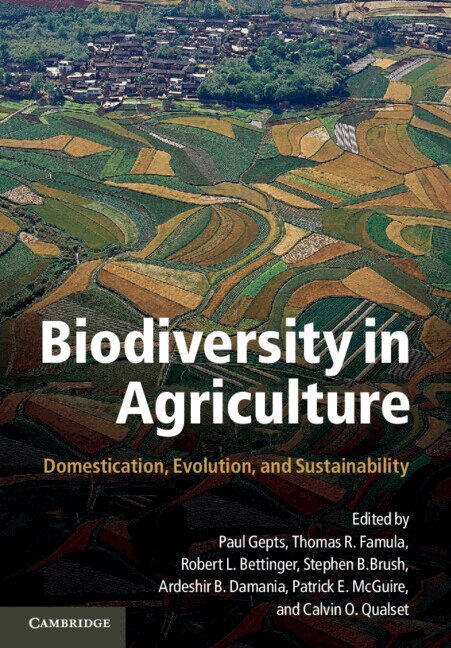
The introduction of plant and animal agriculture represents one of the most important milestones in human evolution. It contributed to the development of cities, alphabets, new technologies, and ultimately to civilizations, but it has also presented a threat to both human health and the environment. Bringing together research from a range of fields including anthropology, archaeology, ecology, economics, entomology, ethnobiology, genetics and geography, this book addresses key questions relating to agriculture. Why did agriculture develop and where did it originate? What are the patterns of domestication for plants and animals? How did agroecosystems originate and spread from their locations of origin? Exploring the cultural aspects of the development of agricultural ecosystems, the book also highlights how these topics can be applied to our understanding of contemporary agriculture, its long-term sustainability, the co-existence of agriculture and the environment, and the development of new crops and varieties.
Inbunden, Engelska, 2012
1 310 kr
Skickas inom 11-20 vardagar
The introduction of plant and animal agriculture represents one of the most important milestones in human evolution. It contributed to the development of cities, alphabets, new technologies, and ultimately to civilizations, but it has also presented a threat to both human health and the environment. Bringing together research from a range of fields including anthropology, archaeology, ecology, economics, entomology, ethnobiology, genetics and geography, this book addresses key questions relating to agriculture. Why did agriculture develop and where did it originate? What are the patterns of domestication for plants and animals? How did agroecosystems originate and spread from their locations of origin? Exploring the cultural aspects of the development of agricultural ecosystems, the book also highlights how these topics can be applied to our understanding of contemporary agriculture, its long-term sustainability, the co-existence of agriculture and the environment, and the development of new crops and varieties.
E-bok
Engelska, 20029 002 kr
Läs direkt efter köp
One of the critical issues of our time is the dwindling capacity of the planet to provide life support for a large and growing human population. Based on a symposium on ecosystem health, Managing for Healthy Ecosystems identifies key issues that must be resolved if there is to be progress in this complex area, such as:Evolving methods for regional ecosystem health assessment employing complex adaptive systems coupled with adaptive technologies to permit accurate determination of changes in regional and global environments Issues and methods for assessing, monitoring, and managing diversity and its impact on human health in the context of climate change, agroecosystems, restoration of forests, politics, culture, and tradition.Leading thinkers in the field provide a coherent synthesis and a benchmark for the practice of this emerging field worldwide. The more than 100 peer-reviewed papers are grouped into three major parts. The first, Emerging Concepts, explores the diverse meanings of ecosystem health within ecological, socio-economic, and human health perspectives, and the linkages to related concepts such as ecological integrity, sustainable development, and ecological footprints. The second part, Issues and Methods, introduces methods for assessing and monitoring ecosystem health, including strategies for gaining political and stakeholder input and support for science-based ecosystem management. The final part, Case Studies, reports experiences of interdisciplinary teams grappling with specific issues in a variety of aquatic and terrestrial ecosystems.
E-bok
PDF, Engelska, 20029 002 kr
Läs direkt efter köp
One of the critical issues of our time is the dwindling capacity of the planet to provide life support for a large and growing human population. Based on a symposium on ecosystem health, Managing for Healthy Ecosystems identifies key issues that must be resolved if there is to be progress in this complex area, such as:Evolving methods f
Inbunden, Engelska, 2002
5 354 kr
Tillfälligt slut
One of the critical issues of our time is the dwindling capacity of the planet to provide life support for a large and growing human population. Based on a symposium on ecosystem health, Managing for Healthy Ecosystems identifies key issues that must be resolved if there is to be progress in this complex area, such as:Evolving methods for regional ecosystem health assessment employing complex adaptive systems coupled with adaptive technologies to permit accurate determination of changes in regional and global environments Issues and methods for assessing, monitoring, and managing diversity and its impact on human health in the context of climate change, agroecosystems, restoration of forests, politics, culture, and tradition.Leading thinkers in the field provide a coherent synthesis and a benchmark for the practice of this emerging field worldwide. The more than 100 peer-reviewed papers are grouped into three major parts. The first, "Emerging Concepts," explores the diverse meanings of ecosystem health within ecological, socio-economic, and human health perspectives, and the linkages to related concepts such as ecological integrity, sustainable development, and ecological footprints. The second part, "Issues and Methods," introduces methods for assessing and monitoring ecosystem health, including strategies for gaining political and stakeholder input and support for science-based ecosystem management. The final part, "Case Studies," reports experiences of interdisciplinary teams grappling with specific issues in a variety of aquatic and terrestrial ecosystems.